The blood on my knuckles matched the crimson ink of the legal document sprawling across the mahogany desk. I stared at the stain, a jagged smear against the crisp, heavy bond paper that had cost more than my first car. My hand throbbed in time with the hum of the air conditioning.
Marcus Thorne leaned back, his leather chair creaking into the silence. He didn’t mention the bruise or the shattered glass of the water carafe I had accidentally swept aside when he slid the contract across the wood.
You understand the implications of the signature, Naomi, he said, his voice as smooth and cold as polished steel.
I traced the line where my name would dismantle my father’s entire legacy. My throat tightened, not with regret, but with the sharp, acidic tang of long-buried iron. I looked at the glass wall of the office, reflecting the sprawling city below, and realized I finally held the scalpel. My fingers stopped shaking. I was no longer the girl they sent to the warehouse to keep the family reputation pristine; I was the architect of their displacement. I picked up the pen. It was time to build a new horizon.
The alarm clock did not buzz; it hummed a low, synthetic tone at 5:45 a.m., a sound I had calibrated to be just irritating enough to force my eyes open. I sat up, the sheets sliding against my skin with the familiar, dry friction of cheap cotton. My bedroom in the cramped apartment on 4th Street smelled faintly of the damp concrete that seeped through the building’s foundation every time it rained. I stood on the cold hardwood, checked the weather app—overcast, high of fifty-two—and navigated the hallway toward the kitchen.
The coffee maker gurgled, a rhythmic, sputtering protest that filled the silence of the flat. I watched the dark liquid drip into the glass carafe, the steam rising in thin, wispy spirals. I took my mug black, the heat grounding me against the chill that lingered in the corners of the room. I spent the next twenty minutes standing at the counter, checking the bus schedule on my phone and smoothing the collar of my stiff, polyester-blend blouse. There was no grandeur to the morning, only the rote efficiency of a gear turning in a machine that didn’t know I existed.
The commute was a grey blur of windshield wipers and muted conversations. On the bus, a man in a rumpled suit hummed to himself, his briefcase balanced precariously on his knees. I stared out the window, watching the industrial district slide by, the brick facades of shuttered warehouses standing like gravestones for a manufacturing era that had long since packed up and left.
I arrived at the office at 7:15, the lobby floor echoing with the click of my sensible heels. The air inside was recycled and smelled of ozone and lemon-scented floor cleaner. I walked to the copy room, where the heavy floor printer groaned under the weight of a stalled paper jam. I reached into the bowels of the machine, my fingers stained with a smudge of toner, and pulled out a mangled sheet of internal memos.
Morning, Naomi, someone chirped from the doorway—a junior analyst whose name I could never quite commit to memory. Looks like rain again, huh?
I didn’t look up from the printer, just gave a brief, tight nod. Yeah, looks like it.
I hated the small talk, the way it filled the space between people who had nothing to say to one another. I finished the jam, reset the machine, and felt a quiet, jagged sense of satisfaction when the paper began to feed smoothly again. My job was a series of these tiny, invisible repairs. I was the person who kept the systems running while everyone else focused on the vision. I told myself it was enough. I told myself that the stability of a paycheck and a quiet desk was the only metric of success that mattered.
I sat at my desk, arranged my pens in a neat, parallel line, and began reviewing the load-bearing calculations for a project I knew would be handed off to someone with a more prestigious title before it ever broke ground. It was safe. It was manageable. It was the life I had built to ensure that no one ever looked too closely at the person pulling the levers.
I was reaching for my mug when the phone on my desk let out a sharp, piercing trill that shattered the quiet.
The sound was alien in the sterile hum of the office. I stared at the blinking extension, the black plastic casing cool under my palm. It was the internal line, the one that usually signaled a clerical error or a request for more inventory data. My fingers moved with practiced indifference, pressing the button to connect.
The voice on the other end was not the shift supervisor. It was smooth, textured like expensive stationery, and carried the weight of a man who never had to repeat himself. Marcus Thorne did not introduce himself; he simply asked if I was looking at the structural integrity report for the shipyard expansion.
I pulled the file closer. The ink was still fresh, the calculations precise enough to support a skyscraper. I am, I said, my voice barely a whisper in the empty office.
He asked if I had noticed the flaw in the third support beam, the one the lead architect had marked as insignificant.
I looked at the blueprint. The load-bearing variance was less than a millimeter, a detail hidden beneath a layer of complex notation meant to confuse anyone who wasn’t looking. It was the kind of error that wouldn’t show up for a decade, but would eventually buckle under heavy snow.
It is going to fail, I said, the words catching in my throat as the reality of the error settled into my chest.
He paused, a deliberate silence that stretched long enough for me to hear the distant clatter of the night cleaning crew in the lobby. He told me to meet him in the auditorium. Not in ten minutes. Now.
I hung up, the receiver vibrating with a residual hum. The office felt suddenly small, the walls closing in like a tightening vise. I thought of the twenty years my father had spent lobbying for a seat at that specific firm, the dinners where he drank too much and talked about their legacy as if it were his birthright. I thought of the night shifts, the grease under my nails, and the way my mother had told me to stop bothering with higher-level equations because they were too exhausting for someone like me.
I stood up. I didn’t reach for my coat. I walked toward the auditorium doors, my shoes clicking against the linoleum with a rhythmic, steady finality. My heart hammered against my ribs, a frantic cadence that defied my usual stillness. I was no longer the girl who made sure the systems kept running; I was the one who had finally traced the crack in the foundation.
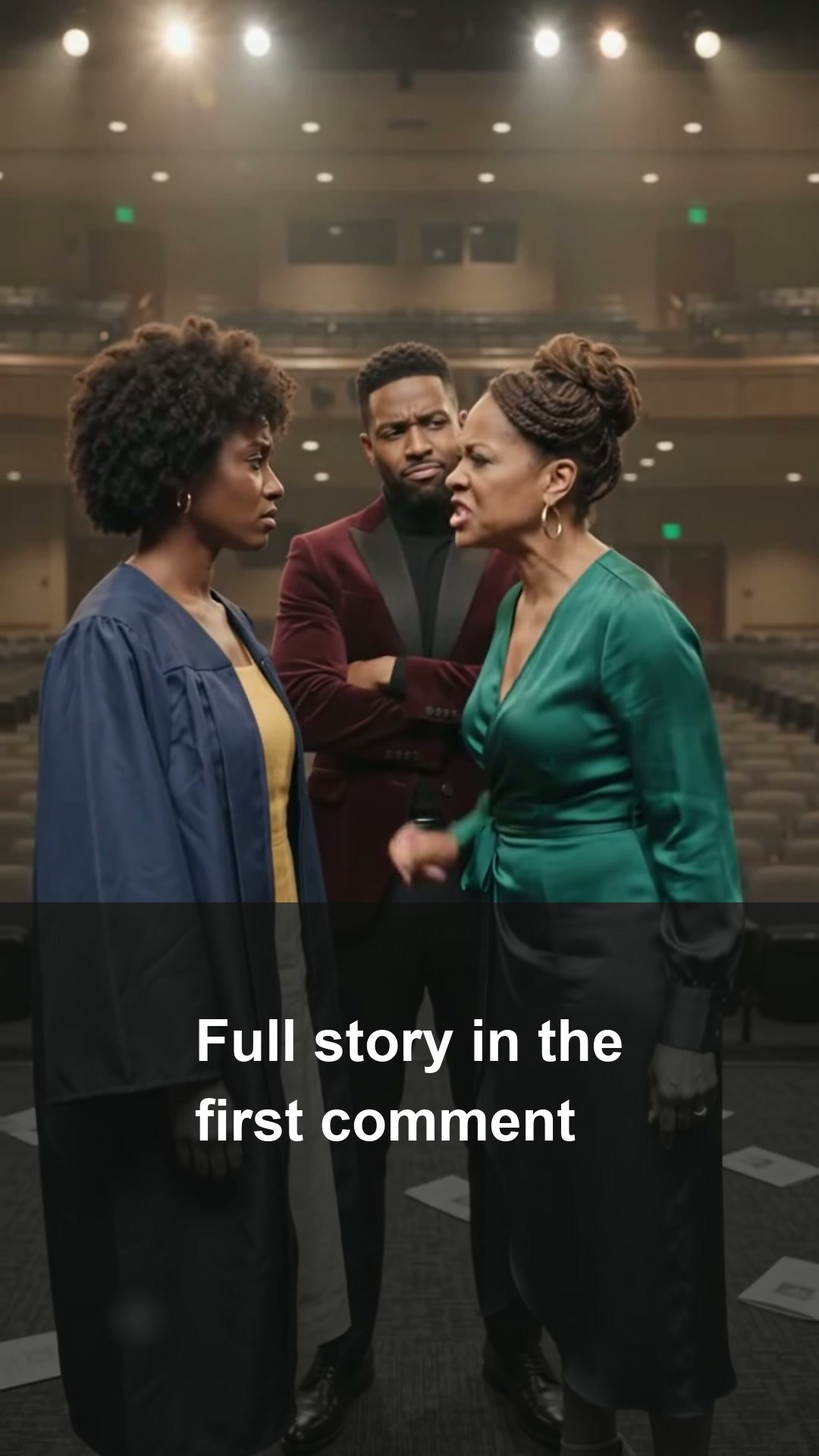
I pushed the heavy oak doors open. The auditorium was vast, an cavern of velvet seats and dim, recessed lighting. At the center of the stage, two men stood in shadows, silhouettes of the corporate world that my father had worshipped from afar. They didn’t look at me with the expectation of a subordinate. They looked at me as if they had been waiting for the only person who knew how to fix the mess they had inherited.
I took the first step onto the stage, the light catching the sharp, cold edge of the steel key one of them held out.
The air in the auditorium tasted of dust and expensive floor wax. I reached for the key, my palm steady, feeling the bite of the brass teeth against my skin. It was heavier than it looked, a physical weight that anchored me to the floorboards. Across from me, Marcus Thorne didn’t smile. He simply watched, his eyes tracking the way my pulse jumped in my throat. I thought of my father’s study, the shelves sagging under the weight of trade journals he never read, and the way he had spent fifteen years begging for a meeting that these men had just handed to me like a chore. My mother would have called this luck, a fluke of industry, something to be downplayed at dinner to ensure Ethan didn’t feel small. I tightened my grip until the metal left a crescent-shaped indentation in my palm. The silence in the room wasn’t empty; it was a pressurized chamber, holding back a decade of being the daughter who stayed in the background to ensure the lights stayed on for everyone else. I looked at the men, then back toward the dark, cavernous rows of seats where, in my mind, my family sat waiting for their turn to claim credit for my survival. I realized then that the foundation I had been building wasn’t for them to stand on. It was a barrier I had engineered specifically to keep them out. I looked at the key, then up at Marcus, the architecture of my new life suddenly clicking into place with the finality of a deadbolt sliding home. I stepped back, the distance between us widening, and felt the last tether to their narrative snap. I didn’t need their pride, or their validation, or even their permission to be excellent. I looked them directly in the eye and said, My family is no longer a part of the calculation.
The kitchen floor was linoleum, patterned with faded yellow daisies that curled at the edges. I was ten, sitting beneath the table, tracing the grout lines with a fingernail while my mother stood at the stove. She was vibrating with a frantic, caffeinated energy, the spatula in her hand darting like a bird. The air smelled of burnt toast and the sharp, metallic tang of my father’s impending mood. He was in the study, his voice a low, rhythmic rumble as he recounted his latest business strategy to a silent telephone line. My brother Ethan, five years my senior, sat at the table above me, his legs swinging, his heel drumming against the table leg in a rhythmic mockery of my focus. He was holding a model plane, the wing snapped off, waiting for me to fix it. He didn’t ask; he just pushed it over the edge of the table until it hit my shoulder. I looked up. His eyes were bright, vacant, and expecting. I fixed the wing with a dab of superglue, my hands steady, my breath held. Mom turned, saw the repair, and didn’t thank me. She just smoothed Ethan’s hair and sighed, saying that it was a blessing I was so practical, so good at fixing the messes the dreamers left behind. I realized then that my utility was a trap; the more I fixed, the less I was expected to exist as anything other than a spare part. I decided then to keep my hands busy, to build things that didn’t break, and to never, ever ask for help with the glue. I would become the person who didn’t need the repair, and that was the hook that pulled me into a lifetime of hiding my own architecture.
High school graduation was a rehearsal for a play I wasn’t allowed to star in. We stood in the humid gymnasium, the smell of floor wax and stale sweat thick enough to choke on. My father wore a suit that was too large in the shoulders, his face a mask of performative pride, but his eyes were darting toward the school’s donor board, looking for a way to wedge Ethan’s name into a space meant for merit. I held my diploma, the heavy vellum parchment cold against my sweating palm. I had ranked third in the class, a quiet achievement buried under the noise of Ethan’s latest suspension for erratic behavior. Mom approached, her hands clutching her pearls until her knuckles turned white. She leaned in, her voice a low, sharp blade. She told me not to mention the ranking, that it made things difficult for the family, that Ethan’s failure was enough for one household to carry and I shouldn’t add the burden of my own success. I looked at her, at the frantic, desperate twitch of her eyelid, and I felt a profound, freezing clarity. I realized that my success was a threat to their narrative of struggle. I tucked the diploma into my bag, hid the honors sash under my coat, and decided that the only way to win was to stop playing the game of comparison. I stopped speaking of my grades that night, and the silence became my first real load-bearing wall.
The warehouse was a cavern of concrete and cold air, the only place where the currency was hours worked, not names dropped. I was twenty-two, hauling crates at three in the morning, my spine a line of burning heat. My father called on a Tuesday, his voice tinny through the speakerphone as I leaned against a pallet. He didn’t ask how I was; he asked if I could cover Ethan’s car insurance because his latest venture—a boutique import shop that lasted three weeks—had folded. I looked at the dark, looming shadows of the shelves, the way the light hit the dust motes like golden confetti. I thought about the tuition I was saving, the engineering textbooks I hid under my bed like contraband. I told him I didn’t have the money. He laughed, a dry, dismissive sound that curdled in the air. He told me I was being selfish, that I lacked the vision to see how family investment worked, that I was destined to spend my life in a uniform because I didn’t understand the value of leverage. I hung up, the vibration of the phone against my palm feeling like a dying heartbeat. I decided right then that every dollar I earned would be a brick in a wall they couldn’t scale. I went back to the forklift, the metal cold and hard, and realized that his insults were the best fuel I had ever received.
The marriage was a brief, brittle thing, a pact between two people who were both trying to escape their own gravity. He was a junior architect, full of grand theories about cantilevered balconies and glass facades, but he couldn’t hold a conversation about the logistics of a budget. We sat in our apartment, the walls thin enough to hear the neighbors’ arguments, and he told me I was too precise, that I took the joy out of the process by obsessing over the structural integrity of the roof. He said it with a smile, the kind that was meant to be endearing, but I saw the condescension layered beneath it like sediment. He wanted the house to look like a magazine spread, even if it meant the foundation was rotting. I saw the pattern then—the same pattern that defined my parents, the same glorification of the aesthetic over the functional. I looked at his sketches, beautiful and impossible, and then at my own calculations, dry and indestructible. I realized I was building a life with a man who would leave me to clear the rubble once the roof inevitably caved in. I packed my books and my protractor, left the sketches on the table, and walked out without looking back. I decided that I would never again compromise my structural integrity for someone else’s view of the skyline.
There was a dinner, years later, where my father tried to explain his bankruptcy as a tactical retreat. The dining room table was set with fine china, the remnants of a life that was being liquidated piece by piece. He sipped his wine, his gaze unfocused, talking about the vision he had for a firm he had no right to own. I sat across from him, watching the way his hands shook as he reached for the salt. My mother chimed in, talking about how they had always planned for this, how they were teaching us the value of resilience. I felt a surge of nausea, not for their loss, but for their commitment to the lie. They were architects of an illusion, and I was the only person in the room who knew how to read the blueprints of their ruin. I thought about the thousands of hours I had spent in classes, in labs, in the quiet, solitary work of becoming someone who actually understood how things held together. I decided in that moment that I would no longer be the audience for their performance. I stood up, excused myself, and walked out the front door, leaving them to toast to their own ghosts. I didn’t look back at the house, a structure built on sand, because I was already standing on the ground I had cleared for myself.
The final warning came from a friend of the family, a man who cornered me in the lobby of my first firm. He told me I should be more generous with my siblings, that I had a duty to ensure Ethan had a seat at the table. He said it was the natural order, that the strong should carry the weak. I looked at him, his face a mask of comfortable, unexamined tradition. I thought about every time I had been told to dim my light so the room wouldn’t look too bright for them. I realized the warning wasn’t about family; it was about the threat I posed to the status quo. If I succeeded, the entire hierarchy would have to admit that their favorite sons were just hollow space. I looked at him, his mouth still forming the platitudes, and I didn’t see a mentor. I saw an obstacle. I decided that I would be the architect of my own rescue, and if that meant the table they wanted me to hold up came crashing down, then that was the cost of the foundation. I took the elevator to the top floor, the hum of the cable a promise of ascent, and I left the lobby, the family, and the expectations behind me in the dust of the lobby floor.
The office air smelled of ozone and expensive espresso, a stark departure from the damp concrete of my parents’ basement where I had spent three years drafting blueprints on a folding table. I sat at my new desk, the mahogany surface cold enough to bite through my sleeves. My phone vibrated against the wood—Ethan, calling for the tenth time today. I didn’t answer. I remembered his graduation party, the way he had toasted to his own potential while I stood in the kitchen scrubbing wine stains out of Mother’s rug. He had always been the golden failure, draped in the luxury of being allowed to dream, while I was the structural reality that kept the floor from giving way. I swiped the notification into the trash, feeling the familiar, jagged ache of needing his acknowledgement even as I despised his voice.
I tapped the screen to open my email. Evelyn, my mother, had sent a flurry of messages, each one curating a version of my promotion that centered on her maternal guidance. She wrote about my innate grace, as if my engineering degree were a talent inherited like a family nose rather than a series of late nights and skipped meals. She lived in a world of performative domesticity, convinced that if she polished the narrative enough, the underlying rot wouldn’t show. I imagined her in our living room, rearranging the framed photos of Ethan’s failed startups to make space for a picture of me she didn’t have. I clicked block on her contact. The silence that followed felt like the first breath I had taken in a decade.
Arthur, my father, was different. He had always valued potential over the concrete labor I offered, waiting for his big break through Ethan’s schemes while ignoring the bills I paid to keep our lights on. I looked at the contract in front of me, the one that effectively liquidated the debt he had leveraged against my future. He was a man who worshipped the idea of success but feared the work required to build it. I remembered him laughing at my decision to study civil engineering—calling it a trade for the practical, not the brilliant. I touched the pen to the paper. If I signed this, his professional reputation would be shredded by the very firm that had kept him afloat for years. My hand didn’t shake. I realized then that my desire for his apology was just another form of dependence. I didn’t need him to admit I was brilliant; I only needed to stop paying for his blindness.
The door clicked open, and Marcus Thorne walked in. He looked at me, not with the predatory hunger of the corporate elite, but with the calculated appraisal of someone who knew exactly how much weight a structure could bear before it snapped. He was the catalyst, a man who saw in my quiet, precise fury the leverage he needed to dismantle the stagnant rot of my family’s social circle. He played the mentor, but he was really a demolition expert, and I was his wrecking ball. I held his gaze, refusing to be the grateful protégé. I wasn’t here to save his company; I was here to secure my own exit. I watched him wait for a smile, a sign of gratitude, or a flicker of doubt. I gave him nothing but a direct, steady stare. I had spent my life being the support system for everyone else’s collapse. It was time to see what happened when the pillar walked away. I signed the document, the ink dark and permanent against the white, and slid it across the desk toward him. The sound of the paper grazing the wood was the loudest thing in the room. I had finally built something that was entirely, undeniably mine.
The ink on the contract was still tacky, a testament to a shift in gravity that had yet to settle. Marcus Thorne didn’t blink, but his fingers drummed a slow, rhythmic beat against the mahogany surface. I stood up, the chair scraping sharply against the polished concrete floor, and walked to the floor-to-ceiling windows. Below, the industrial district looked like a circuit board I had finally learned how to rewire. My phone vibrated in my pocket—a sharp, insistent tremor. It was the third missed call from my mother in twenty minutes. I didn’t answer. Instead, I pulled out a fresh legal pad and wrote down the names of three local law firms.
I stepped out of the office and into the sterile white glare of the HR department. The carpet was thick, muffling my footsteps as I approached the desk of the benefits coordinator. I placed a pre-drafted letter of resignation on the desk, not for my new job, but for the family trust account I had inadvertently managed for years as a silent partner. I watched the woman’s eyes widen as she scanned the document. She asked if there was a problem with the distribution schedule. I told her I was liquidating my share to satisfy a debt—a debt I owed to my own autonomy.
Within the hour, the counter-action arrived. My father called, his voice booming through the speaker, layered with the practiced indignation of a man who suddenly realized his retirement fund was tied to my signature. He accused me of being impulsive, of sabotaging the family’s structural integrity for a moment of spite. I listened to his breathing, heavy and rhythmic, the sound of a man who had never once considered that I might be the one holding the ledger. I told him the accounts were frozen. I didn’t wait for his rebuttal. I hung up, walked to the bank, and finalized the cancellation of every recurring payment to Ethan’s failing boutique consultancy.
The following morning, I met with a lawyer who specialized in forensic accounting. His office smelled of old parchment and expensive espresso. I laid out the records of the last decade: the diverted funds, the coerced signatures, the elaborate shell games my parents had constructed to hide Ethan’s incompetence. Every page I flipped felt like a brick being pulled from a wall. The lawyer looked over his glasses, his expression shifting from professional detachment to genuine alarm. He asked if I wanted to file a criminal complaint or pursue a civil settlement. I told him I wanted both. I wanted the audit to be public.
The backlash was instantaneous. By noon, my mother had arrived at my apartment building, her silhouette pacing behind the frosted glass of the lobby door. I watched her on the security monitor, her hands trembling as she adjusted her coat. She wasn’t here to apologize. She was here to negotiate the terms of my surrender. I bypassed the intercom, headed to the back service exit, and drove straight to the police station. I carried the folder containing the records of the identity theft Ethan had committed under my name to secure a line of credit. I placed the evidence on the intake desk. The officer looked at the names on the paperwork, then at me. He told me it was a serious allegation. I told him it was the truth.
Leaving the station, I felt a strange, hollow lightness in my chest. My phone wouldn’t stop buzzing. Dozens of notifications from family friends, distant cousins, and business associates—all of them circling the drain of the narrative my mother was desperately trying to patch together. I pulled into a coffee shop, ordered an espresso, and pulled up the portal for the local probate court. My father’s brother had died three months ago, and the will had been curiously quiet regarding my inheritance. I initiated the contest. I requested a formal accounting of the estate and a DNA test to verify the executor’s claim to the secondary property.
The reaction was a violent shudder through the family grapevine. My brother sent me a text, his usual charm replaced by a frantic, jagged aggression. He called me a traitor. He said I was destroying everything they had built, forgetting that I had been the one to pour the foundation while they were busy painting the facade. I opened the message, read the words, and typed a single response: The structure is compromised. I am leaving.
I didn’t wait for his reply. I went to the local news office. I had a meeting with a journalist who had spent years trying to get a comment on the Parkers’ “innovative” business practices. I handed her a thumb drive containing the email threads that proved my father had signed off on faulty materials for the city’s low-income housing project—a project that had been the cornerstone of his reputation. She looked at me, her eyes narrowed with sharp, investigative interest. She asked if I was prepared for the fallout. I told her I had already calculated the load-bearing capacity of my life, and I was ready for the crash.
Back in my car, the silence was deafening. I looked at the rearview mirror, checking for a tail, though I knew they were too busy putting out the fires I had just ignited to come after me. I reached into the glove box and pulled out a small, worn photograph of the house I grew up in—the house they were now losing to foreclosure. I didn’t feel a flicker of regret. I watched the city lights begin to flicker on, one by one, like a grid coming to life under my direction. The escalation was complete. There was no going back to the invisibility of the support beam. I was the architect now, and I had left the blueprints for the collapse on every desk in the city. I put the car in gear and drove toward the skyline, leaving the wreckage behind me.
The coffee shop on 5th was usually a sanctuary of steam and silence, but today it was a minefield. I stood near the sugar station, stirring a black coffee, while the murmur of the morning crowd shifted into a serrated edge. Two tables over, a woman I recognized from the country club—a friend of my mother’s—was gesturing wildly at her tablet. The headline of the local broadsheet, splashed across the screen, caught the overhead light: Parker Firm Dissolution: A Legacy of Paper Tigers.
I traced the rim of my cup. My thumb caught on a jagged chip in the ceramic.
“I heard he didn’t even know,” the woman hissed to her companion, her voice a sharp intake of air. “They say she walked into the board meeting with the forensic audit bound in leather. Like she was reading a grocery list. Can you imagine the humiliation for Arthur?”
I kept my gaze fixed on the steam rising from my cup. It was thin, wispy, and vanishing before it could reach the ceiling.
“Naomi,” the woman added, her voice dropping to a conspiratorial thrum. “The quiet one. The one who worked in the warehouse. My God, the social media comments are brutal. They’re calling it the ‘Parker Purge.’”
I didn’t turn around. I didn’t acknowledge the sting of being reduced to a soundbite. I finished the coffee in three rapid, scalding sips, the burn in my throat grounding me. I had spent a decade being the invisible scaffolding that held them up; it was only fair that I be the one to pull the pins.
My phone vibrated against the marble tabletop—a jagged, persistent buzz. It was a group thread, family-adjacent friends, their digital panic palpable. *Has anyone heard from Evelyn? The house is officially listed. Is it true Naomi is the one who bought the debt?*
I swiped the notification into oblivion. The cost of this ascent was not a clean break; it was the noise. It was the way the grocery store clerk looked at me differently now—not with the casual indifference of a night-shift stranger, but with a terrifying, wide-eyed curiosity. I was no longer the girl who packed bags; I was the woman who broke a dynasty.
I walked out into the biting wind. A black sedan sat idling at the curb, the company driver looking at his watch. I reached for the door handle, but stopped. My reflection in the glass was unrecognizable—too precise, too cold, too much like the architect I had spent my life pretending not to be.
I thought of my mother’s voice, a high-pitched, rehearsed trill she used at parties to explain why I worked in the warehouse. *Naomi is just so grounded,* she would say, her eyes darting to someone more impressive. *She enjoys the simplicity of manual labor. It’s her way of staying humble.*
I pulled the handle and slid into the leather interior. The silence of the car was a physical weight. I had expected a rush of triumph, but there was only the hollow ache of a structure finally emptied of its load-bearing walls.
“Where to, Ms. Parker?” the driver asked.
I looked at the city skyline, the towers I had helped secure, the life I had built from the debris of theirs.
“Not home,” I said, my voice steady. “Take me to the site office. I have a demolition schedule to finalize.”
The site office was a glass-walled box overlooking the rusted skeletons of the old rail yard. I pulled the master key from my pocket and laid it on the drafting table. The metal was cold, vibrating slightly against the laminate. I didn’t reach for the blue-prints. Instead, I opened the bottom drawer and pulled out the manila envelope I had kept sealed for three years. It contained the foreclosure notice for the Victorian on Elm Street, a property now legally mine.
Evelyn’s phone number appeared on my screen, flashing in the dim light of the site. I let it cycle three times before answering.
“Naomi, finally. Your father has been frantic. The bank says there’s been a clerical error regarding the title transfer,” she said, her voice tight, straining for the cadence of authority she had lost months ago.
I watched a crane pivot in the distance, hoisting a steel beam into the grey sky. “It’s not an error, Mother. It’s an eviction.”
The silence on the other end was absolute, followed by a sharp, jagged intake of breath. She didn’t scream. She didn’t demand an explanation. She simply went quiet, the way she did whenever she realized a chess piece had been removed from the board before she could maneuver it.
“You can’t do this to us,” she whispered, the words stripped of their usual performative warmth. “Think of the optics. Think of what the neighborhood will say.”
“The neighborhood will say you moved,” I replied. I looked at the desk—clean, clinical, and entirely mine. There were no framed photos of us at graduation, no trinkets from the life they claimed I hadn’t earned. “I’ve already contacted the movers. They’ll be there at eight.”
I tapped the screen, cutting the connection before she could begin the script of her defense. The relief was not a flood but a slow, steady thinning of the air in my lungs. I felt the invisible tether that had anchored my spine to their expectations finally snap. I walked to the window, watching the city below. It was a grid of logistics, of forces and counter-forces, and for the first time, I was the one who calculated the load. I turned away from the glass, picked up my bag, and walked toward the door. I didn’t look back at the desk. I didn’t need to see the space I had already outgrown. Tomorrow, the morning flight to the coast would take me far beyond the reach of their reputation. The city lay silent, waiting for the first hammer to fall.
The Pacific coastline was a jagged edge of slate and foam, far removed from the sterile geometry of the boardroom. I stood on the damp sand, the hem of my trousers darkening with seawater, watching a golden retriever chase its own reflection in the receding tide. The dog belonged to a stranger, but for a moment, its frantic, uncomplicated joy felt like a borrowed memory. My lungs finally filled with air that didn’t taste of recycled office vents.
I sat on a drift-log, the wood smoothed by decades of saltwater abrasion. Beside me, a small paper bag held a warm, simple croissant from the bakery two blocks inland. It was the first meal I had allowed myself to eat without checking a clock or calculating a deadline. I tore off a corner of the buttery pastry, the heat seeping into my fingertips.
“You look like you’re waiting for a storm to break,” the dog’s owner said, shielding his eyes from the glare of the morning sun.
I traced the grain of the driftwood with my thumb. “I think the storm already passed,” I replied.
He smiled, a brief, kind crinkle at the corners of his eyes, and whistled for the dog. I watched them retreat toward the dunes. I realized then that I had been bracing for a fallout that would never come because the people I feared had lost their leverage the moment I stopped caring about their approval. The silence here wasn’t empty; it was expansive. I took a slow breath, tasting the salt and the cold, clean promise of a Tuesday morning where no one knew my last name. I didn’t need to be the architect of anything today. I just needed to exist in the quiet. I stood up, brushed the sand from my knees, and turned toward the path leading to the garden of my rental cottage. There were seeds to plant.
I walked into the study, the floorboards creaking under my weight. My father’s heavy mahogany desk, once the altar of our family’s conditional love, sat cluttered with unpaid tax notices and Ethan’s abandoned, glossy brochures for failing ventures. I cleared the surface with one sweep of my forearm, the paper sliding into the trash bin with a dry, final rustle. I reached into my bag and pulled out the architectural compass I had bought with my first paycheck from Thorne, a tool I had kept hidden in a sock drawer for years. I set it down on the bare, polished wood, the cold steel clicking sharply against the grain. There were no frames left to hold, no faces staring back from the walls, only the empty, silent expanse of a space finally my own.
Leave a Reply