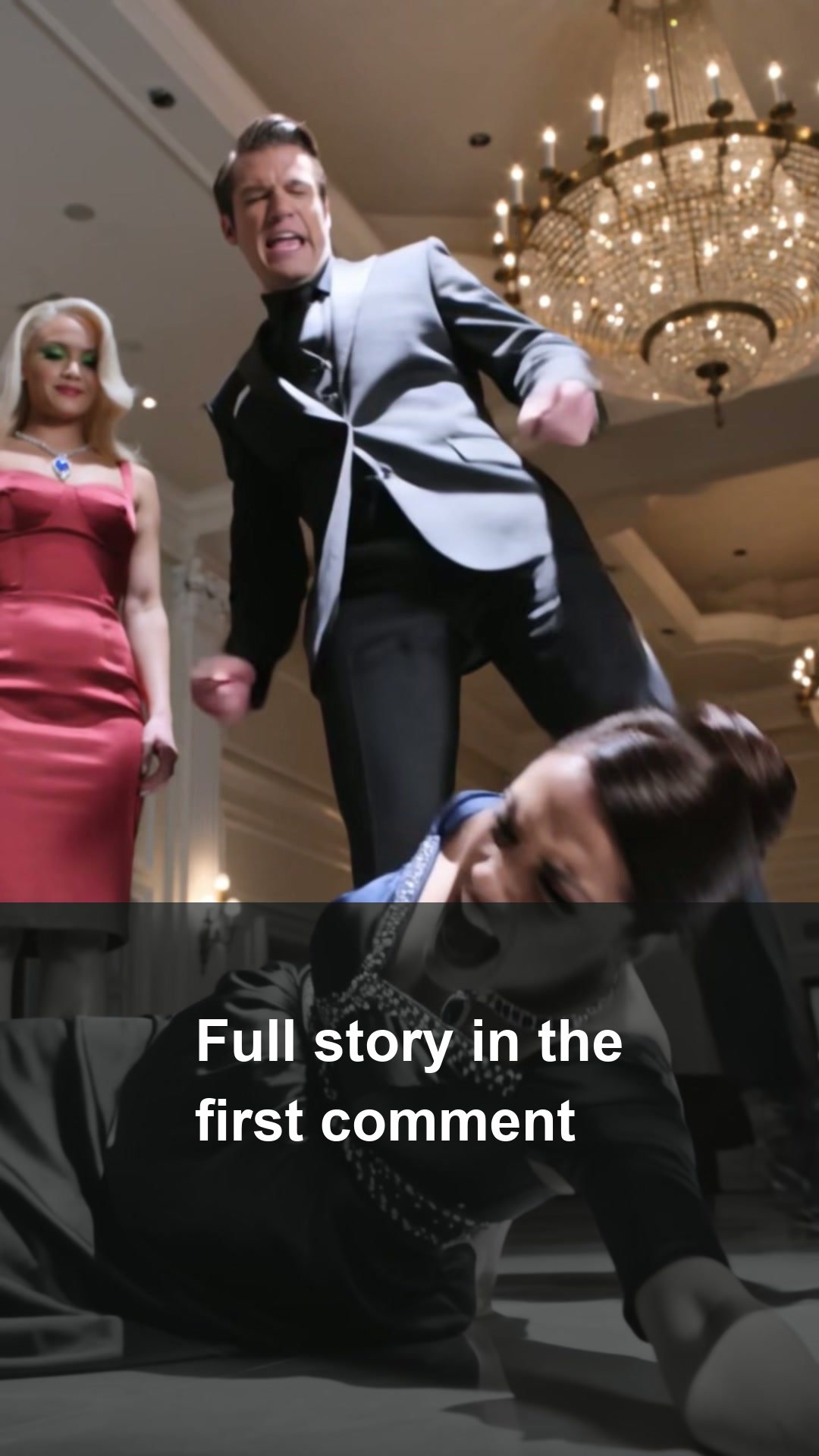
The police badge pressed against Preston’s silk lapel didn’t look nearly as expensive as the tuxedo he had worn five minutes ago. The ballroom fell into a vacuum of silence, the rhythmic hum of the string quartet replaced by the sharp, metallic click of handcuffs snapping shut. Preston’s face, usually a mask of practiced Greenwich poise, crumpled into a mottled gray mess of confusion.
I stood on the mezzanine, the weight of the Sterling sapphire resting cold and heavy against my collarbone. My hand traced the curve of my bump through the silk of my gown, a protective, instinctual reflex.
“Elena?” Preston wheezed, his voice cracking as the officers turned him toward the gilded exit. “What is this? Tell them it’s a mistake.”
I didn’t offer him the comfort of an answer. Instead, I tightened my grip on the mahogany railing, my knuckles turning white. He thought I was his ornamental wife, a silent ledger for his mounting debts. He never bothered to look at the name signed on the mortgage deed.
I took a slow, deliberate breath and stepped away from the ledge. It was time to sign the transfer papers.
The kitchen smelled of burnt beans and expensive roasts, a sharp contrast to the sterile, clinical scent of the gala. I reached for the handle of the espresso machine, the metal cold and biting against my palm. I dialed the grind to its finest setting, the machine humming a rhythmic, grinding lullaby that masked the silence of the house. I watched the dark liquid drip into the porcelain cup, counting the seconds. It was a Thursday. It was always a Thursday.
Preston walked into the room, his tie loose, his breath hitching as he adjusted his cuffs. He was still wearing the scent of the office, that synthetic cedarwood cologne he used to impress his junior partners.
Did you remember the dry cleaning? he asked, not looking at me, his eyes fixed on the blank screen of his phone.
I didn’t answer right away. I held the cup, the heat radiating through the ceramic and into my skin. It was still there, the warmth of the coffee, grounding me in the present. I walked past him toward the window, the morning mist clinging to the floor-to-ceiling glass of the Archdale mansion.
It’s in the mudroom, I said. I set the cup down on the marble island, the sharp click of china on stone echoing in the cavernous space.
He didn’t acknowledge the effort. He just checked his watch, a sharp, metallic sound that signaled the beginning of his frantic, self-important commute. He grabbed a piece of toast, his movements jerky and hurried, already miles away in the firm’s boardroom.
The market is volatile today, Preston muttered, mostly to himself. I need to close the equity deal before lunch. Don’t wait up if I’m late.
I watched him go, the heavy oak door swinging shut with a dull thud. My morning routine was a ritual of preservation. I moved to the office, the leather chair cool beneath me. I opened the day’s ledgers, the columns of numbers neat and orderly, a stark rebellion against the chaos Preston invited into our lives with his whispered, frantic phone calls. Outside, the gardener was clipping the hedges, the mechanical buzz of the shears slicing through the humid Connecticut air. I sipped my coffee, the bitter notes settling on my tongue. I felt the baby shift, a small, insistent flutter against my ribs.
I looked at the mahogany desk, the inkwell, the stack of pristine stationery. Everything was perfectly, painfully normal. I opened the bottom drawer and pulled out the file I had started weeks ago, the one hidden beneath the tax returns and the mundane receipts for home maintenance. My fingers traced the edges of the mortgage fraud documents. I felt a strange, detached calm, the kind that precedes a storm. I wasn’t just a wife; I was a curator of a crumbling museum. I spent the next hour documenting the discrepancy in the quarterly reports, the way the numbers didn’t quite line up, the way his signature looked a fraction too practiced.
The house felt like a tomb of quiet wealth. I stood up and walked to the hallway, my reflection staring back from the gilded mirror. I looked tired, the shadows beneath my eyes deepening, but my posture was rigid, unbreakable. I reached out to adjust a painting, ensuring it was level. The silence was absolute.
Then, the phone on the desk gave a single, piercing ring.
The screen illuminated the mahogany surface, displaying Preston’s office number. I didn’t answer. I watched the vibrations travel across the desk, a rhythmic stutter against the silence. It was a call he intended to be a final check on his leverage—a reminder of who supposedly held the keys to the Archdale estate. I walked past the desk, the floorboards sighing under my weight, and made my way to the wall safe hidden behind the heavy silk tapestry. My fingers traced the cold steel dial. I knew the sequence by heart, the numbers echoing my father’s birthday, the date he warned me that loyalty was a luxury I couldn’t afford to misplace.
Click. The heavy door swung open.
I pulled out the manila folder. The forged mortgage documents lay inside, the ink still smelling faintly of chemical arrogance. The signature at the bottom—my own, faked with a chilling lack of finesse—looked like a caricature of my identity. I gripped the paper, the edges biting into my palm. I thought of the months spent listening to him talk about his strategic acquisitions, his eyes never meeting mine, always scanning the horizon for the next thing to claim as his own.
I stepped out into the hallway and caught my reflection in the floor-to-ceiling glass. I tucked the folder into my evening clutch, the weight of it anchoring me. My reflection was a portrait of a woman he thought he had successfully erased.
Preston appeared at the far end of the corridor, his tuxedo jacket discarded, his tie hanging loose. He looked frantic, his hair pushed back in chaotic ridges.
Elena, he barked, not looking at me but at the empty safe. Did you move the files?
I straightened my necklace, the sapphire pendant resting against my throat like a cold, blue eye. I walked toward him, my heels biting into the hardwood with precise, rhythmic intent. I kept my face blank, a polished surface reflecting none of the fire beneath.
I didn’t move them, Preston, I said, my voice steady, stripped of the soft, compliant cadence I’d worn for years. I simply reclaimed them.
He stopped, his brow furrowing as he finally registered the change in the air. His eyes flickered to the clutch in my hand, then back to my face. The confusion was brief, quickly replaced by a sneer that didn’t quite reach his eyes. You’re playing at something you don’t understand, he muttered, stepping into my personal space, his scent of expensive scotch and desperation clinging to the air. You’re a passenger in this life, Elena. Don’t mistake yourself for the driver.
He reached for my arm, his fingers tightening. I didn’t flinch. I felt the baby kick—a sharp, sudden protest against his presence.
I’m the one who owns the road, I whispered, pulling my arm away with a sharp, clean motion that caught him off guard. The gala starts in an hour, and you’re going to be the main attraction.
I turned toward the stairs, leaving him standing in the dark, silent hallway. The hook was set.
The foyer was cavernous, smelling of lilies and floor wax, but the silence inside was sharper than the cold air outside. I bypassed the main staircase and retreated into the library, sliding the heavy oak door shut until the latch clicked. My breath hitched, a thin, jagged sound in the quiet. I reached into my clutch and pulled out the burner phone, my fingers steady as I punched in the number for the boutique hotel where Preston supposedly spent his Tuesday afternoons.
The desk clerk picked up on the third ring, his voice dripping with the practiced, oily deference of a man paid to look away. When I identified myself as Preston’s wife, the line went dead for a heartbeat before he stuttered, telling me that Mr. Carter had checked out yesterday morning, not Tuesday. He’d never even booked a room for the day he claimed to be in meetings.
I stared at the leather-bound spines of my father’s old ledgers, the gold lettering blurring. If he wasn’t at the hotel, the consulting fee invoice I’d found—the one detailing a suite rental—was a complete fabrication. A deliberate paper trail leading to nowhere.
I didn’t wait for my pulse to settle. I called the nurse at the clinic where Preston insisted I go for my prenatal check-ups. Her tone was brisk, bordering on annoyed, until I pressed her about the billing cycle for the last three months. There was a long, awkward pause on the other end, the sound of a printer whirring in the background. She finally confessed that no payments had been received since October. According to her records, the insurance policy Preston claimed was covering the pregnancy had been canceled months ago for non-payment.
My hands felt ice-cold against the mahogany desk. He hadn’t just been stealing; he had been skimming from funds meant to secure my health. The betrayal felt physical, a slow-acting poison in my veins. I needed a witness, someone who hadn’t been bought by his charm.
I dialed Miller, the retired groundskeeper who lived on the edge of the estate. He answered on the first ring, his voice gruff, heavy with the weight of someone who spent his days watching the world go to seed. When I asked if he’d seen Preston leaving the property on the days he was meant to be working, Miller hesitated. He eventually let out a low, gravelly sigh, admitting that he’d watched Preston pull out of the gate every morning at eight, but he’d returned by noon, meeting a woman in a silver sedan by the old stone wall at the property line.
He hadn’t been working. He had been meeting an accomplice, right under my nose, behind the shelter of the pines.
I hung up, the silence of the library closing in. The pieces were jagged, refusing to fit. The hotel said he was never there. The clinic said he never paid. The groundskeeper said he never left. Each lie was a different color, a different shape, creating a mosaic of pure, unadulterated fraud.
I shoved the phone into my bag, adjusted my silk cuffs, and walked toward the door. I needed to see that stone wall. I needed to see the spot where he had traded my life for his own ambitions. The driver was waiting, but I decided to take the keys to the vintage Jaguar. I needed the weight of the steering wheel. I needed to move. I stepped out into the night, the gravel crunching beneath my heels, and turned the ignition. The engine roared to life, a low, guttural growl that promised something much worse than a divorce. I drove toward the gate, the headlights cutting through the darkness, unaware that the real secret was waiting just beyond the turn.
The Archdale mansion loomed ahead, a jagged silhouette of stone against a bruised violet sky. I killed the engine, letting the silence settle into the cabin until the ticking of the cooling metal became a rhythmic, metallic heartbeat. I stared at the front entrance, where Preston was currently holding court, likely gesturing with the champagne flute I had paid for, boasting about a liquidity he did not possess. I gripped the door handle, the cold leather of my gloves creaking under the tension of my knuckles. My fingers brushed the hard, sharp edge of the flash drive hidden in my pocket—the anchor that would drag his world to the bottom of the ocean.
I stepped out onto the gravel. Each stride toward the ballroom felt like a countdown. Inside, the muffled sound of a string quartet fought against the rhythmic thumping of my own pulse. I caught my reflection in the floor-to-ceiling foyer mirror: pale, composed, and terrifyingly steady. My reflection looked like a stranger, a woman who had spent three years playing the role of a silent ornament while he stripped my father’s legacy piece by piece.
I pushed the heavy oak doors open. The humidity of the ballroom hit me first, thick with expensive perfume and the smell of jasmine. Preston stood at the center of a circle of investors, his laughter loud and practiced. He looked up, his eyes bright with the thrill of the hunt, unaware that the predator had already circled back. He straightened his tie, offering me that familiar, condescending smirk he reserved for when he thought I was performing my duties correctly. He stepped away from the group, crossing the room to reach me, his hand moving toward the small of my back in a possessive, performative gesture. He leaned in, his breath smelling of aged scotch and practiced deceit. I didn’t flinch. I just looked him directly in the eye and spoke.
I never loved you; I was just waiting for the papers to clear.
The words hung between us like a glass shard, suspended in the air before the inevitable shatter. Seeing the confusion ripple across his face brought me back to the velvet-lined silence of my father’s study, twenty years ago. I was nine, sitting beneath the mahogany desk, watching my father’s polished brogues pace back and forth. He was on the phone, his voice a low, gravelly vibration that rattled the floorboards. He was explaining to a creditor that money was not a fluid concept, but a foundation—something you built, not something you spent. I had spent that afternoon counting the coins in my piggy bank, a small, ceramic owl, believing that if I gathered enough copper, I could buy the kind of attention my mother gave only to her guests. When he hung up, he didn’t check for me under the desk. He simply opened the wall safe, the click of the dial sounding like a gunshot. He didn’t see me, but he felt the weight of his legacy, and that was the day I learned that wealth was a fortress, and people were merely the siege engines trying to break the gates.
My mother’s voice drifted down the hallway, sharp and rhythmic, scolding the maid for the way the silver spoons were angled. It was a pattern, an endless, circular dance of keeping up appearances while the foundation rotted underneath. My brother, Julian, was the only one who seemed to understand the absurdity of it, but he had been sent away to boarding school in Switzerland by the time I was twelve. I remember the last time I saw him at the train station. He grabbed my shoulders, his eyes darting toward the chauffeur, and whispered that I should never let them know how much I actually knew. He told me to keep my cards beneath the table, even when the stakes seemed low. I didn’t understand then, but the logic settled into my marrow. I watched my mother pivot from a cold, silent woman at breakfast to a vivacious, laughing socialite at dinner, and I decided right then that I would never be that exhausted. I would be the one holding the ledger, not the one being accounted for.
The school years were a series of calculated performances. At Miss Porter’s, I didn’t seek out the girls with the most expensive handbags; I sought out the girls whose parents were terrified of the IRS. I learned how to read a balance sheet before I learned how to drive. I sat in the library, the smell of old paper and dust thick in the air, and traced the lines of my father’s investment portfolios. I saw where the money went, and more importantly, where it disappeared. When I met Preston at that charity gala in my junior year of college, he was an anomaly. He was hungry, polished, and perfectly suited to the role of the devoted suitor. He had the right pedigree, the right tailor, and the right amount of ambition to cover his lack of substance. I was twenty-two, still grieving my father’s sudden death, and I allowed myself the indulgence of believing he wanted me for my mind. I didn’t correct him when he assumed the Sterling fortune was tied up in trusts I couldn’t touch. I let him believe I was just another heiress with a dwindling allowance, a woman he could mold into a trophy.
The wedding was an affair of white lace and stifling expectations. I stood at the altar, feeling the weight of the sapphire pendant around my neck—the one my mother had worn to hide the bruises on her collarbone—and I made a vow that had nothing to do with him. I promised myself I would never be a victim of a man’s ego. The first sign of the rot was subtle. We were six months into our marriage, renovating the Greenwich house. Preston had taken over the paperwork, claiming he wanted to save me the stress. He slid a mortgage document across the marble kitchen island, his pen poised, his smile too tight. He told me it was a routine consolidation of our assets. I read the fine print twice, the ink blurring under the harsh kitchen lights. He had leveraged the Sterling estate, the land that had been in my family for four generations, against a firm he didn’t even own. I looked at him, his face expectant, waiting for the soft, compliant nod of a wife who didn’t understand the numbers. I signed, but I made sure my thumbprint smeared the notary seal.
He started small. The criticism of my hair, the snide remarks about how I spent my afternoons, the way he insisted on being the one to manage our shared accounts. He loved the narrative of the self-made man, even though he had never made anything. He was a parasite, and he played the part so well that I almost admired the performance. But then came the night he forgot to hide his phone. I was in the bedroom, the moonlight casting long, jagged shadows across the floor, when his screen lit up with a message from a woman I recognized from the country club. It wasn’t just an affair; it was a business arrangement. She was funding his new ventures in exchange for access to my social circle. I lay there in the dark, my heart beating with the steady, cold rhythm of a clock. I didn’t confront him. I didn’t scream. I simply went to the study the next morning, opened the hidden compartment behind the portrait of my great-grandfather, and pulled out the real ledger.
The patterns were all there. The missing tens of thousands, the falsified tax filings, the way he had systematically stripped away my independence while pretending to build a life for us. Every insult he had leveled at me—my appearance, my lack of ambition, the way he claimed he was the only thing keeping me relevant—it was all just a distraction, a magician’s trick to keep me from looking at the vanishing act he was performing with my inheritance. I spent the next two years documenting it all. I took photos of his files, recorded his late-night calls, and funneled my actual fortune into an offshore account he didn’t even know existed. I watched him grow more arrogant, more reckless, believing he had finally mastered the game. He thought I was the prize he had won, but I was the house, and the house always wins.
The day I told him I was pregnant was the day he finally stopped hiding his disdain. He looked at me, not with affection, but with the irritation of someone whose schedule had been inconvenienced. He walked over to the window, staring out at the gardens, and started talking about the costs of a child—the nursery, the schooling, the reputation management. He spoke of the baby as a ledger entry, something to be managed and leveraged. That was the moment the last of my affection evaporated. I felt the baby shift, a tiny, defiant movement, and I knew then that I would burn his world down to ensure this child never knew a man like him. I saw his reflection in the window, his expression cold and calculating, and I realized he was already planning how to use our child to secure his place in the Sterling boardrooms. He was a predator who had spent his entire life hunting the wrong target.
I remember sitting in the library on our fifth anniversary, the air thick with the scent of lilies he had sent—flowers I despised because he only ever ordered them to signify a debt he wanted erased. I had the sapphire necklace in my palm, the cold weight of it pressing against my skin. It was more than a jewel; it was a weapon. I had spent years waiting for this exact moment, for the night he would be most exposed, surrounded by the people whose opinions he valued more than his own life. He had spent his time building a house of cards, convinced that the wind would never blow in his direction. I didn’t need to shout. I didn’t need to make a scene. I just needed to show up, fully realized, and let him see exactly what he had lost. The history of our marriage wasn’t written in vows; it was written in the fraud he committed, the lies he told himself, and the silence I maintained while I sharpened the blade. The clicking of my heels against the stairs was the final countdown, and I knew, with the clarity of a winter morning, that his ruin was not a tragedy. It was an audit.
The ballroom smelled of lilies and the sharp, metallic tang of expensive champagne. Preston stood by the mahogany bar, his cufflink catching the chandelier light—the same gold ones he had stolen from my father’s bureau before we were even wed. He checked his watch, a nervous twitch in his jaw that betrayed the calm veneer he wore for the board. He believed he was the architect of this room, yet he was merely the guest of my bank account. I watched him smooth his silk tie, his vanity a brittle shield against the fact that he hadn’t paid a mortgage payment on our home in six months. He wanted to be a titan, but he was just a man who feared the bank’s foreclosure notice more than he feared losing me.
Clara, leaning against the velvet curtains near the terrace, signaled him with a tilt of her flute. She looked radiant, her dress a shade of blue that mimicked the sapphire at my throat. She had spent years playing the confidante, yet beneath her designer lace, she was starving for the lifestyle she thought Preston provided. She had helped him forge the signatures on the equity loan, convinced she was securing a future as the mistress of a man who didn’t actually own his own socks. She was a scavenger, desperate to believe that proximity to power was the same thing as possession. I wondered if she knew that I had already frozen the accounts she assumed would be her severance pay.
Arthur, my father’s former lead council, stood near the dais, nursing a tonic water. He was a man of impeccable ethics and a crumbling liver. He had spent his life protecting the Sterling estate from the likes of Preston, yet he harbored a secret shame: he had accepted a bribe from a rival firm decades ago and had been paying for it in silence ever since. He looked at me, his eyes clouded with a weary recognition. He knew what was in the folder I clutched beneath my wrap. He wanted to intervene, to pull me aside and suggest a quieter path, but his own past kept his mouth shut. I caught his gaze and held it, letting him see that I knew his secret too. He turned away, his shoulders slumping under the weight of his own complicity.
Beside him, the IRS auditor, posing as a donor from the regional arts council, adjusted his glasses. He was a man who found justice in ledgers, a man who saw the world as a series of imbalances waiting to be corrected. He wasn’t here for the gala; he was here to witness the collapse of a ledger that didn’t add up. He caught my eye, a small, grim nod of confirmation. He was the shadow at the edge of the light, the cold reality that would soon replace the music. I walked past the appetizer trays, the scent of truffle oil thick and cloying, and felt the baby kick against my ribcage. It was a firm, grounding reminder that I was no longer just an heir; I was a legacy. I reached the microphone, my fingers brushing the cold metal, and felt the sudden, terrifying thrill of gravity taking hold. The room held its breath, suspended in a golden, artificial peace, waiting for the first word that would turn the lights out on the only life Preston had ever cared to perform.
I took the breath that would sever our marriage. My voice did not shake, it merely cut through the chatter like a surgical blade, clear and devoid of the performative softness Preston required of me. I spoke of the mortgage fraud, the falsified signatures on the Sterling estate documents, and the shell company he had laundered our liquidity through. The ballroom, previously a cacophony of clinking crystal, fell into a vacuum of silence. Preston stood near the buffet table, a half-eaten shrimp cocktail suspended halfway to his mouth. His face drained of color, then flushed a violent, mottled red. He dropped the fork. It hit the parquet floor with a sharp, dissonant ping.
I didn’t wait for his rebuttal. I stepped down from the dais and walked directly to the exit, where my solicitor, Arthur Vance, was already waiting with a leather-bound folio. I pressed the digital recorder into his palm—the device containing Preston’s drunken, boastful confession from three weeks prior. Arthur nodded, his expression the same sterile mask he wore for tax audits. He slipped the device into his inner breast pocket and vanished into the night. That was the first domino.
By the time I reached the foyer, I pulled my phone from my clutch. My thumb moved with mechanical efficiency, cancelling the standing authorization for his personal American Express. A notification pinged instantly: *Declined.* I imagined him at the bar, trying to tip the server, the screen flashing the universal red light of his impending ruin. He caught up to me at the grand staircase, his hand gripping my wrist with enough force to bruise. His breath smelled of expensive scotch and panic.
Elena, you are making a mistake, he hissed, his eyes darting toward the security guards who were now edging closer. Think about the optics. Think about the baby.
I pulled my arm back, the movement sharp and decisive. The baby is the only reason you are still breathing, Preston, I said, my voice low enough that only he could hear the static hum of my resolve. I turned my back on him. I didn’t care to watch the security team intercept him; the sound of his protests being muffled by the heavy oak doors was satisfying enough.
The following Monday, I sat in the austere, glass-walled office of an employment law firm in the city. The fluorescent lights hummed, echoing the headache pulsing behind my eyes. I placed the stack of internal emails I had printed from his work laptop onto the desk. They detailed his systemic harassment of my father’s former associates, the ones who had questioned his erratic accounting. I signed the HR complaint form with a steady hand. Within the hour, the firm’s board had been alerted to the breach of fiduciary duty. By noon, his office access badge was deactivated, and his terminal was wiped clean. He was no longer just a husband who had betrayed me; he was a liability being scrubbed from the corporate record.
The counter-action was swift. On Tuesday, a process server arrived at the Archdale estate. Preston had filed for an emergency injunction, claiming I was mentally unstable and unfit to manage the trust. I opened the door, watched the man fumble with the thick envelope, and felt a cold, jagged smile pull at my lips. He was trying to invoke the old clauses, the ones that assumed I was the fragile socialite he had groomed me to be.
I spent the afternoon at the Sterling Trust archives. I didn’t just read the will; I contested it. I had the original, handwritten codicil my father had left—the one I’d kept hidden in the floorboards of the study—delivered to the presiding judge’s chambers. It explicitly stated that any spouse attempting to seize the estate through fraudulent encumbrance would be permanently disinherited from any claim to the property. I had the DNA test results from the private lab in my bag, confirming the paternity of the child; a necessary shield against his inevitable claims of infidelity.
By Wednesday, the court clerk had processed the filing. I sat in the quiet of the morning, watching the fog roll over the manicured lawn. The phone rang—a blocked number. I knew it was him. I let it go to voicemail.
Elena, you’re destroying everything, his voice rasped through the speaker, a jagged, pathetic sound. I have people. I can fight this. I’ll make you look like a gold-digging widow before you even get the chance to serve the papers.
I deleted the message. I didn’t feel the need to reply. Instead, I called the bank and finalized the freeze on the joint accounts. His last few checks bounced before the afternoon was out. The dominoes were falling faster now, creating a kinetic chain I had set in motion with a single sentence. I stood up, walked to the window, and pressed my hand against the cold glass. The house was mine, the legal walls were tightening around him, and for the first time in years, the air in the room felt breathable. I walked to the mahogany desk, picked up a fountain pen, and prepared to sign the final divorce petition. There was no hesitation, only the steady, rhythmic beat of my heart, echoing the quiet certainty that his collapse was merely the opening act of my survival.
The morning after the gala, the silence of the Archdale mansion was not peace; it was a vacuum. I sat in the sunroom, watching a black SUV idle at the iron gates. It was a reporter from the Chronicle, his camera lens glinting like a predator’s eye. I picked up my porcelain teacup, the fine china clinking against the saucer—a sharp, brittle sound that seemed to vibrate through the entire house.
My phone, resting on the glass table, lit up with a text from Clara. *I didn’t know, Elena. You have to believe I’m as much a victim as anyone else.* I stared at the screen, the blue light washing out the exhaustion under my eyes. I didn’t respond. The social media feed was a river of vitriol. My name was trending alongside words like “heiress” and “heist,” while Preston’s face—contorted, desperate, and sweating—was plastered across every blog in the city. The comments were brutal, a digital vivisection of a man who had built his identity on the assumption that I was a hollow ornament.
A heavy knock rattled the front door. I stood, my legs stiff, and walked to the entrance. Through the peephole, I saw Mrs. Gable from the charity board, her face pinched in a mask of performative concern. I didn’t open it. I knew she wasn’t here for me; she was here to gauge the temperature of the wreckage, to see if the contagion of Preston’s disgrace had touched her own reputation.
“He’s gone, Clara,” I whispered to the empty foyer, my voice flat. “And so is the illusion.”
The fallout wasn’t just the money. It was the way the world shifted. My phone buzzed again—my father’s lawyer. *The firm is distancing itself,* he said, his voice clipped. *The board is worried about the public association. You need to make a statement.* I leaned my forehead against the cool mahogany of the doorframe. The pressure of the baby against my ribs felt like a physical anchor, grounding me even as the world outside tore itself apart. I had expected a clean break, but this was a slow, messy erosion. Every friend who texted was a spy; every neighbor was a judge.
I walked back to the kitchen, passing the framed photograph of Preston and me at our wedding. I didn’t take it down. Instead, I stood before it and watched the dust motes dancing in the morning light. He had wanted to play the master of the house, to treat my life like a portfolio he could leverage. He hadn’t realized that when you build a kingdom on sand, you don’t just lose the walls; you lose the ground beneath your feet.
I reached for the landline on the wall, my hand steady. I dialed the head of the local school board. “Yes,” I said, cutting off his stuttered greeting. “My son’s enrollment remains unchanged. I am the sole guardian of his future, and I assure you, my focus is entirely on his stability.”
I hung up before he could respond. The decision was final. I wasn’t just surviving the collapse; I was curating the debris. The driveway was still full of journalists, and the phone was still screaming with the frantic demands of people who had once treated me like a ghost. I turned toward the grand staircase, stepping over a discarded invitation to the autumn ball. I had dismantled his life, and now, I had to figure out how to fill the space where he used to be. The next knock came, louder this time, shaking the frame. I didn’t flinch. I just turned toward the library, ready to begin the work of reclaiming the silence.
The heavy oak door of the library swung open, revealing the process server. He held a thick manila envelope, his expression neutral, eyes scanning the room as if expecting to find Preston lurking in the shadows. I took the papers without a word, the crisp edges biting into my palm. My signature on the divorce decree was already dry, a finalized geometry of separation. Preston was currently sitting in the lobby of the precinct, waiting for the fraud charges to be formalized. I walked to the desk and dropped the envelope next to the Sterling Trust deed.
“Is he still asking for me?” I asked, looking at the lawyer who had trailed the server inside.
“He wants to discuss the liquid assets,” the lawyer said, shifting his weight. “He seems to think there is still a middle ground.”
I sat in my father’s high-backed leather chair and picked up the sapphire necklace. It felt cool, grounding, a heavy weight that finally belonged to no one but me. I didn’t answer him. Instead, I stood up and walked to the wall safe behind the portrait of my mother, entering the sequence that reset the house’s security protocols. The silent hum of the alarm system cycling confirmed that every gate was locked against him. I watched the lawyer leave, his heels clicking against the hardwood until the house settled into a profound, hollow stillness.
I walked to the master bedroom, the floorboards cold beneath my feet. My wedding gown lay in a heap on the chaise lounge, a discarded ghost of the life I had been forced to play. I reached for the silk robe in the closet and pulled it tight, the fabric soft against my skin. There was no residue of Preston here, only the sharp scent of my own perfume. I sat by the floor-to-ceiling window, looking out over the expansive, dark grounds.
My hand moved to my stomach. A sharp, rhythmic flutter pressed against my palm—the baby, restless and alive. It was the first time in years I had felt truly anchored. The fraud, the public ruin, the cold dismantling of his ego; it felt like cleaning a long-festering wound. I reached for the jeweler’s box on the vanity and tucked the sapphire necklace inside, ready to send it for a new setting. A small piece of jewelry for a daughter who would never know the weight of a man’s debt. The eastern sky began to bleed a thin, pale violet. The sunrise was coming, and for the first time, I didn’t need a witness to prove I was standing.
I walked onto the back terrace, the cool salt air of the coast hitting my lungs like a physical weight lifted. The sunrise turned the lawn into a field of liquid silver. My heels were gone, and the damp grass seeped through my silk slippers, grounding me. I sat on the iron bench, listening to the rhythmic percussion of the tide against the cliffs below. The silence of the estate was not empty; it was heavy, solid, and entirely mine.
My phone, tucked in the pocket of my robe, stayed dark. No notifications, no frantic bankers, no Preston. I reached down and stroked the head of the golden retriever, Barnaby, who had been sleeping by the glass doors. He leaned his weight against my shins, his rhythmic breathing a steady pulse in the quiet.
I took a breath and held it, tasting the salt.
My therapist, Dr. Aris, had told me during our last session that recovery was not about forgetting. It was about the physical act of reclamation. I pulled a small, worn trowel from the terrace basket. I knelt in the garden bed, the soil cool and dark under my fingernails.
I began to dig, moving the earth away from the roots of the hydrangeas. The work was simple and repetitive. It required nothing of me but presence.
“You look different,” my gardener, Silas, said, stepping out from the greenhouse. He didn’t offer a polite smile; he just watched the dirt on my hands.
“I am,” I said. My voice sounded thin, unused.
He nodded once, turned, and went back to his shears. I didn’t need to explain myself. I didn’t need to justify the mess I’d made or the peace I’d found in the rubble. I pushed the bulb into the hole and packed the earth tight. It was a start. I stood up, wiped my palms on my robe, and looked toward the gate. A delivery truck pulled up to the main entrance, carrying nothing more than groceries. Time to eat.
The kitchen was cavernous, smelling faintly of the expensive, sterile polish the cleaning crew had used that morning. I set the grocery bags on the marble island, the sharp crinkle of plastic echoing against the high ceiling. I didn’t turn on the chandelier. The morning light filtering through the tall windows provided enough visibility to see the dust motes dancing in the air. I opened the refrigerator, its bright, artificial hum filling the void where the shouting used to be. My thumb traced the edge of a ceramic bowl, my movements slow and deliberate. I took a single, bruised apple from the paper bag and set it on the granite. Beside the fruit, glowing deep navy in the dim, early light, sat a single, heavy sapphire earring left behind on the polished ballroom floor.
Leave a Reply