The kitchen air tasted of burnt sugar and the metallic tang of blood.
I stood over the ruins of the tiered cake, my mother’s favorite heirloom platter pulverized into white dust against the obsidian floor. Emily crouched in the corner, her fingers pressed against her raw, indented skin. The silence in the room was absolute, a heavy, suffocating pressure that made the sprawling Sterling mansion feel like a tomb.
Margaret stood by the center island, her posture as rigid as the marble columns framing the doorway. She didn’t look at the mess. She looked at her watch.
“Pick it up, Daniel,” she said, her voice devoid of default. “The guests will be here in twenty minutes.”
My heart hammered against my ribs, a frantic, irregular rhythm. I looked at the red welts on Emily’s wrists—the physical evidence of a lifetime of suffocating control. I had spent years designing buildings to withstand seismic shifts, yet I had let my own foundation rot from within.
I didn’t pick up the platter. I stepped toward the heavy mahogany door, my hand closing firmly around Emily’s arm to pull her up.
“We’re leaving,” I said.
The lock clicked, final and sharp.
The morning air in our apartment smelled of dark roast coffee and the faint, dusty scent of blueprints. I stood in the kitchen, watching the steam rise in thin, curling ribbons against the windowpane. Outside, the city was a grid of grey concrete and muted yellow taxis, the sky a flat, overcast slate that promised nothing but a steady drizzle. Emily was sitting at the small oak table, her fingers tracing the rim of her mug. She had traded her usual silk blouse for an oversized sweater, the wool soft against her skin.
I poured the coffee, the liquid splashing dully against the ceramic. It was Tuesday, a day of scheduled appointments and long, rhythmic hours at the firm. My calendar was a series of neat, color-coded blocks, each one representing a structural calculation or a client consultation. I liked the predictability of it. I liked that the lines on my drafting table always connected, that the weight of a cantilevered roof could be accounted for with enough math.
How do you take your coffee today? I asked, my voice sounding too loud in the quiet kitchen.
Just a splash of cream, Emily replied. She looked up and offered a small, tentative smile. It’s supposed to be chilly out there. Do you have your coat?
I reached for my charcoal wool coat draped over the chair. It felt heavy and familiar, the pockets containing the same stray receipt and set of keys they had held for months. I checked the time on my watch; six-forty. If I caught the subway now, I would hit the office just as the first wave of assistants arrived. I would be able to clear the stack of invoices sitting on my desk before the partners arrived for the morning briefing.
It felt good to have a rhythm that wasn’t dictated by anyone else, I thought. I glanced at the stack of mail by the door, mostly bills and the occasional architectural journal. Everything was in its place. The world felt anchored, solid, and utterly indifferent to the chaos that existed in other parts of my life. I pushed the thought of the Sterling Estate away, tucking it into a compartment of my mind labeled for later, or perhaps for never.
I leaned down and kissed her forehead, the smell of her shampoo grounding me. I’ll be back by six, I promised. Maybe we can try that new pasta place near the park.
She nodded, her gaze drifting back to the window. You’re going to be late if you don’t move, Daniel.
I laughed, a short, sharp sound. You’re right. I’m going.
I opened the heavy front door, the hallway light flickering once before settling into a steady hum. I stepped out, my shoes clicking rhythmically against the hardwood floor of the corridor. I adjusted my bag on my shoulder, feeling the weight of the laptop inside, and took a deep breath. It was a normal day. A Tuesday. The kind of day where the most exciting thing that could happen was a conversation about the upcoming zoning board meeting or a minor disagreement over the layout of a facade.
I reached the elevator and pressed the button, watching the numbers climb slowly from the lobby. The silence of the apartment building was comforting, a stark contrast to the echoing, hollow halls of my mother’s home. I was exactly where I wanted to be.
Just as the elevator doors slid open with a soft metallic groan, the muffled, sharp ring of my phone vibrated against my thigh. I pulled it out, expecting a message from a contractor. Instead, the screen glowed with an unknown, private number, the digits blinking steadily in the dim light of the hallway. I stood motionless, the elevator doors waiting for me to step inside, as the phone rang again, demanding an answer.
I answered on the third ring. Elena’s voice was a jagged whisper, barely audible over the hum of the ventilation system. She was crying, though she tried to stifle the sound with a sharp, ragged inhale. Daniel, you need to come back. Now. She is in the kitchen with the cake. She pushed her, Daniel. She pushed her hard.
The elevator doors began to slide shut, catching the edge of my shoe and bouncing back open with a sharp, automated beep. I didn’t step in. I turned toward the stairs, my pulse hammering a frantic rhythm against my eardrums. Every step down felt like a betrayal of the life I thought I had built. I kept seeing Emily’s face—not the mask of polite composure she wore for my mother’s sake, but the way she looked when she was tired, her hand resting protectively over the gentle swell of her stomach.
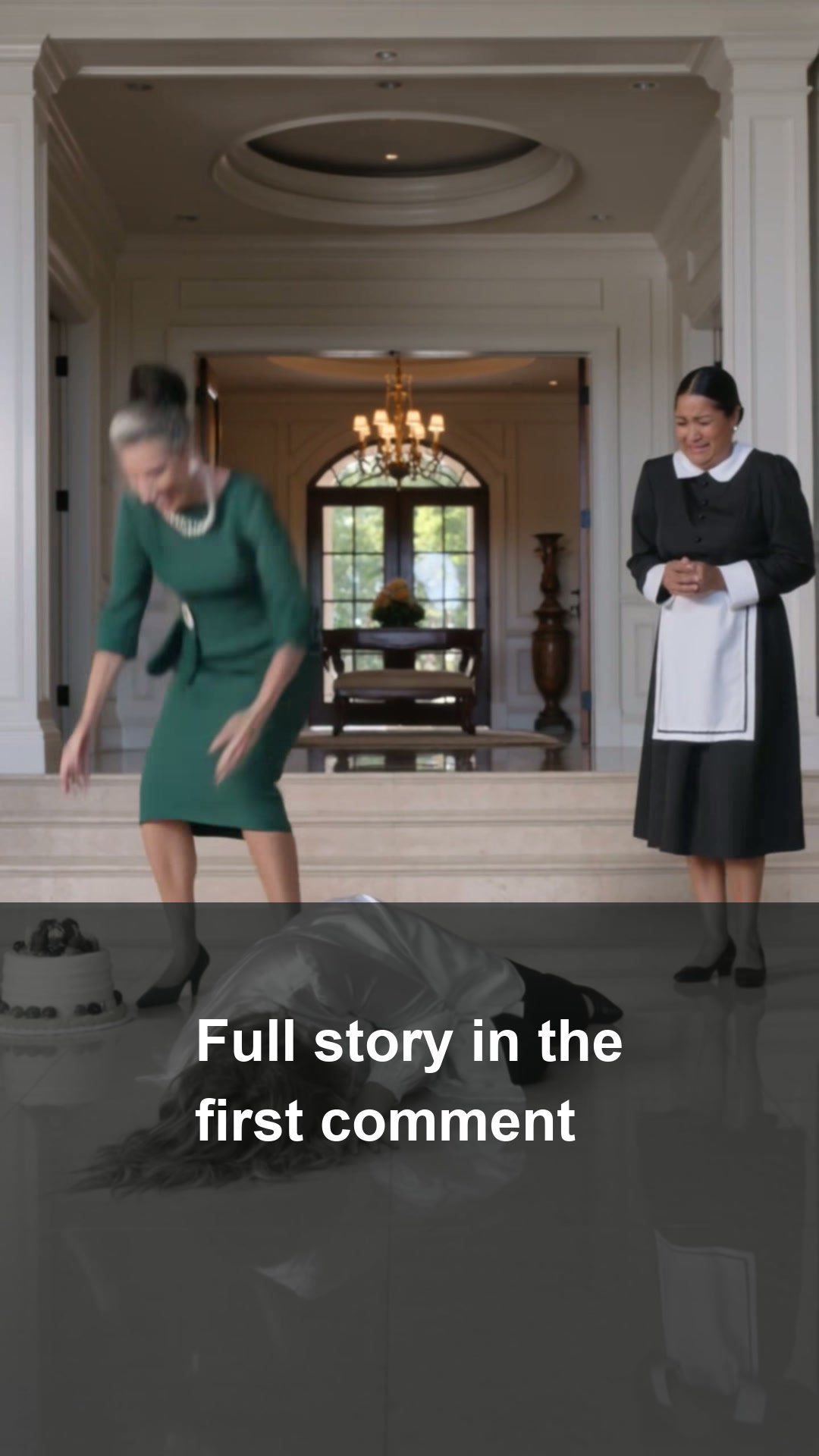
I reached the Sterling Estate’s kitchen by the service entrance, my breath coming in shallow, jagged gasps. The room was unnaturally still. The smell was the first thing to hit me—the cloying, sickeningly sweet scent of vanilla buttercream and the sharp, metallic tang of spilled wine. The marble floor was a carnage of crushed sponge and shattered porcelain. In the center of the debris, Emily sat on the floor, cradling her abdomen, her face bleached of all color.
Margaret stood over her, perfectly composed, clutching a silver serving fork like a conductor’s baton. Her eyes didn’t flicker when I entered. She didn’t look at me; she looked at the wreckage as if it were a structural flaw in a building she had commissioned.
I walked toward them, my shoes crunching into the ruined cake. I didn’t see the mess anymore. I saw the dark, angry welts blooming across Emily’s wrists where my mother’s fingers had dug in, a map of ownership and violence.
Mother, I said. My voice was dangerously flat, devoid of the deference that had defined every interaction we had ever had.
She finally looked up, her lips curling into a thin, rehearsed smile. She was clumsy, Daniel. She ruined the heirloom platter. I was merely helping her regain her footing.
I looked down at Emily. She was trembling, her eyes darting to me with a mixture of terror and pleading. The silence in the room stretched, heavy and suffocating. In that moment, the facade of the Sterling estate—the granite pillars, the lineage, the expectations—crumbled into dust. I didn’t feel the weight of my inheritance or the fear of her disappointment. I felt a cold, crystalline clarity.
I reached down, took Emily’s hand, and pulled her to her feet. My mother’s smile faltered, her grip on the fork tightening until her knuckles turned ivory.
Don’t ever touch her again, I said. I didn’t shout. I didn’t have to. I turned to walk out, my hand firm on Emily’s back. The hook was set; there was no going back to the way things were.
I stepped into the hallway, the marble beneath my loafers feeling suddenly like thin ice. I pulled my phone from my pocket, the screen casting a pale, sickly light against the neoclassical moldings. My thumb hovered over my father’s contact, but I diverted to the estate’s landline.
Dad picked up on the third ring. He sounded tired, the background noise a rhythmic, hollow clacking of golf clubs being arranged in a bag. When I asked him about the incident in the dining hall, he let out a sharp, dismissive huff. Daniel, you’re overreacting, he said, his voice clipped and dry. Your mother was simply adjusting Emily’s posture. She’s worried about the baby’s presentation at the prenatal gala. I stared at a portrait of my grandfather, his painted eyes seemingly locked on the floor where I had just left my wife. I hung up without saying goodbye.
The hotel was my next target. I dialed the concierge, my voice tight as I demanded the security logs from the morning of the gala. The manager, a man who had curated our family’s reputation for twenty years, didn’t hesitate. Mr. Sterling, there are no logs for the east wing, he said, his tone overly practiced. The cameras were being serviced for the upcoming season. I bit my tongue, the metallic tang of rage rising in my throat. I decided then that the estate’s infrastructure was no longer my sanctuary, but a cage designed to hide the rot.
I moved to the solarium, catching Elena, the head maid, as she polished the silver service. She didn’t look up. Her hands were trembling, vibrating against the tray like a moth hitting a window. I asked her what she saw when the cake went down. She froze, then leaned in, whispering so softly I had to lean my forehead against the cool glass of the windowpane. It wasn’t an accident, she murmured, her eyes flicking toward the security cameras in the corners. Your mother didn’t trip, sir. She shoved the chair into the tray before Mrs. Sterling even reached the table. I watched the color drain from her face as she realized what she’d admitted. She looked like a woman who had finally dropped a heavy load, even if it meant her own ruin.
I needed the nurse who had attended Emily the previous week for her migraine. I drove to the clinic, the city blur of neon and rain doing nothing to steady the tremors in my hands. The nurse, a woman named Sarah, looked at the medical chart I’d brought with me. She frowned, tracing the entry for the migraine medication. This isn’t what I prescribed, she said, pointing to the chemical additive listed in the margin. This is a sedative, something used for patients in geriatric wards to keep them still. I felt the floor drop out from under me.
I sat in the idling car for a long minute, watching the windshield wipers struggle against the downpour. Each contradiction was a jagged piece of a puzzle that refused to lock together. My father saw an adjustment, the security systems saw nothing, the maid saw an assault, and the nurse saw a slow, chemical erasure. I realized then that I hadn’t been investigating a single event; I had been mapping a systematic, decade-long dismantling of my wife’s autonomy. I put the car in gear. I wasn’t going back to the estate. I was going to the bank.
The marble lobby of the Sterling Trust smelled of floor wax and old money. My shadow stretched long across the polished stone as I approached the teller’s window, my fingers tracing the cold metal of the key in my pocket. I looked at my reflection in the glass and saw a stranger, someone whose features were hardening into the same sharp lines I had spent thirty years trying to appease. My pulse hammered a steady, rhythmic warning against my ribs. I authorized the transfer of the liquid assets, the movement of numbers on a screen that represented the literal foundation of our family’s influence.
The bank manager looked up, his expression a practiced mask of neutrality, though his eyes darted toward the exit. He cleared his throat. He reminded me of the family’s legacy, of the structural integrity of the Sterling name that would crumble if these funds were moved. I didn’t answer. I signed the documents, the ink bleeding into the paper like a dark, permanent stain.
I left the bank and drove back to the mansion, the engine’s hum feeling like a heartbeat. When I stepped through the heavy oak doors, the silence of the house felt suffocating. Emily was in the kitchen, her back turned to me, staring at the empty marble counter where the cake had sat. My mother stood by the window, a tea cup balanced precariously in her hand, her posture as rigid and upright as a cathedral spire. She turned to greet me, the corners of her mouth twitching into a rehearsed, indulgent smile that didn’t reach her eyes. She started to speak, her voice dripping with that familiar, saccharine concern about my stress levels and Emily’s unfortunate fragility. I walked past her, ignoring the tea service, and stood directly in front of my wife. I looked at the red welts encircling her wrists, the physical maps of my own cowardice. My mother reached out to touch my arm, her fingers cold and trembling. I took your house, I said.
The memory does not begin with a grand betrayal; it begins with the smell of floor wax and the silence that preceded a reprimand. I am seven years old, standing in the foyer of the Sterling estate. My father is a ghost who flickers through the background, his existence defined by the rustle of a newspaper and the closing of a study door. My mother is the air in the room, thin and cold. I have dropped a porcelain soldier on the marble floor. It did not break, but the sound was too loud, a sharp crack against the stifling quiet. Mother appears at the top of the grand staircase, her dressing gown a sharp, violet shadow. She doesn’t shout. She descends slowly, her footsteps rhythmic, each one a hammer strike on my heartbeat. She asks me if I am clumsy, if I am trying to ruin the aesthetic of the entry hall, or if I am simply incapable of grace. I apologize, my voice thin, and she reaches out to smooth my hair, her nails digging into my scalp just enough to leave an imprint. She tells me that mistakes are choices, and choices have consequences. I decide then that the safest path is to be invisible, to become the architecture she demands.
Years later, in the library, I am twelve. I am showing my father a sketch of a bridge, lines of graphite cross-hatched to show structural integrity. He doesn’t look at the paper. He looks at his watch, a silver circle of indifference. He tells me that Sterling men do not build bridges for others to walk across; they own the land the bridges stand on. He stands up, his movements stiff, and walks toward the fireplace. He doesn’t look back when he says that if I want to be useful, I should learn how to manage the ledger, not the drafting table. I feel the bridge in my hand, a fragile thing of lead and paper, and I think that if I just keep quiet, if I just keep performing, he will eventually look at the lines I’ve drawn. I decide to hide the sketches in the back of my desk. I never show him another drawing.
The pattern shifts when my sister, Clara, tries to leave. I am sixteen, sitting on the bottom step of the stairs, listening to the muffled shouting coming from the conservatory. Clara is sobbing, a raw, ugly sound that cuts through the house’s polished veneer. Mother is lecturing her on gratitude, on the cost of the clothes on her back, on the debt she owes for the life she has been granted. I hear a sharp, metallic smack—a heavy book hitting a table—and then silence. When Clara emerges, her face is a mask of bruised resolve, but she stops when she sees me. She whispers that I need to get out, that this house eats people until there is nothing left but hollow shells. She reaches for her coat, but Mother is there in the doorway, a glass of sherry in hand, smiling that smile that curdles the air. She tells Clara that if she walks out that door, she is dead to this family. She makes it sound like a math problem, a simple subtraction of assets. Clara leaves. I stay, rooted to the floor, telling myself that Clara was always too emotional, too volatile. I decide to bury my own anger under a pile of schoolbooks and late-night study sessions.
By the time I am twenty-five, I have mastered the art of the nod. I am an architect now, and I design buildings that are structurally impeccable, designed to withstand any force. I am dating a girl named Sarah, a girl with bright eyes and a laugh that actually fills a room. We are having dinner at the estate. Mother is at the head of the table, her gaze tracking every movement of Sarah’s fork. She asks about Sarah’s father’s business, then pauses, tilting her head as if contemplating a blight on a leaf. She says, Oh, is that the firm that filed for bankruptcy last year? How dreadfully embarrassing for you. Sarah turns a shade of pale that I recognize from my own childhood, the sudden, paralyzing realization that she is being dismantled in front of the help. I say nothing. I focus on my wine, telling myself that Mother is just being honest, just vetting my connections. I decide that Sarah is the problem, that she lacks the thick skin required to exist in this world. We break up two weeks later. I feel a hollow space in my chest, but I fill it with a new project, a high-rise in the city, something tall and impenetrable.
Then Emily arrives. She is different. She doesn’t flinch at the marble floors or the way the staff hovers like ghosts in the periphery. I remember our first week living at the estate, the suffocating atmosphere of the breakfast table. Emily moves a vase of lilies from the center of the table to the side, wanting more light. Mother walks in, her gaze locking onto the vase instantly. She doesn’t speak. She simply walks over, picks up the vase, and moves it back to the exact center, her hands moving with a mechanical, eerie precision. She looks at Emily and says that things have a place here, and when people move them, it suggests a lack of respect for the home. Emily looks at me, her eyes searching for a crack in my resolve. I look away, staring at the steam rising from my coffee. I think about the porcelain soldier, the library, and the way the house expects silence. I tell Emily that it’s just the way things are, that she shouldn’t take it personally. I decide that if I can just keep the peace, if I can just be the buffer, we will be fine.
But the silence is a debt that accrues interest. I watch Mother re-arrange the furniture in our bedroom while we are out, the chairs turned just a few degrees, the art replaced with something older, darker. Each time, Emily tries to reclaim the space, and each time, Mother counters with a saccharine-sweet remark about Emily’s lack of vision or her modern, unrefined tastes. I see Emily’s migraines begin, the way she presses her temples when the front door opens. I see the staff members, like Elena, casting glances at us that are filled with a strange, frantic pity. I see the red marks on Emily’s wrists for the first time on a Tuesday, when Mother has decided that the cake I bought for our anniversary was a waste of calories and an affront to the family’s health. She had pulled Emily toward the kitchen to explain the proper way to host a dinner, her grip tightening until the skin bloomed in angry, crimson crescents. I walked in, saw the marks, saw Emily’s trembling chin, and I felt the tectonic plates of my life begin to shift. I thought about the bridge I never showed my father. I thought about Clara’s voice in the dark. I realized that the house wasn’t just a building; it was an engine, and it had been churning through everyone I ever cared about. I looked at my mother, who was still holding the serving platter, waiting for me to apologize for the interruption, waiting for me to tell Emily that she was overreacting. I saw the entire architecture of my life—the cold, beautiful, rigid design—and I saw the structural failure at the center. I decided that the house had to fall. I walked toward the counter, toward the crushed frosting, toward the woman who had spent thirty years teaching me that love was just another word for ownership. I took the first step, and for the first time in my life, I did not look back to see if she was watching.
I walked into the kitchen, the marble floor cold even through my soles. Elena stood by the industrial sink, her fingers tracing the rim of a porcelain cup until the bone turned white. She was the one who had scrubbed the blood from the nursery floor after the first incident, a woman whose life had been measured in the silence of other people’s secrets. She looked at me, her eyes darting toward the heavy mahogany door where my mother still stood, then back to my hands. She wanted to tell me the truth, but the fear of displacement kept her throat constricted. I moved past her, ignoring the hierarchy she had been trained to worship, and placed a firm hand on her shoulder. It was a small, physical acknowledgment of her humanity, a promise that she was no longer a ghost in this house. She exhaled, a jagged, broken sound, and finally set the cup down. I realized then that she wasn’t just a servant; she was a witness waiting for a leader.
In the dining room, my mother sat at the head of the table, her spine pressed against the velvet chair like a structural steel beam. She was folding a linen napkin, her movements precise, clinical, and entirely devoid of warmth. She had spent decades perfecting this performance of matriarchal elegance, yet she couldn’t hide the flicker of agitation in her jaw. She believed that ownership was a natural law, that because she had birthed me, she had commissioned my life like one of my own blueprints. She looked up as I entered, expecting the usual deferential apology for the mess. I saw the contradiction in her: a woman who demanded absolute loyalty while treating every human being as a disposable asset. I didn’t speak. I simply pulled the chair out from beneath her, the wood screeching against the floor, and watched her poise crumble. She didn’t know how to exist without a stage, and I was busy dismantling the floorboards.
Emily stood by the window, her hands cradling her stomach, protecting the unborn life from the frigid atmosphere of the estate. She was my wife, the woman who had traded her autonomy for a version of domesticity that had nearly erased her. Her strength was hidden in her capacity to endure, a resilience that had been weaponized against her by my own silence. She looked at me, not with the demand for rescue, but with a weary, quiet appraisal. She was waiting to see if I was actually capable of change or if this was just another temporary shift in the weather. I walked to her and took her hands, feeling the lingering stiffness in her wrists where the marks had been. I didn’t say a word, but the shift in my posture—the way I turned my back to my mother—spoke for me. She leaned into me, her sigh of relief vibrating through my chest.
I looked at the house, the vast, hollow rooms that had never known a genuine smile. It was an architectural marvel, and it was a tomb. I decided then that I would not spend another hour pretending these walls were a home. I turned to my mother, who had finally stopped folding the napkin, her eyes narrowing as she realized the dynamic had fractured beyond repair. I told her the carriage would be ready for her in an hour. She laughed, a sharp, brittle sound that echoed in the high ceilings, convinced I was bluffing. I didn’t argue. I simply walked out, leaving the weight of the Sterling legacy to collapse under the pressure of its own arrogance. The hook was set. I walked out into the garden, the air suddenly tasting of rain and possibility, knowing the foundation was finally moving.
I stood on the gravel path of the estate, my phone heavy in my palm. The silence of the garden was absolute, save for the crunch of my own footsteps. I didn’t look back at the mansion. I opened my banking app, the interface cool and clinical. With a few taps, I froze the secondary accounts, effectively severing the financial umbilical cord my mother had used to manipulate every aspect of our household expenditures. I watched the status bars turn from green to grey. It was a digital guillotine. My heart hammered against my ribs, a frantic, syncopated rhythm. I was burning the bridge while I was still standing on it, but the fear was eclipsed by a sudden, cooling clarity.
I walked to my car and drove to the precinct. The air inside the station smelled of floor wax and stale coffee. I sat across from an officer whose nametag was skewed, the fluorescent lights buzzing overhead like an angry wasp. I laid out the specifics: the documented incidents of harassment, the physical intimidation of my wife, the clear, undeniable pattern of psychological abuse. When the officer asked for proof, I handed over a thumb drive containing recordings Elena had provided—the audio of my mother berating Emily in the kitchen, the calculated threats, the chilling, calm malice that stripped away the facade of the elegant matriarch. As the officer typed, his fingers heavy on the keys, I felt the gravity of the paperwork. This was no longer a domestic dispute. This was a state record.
That evening, I met with Marcus, a shark of a lawyer whose office overlooked the harbor. I pushed the family trust documents across his mahogany desk. The paper felt like vellum, thin and fragile. I told him I wanted to contest the entire structure of the Sterling inheritance, specifically the clauses that tethered my autonomy to my mother’s approval. He looked at me over his spectacles, his expression unreadable. He told me the fallout would be catastrophic, that my mother would go scorched earth. I simply nodded and signed the retainer, authorizing him to file for an injunction against her interference. When I left, the city lights blurred into streaks of gold and red. The decision was irreversible.
The next morning, I arrived at the office early. My assistant, Sarah, looked up, startled, as I strode toward HR. I walked past the mahogany doors of the executive suite, my pulse steadying. I filed the formal complaint against the staff members who had been acting as my mother’s spies, providing evidence of their illicit surveillance. By noon, three of them were escorted out of the building. My phone began to vibrate—a relentless, stuttering pulse. My mother. I didn’t answer. I sent a single text: The locks are changed. Do not return to the estate.
The reaction was immediate. A notification from the security firm flashed: an unauthorized attempt to access the mansion’s keypad. My mother was at the gate. I envisioned her there, standing in the rain, the fine wool of her coat soaking through, her face a mask of shocked indignation. She had never been denied entry. She had never been ignored. The thought brought a grim satisfaction that tasted like iron. I blocked the number.
I arrived at home to find Emily sitting on the nursery floor, painting a swatch of warm, soft yellow on the wall. She looked up, her eyes wide, uncertain. I told her what I had done. I told her about the police, the lawyer, the accounts, the locks. She didn’t cry. Instead, she stood up and walked over to me, her hand resting on her stomach. The silence in the room was no longer the heavy, stifling quiet of the Sterling estate; it was the quiet of a room that finally belonged to us.
Then, the doorbell rang. It wasn’t the polite, rhythmic chime of a visitor. It was a sustained, aggressive assault on the button. My mother’s voice carried through the heavy oak door, muffled but unmistakable. She was screaming, a sound devoid of grace, stripped of the poise she had spent decades curating. She demanded to be let in. She threatened me with disinheritance, with social annihilation, with the destruction of everything I had built. She sounded small. I looked at the security monitor mounted by the door. She was pacing the porch, her hair disheveled, her hands clawing at the stone frame.
I turned back to the nursery. I took the brush from Emily’s hand. The yellow paint was vibrant, defiant against the cold, gray history of the house. I dipped the brush and added a long, clean stroke across the baseboard. I knew that by morning, the news would be everywhere. The Sterling name, once synonymous with iron-clad prestige, would be dragged through the mud of the social columns. My mother would be calling in favors, mobilizing the board, trying to exert a control that had already evaporated. She would fight, and she would lose.
The doorbell stopped. The silence that followed was heavy, a vacuum waiting to be filled. I walked to the window and looked out. She was standing at the edge of the driveway, looking up at the house, her silhouette framed by the encroaching dark. She pulled her phone from her purse, her fingers moving with a frantic, stuttering motion. I knew what she was doing. She was calling the board, she was calling the bank, she was calling the world to witness her grievance. I closed the curtains, shutting out the sight of her, and locked the bedroom door. For the first time in my life, I didn’t care what she said. I had replaced the foundation, and now, the house was finally mine to hold. The storm was here, but for once, we were inside, and the walls were solid.
The morning sun did not bring clarity, only the frantic vibration of my phone against the cool granite of the kitchen island. I ignored the screen, watching Emily trace the vein of a knot in the wooden table, her breath shallow. Every notification pinged like a hailstone against a tin roof. The Sterling board had sent a formal inquiry regarding the sudden, unexplained freezing of the estate’s secondary accounts. Beneath that, a deluge of texts from mutual friends—some offering guarded sympathy, others demanding an audience. The narrative was shifting; in the eyes of the elite, I wasn’t a man protecting his wife, I was a son committing professional and social suicide.
I picked up the phone. A message from Julian, my lead contractor, sat at the top. He had pulled the crew from the renovation site at the mansion. He didn’t ask why; he simply stated that my mother had arrived with legal counsel and an injunction, claiming the structural work I’d authorized was a violation of the estate’s historical preservation charter. She wasn’t just fighting for her ego; she was weaponizing the architecture I had spent my life perfecting.
Emily looked up, her eyes rimmed with exhaustion. Is it everyone? she asked, her voice barely a tremor.
I set the phone face down. It doesn’t matter who it is.
It does matter, she countered, tapping the edge of her tablet. The school board president had already emailed, questioning the stability of our family environment for the upcoming enrollment period. It was a veiled threat, a reminder that in this social strata, public perception was the only currency that carried weight. Margaret was painting me as unstable, a man who had suddenly lost his mind to a vengeful, pregnant wife.
I felt a cold, hard knot of resolve tighten in my chest. I opened the pantry, pulling out a bag of flour and a carton of eggs. I needed to do something that wasn’t a calculation or a defense. I began to measure out the ingredients, the white dust coating my knuckles. I was thirty-two years old, and I was learning to build something that didn’t require blueprints or permits—just sustenance.
My phone rang again. A solicitor. I let it go to voicemail. The sound of the whisk against the bowl became the only rhythm that mattered. Outside, the world was fracturing; the neighbors were likely gathering on their manicured lawns, watching the black sedans come and go from my mother’s driveway, speculating on the exact nature of the rot they had always suspected but never named. I imagined them dissecting our lives like specimens on a glass slide.
I felt the sudden weight of the cost. I was burning my bridges, not just with my mother, but with the entire architecture of my past. My career would suffer; my standing in the firm would be scrutinized by the very board members I had once sat with over expensive wine. But as I watched Emily reach out to touch the side of the bowl, her smile hesitant and fragile, the cost felt like a bargain.
I reached for the sugar, pouring it carefully. We were becoming pariahs, but we were becoming our own. I wouldn’t answer the board. I wouldn’t answer the lawyers. I reached for the oven dial, turning it until the internal light glowed, warm and steady. Let them talk. Let the mansion stand empty and the bank accounts remain locked. The fire was coming, but it was coming for the house of cards, not us. I turned to Emily, offering her the wooden spoon. Let’s finish this, I said. We have a new floor to lay, and I don’t care how long it takes.
The legal documents sat on our new kitchen table, a modest slab of oak that lacked the cold, veined indifference of the Sterling marble. I slid the final release form across the grain, the ink still wet. Margaret had refused to sign the waiver for three months, banking on my exhaustion, but the silence of the estate had finally broken her. She wanted the status of the name more than she wanted the boy, and now, she would have both in isolation. The mansion was officially an empty vessel, its keys surrendered to the realtor that afternoon.
Emily traced the edge of the paper, her thumb lingering over the notarized signature. She didn’t look up, but her breathing had lost that sharp, shallow hitch I’d grown to dread. The divorce decree from the estate’s entanglement was settled; we were no longer shareholders in my mother’s performance.
I stood up, the chair scraping against the hardwood—a sound that, in the old house, would have sent staff scurrying to apologize for the noise. Here, it was just wood on wood. I walked to the window. The sun caught the dust motes dancing in the air, unfiltered by heavy velvet curtains. I thought of the heavy, suffocating scent of lilies that used to define our Sundays, replaced now by the smell of toasted flour and morning coffee.
I’m leaving the remaining keys on the mantle, I said.
Emily finally met my eyes, her expression soft, devoid of the watchful anxiety that had defined her expression for years. She nodded, setting the pen down with a decisive click. She walked over to the nursery door, which was painted a pale, muted sage—a color I had chosen because it reminded me of a forest floor, not a catalog. She pushed it open, revealing the crib we had assembled ourselves, every screw tightened by our own hands.
The silence that followed wasn’t the heavy, watchful void of the estate. It was the quiet of a life reclaimed. I thought of the blueprints I was drafting for our future—small, structural, sound. I didn’t need to ask if she was ready; the way she leaned against the doorframe, relaxed and present, was answer enough. I reached out, taking her hand, feeling the steadiness in her palm. We were done with the theater.
I looked at the counter, where a single blue sugar flower sat on the oak. It was a remnant of our first attempt at a cake, imperfect and slightly lopsided, yet entirely ours. I picked it up, watching the light catch its edges. The past was a locked room now, and we had tossed the key into the sea. We turned toward the nursery, the floorboards creaking under our feet, a sound that finally felt like home.
We didn’t paint the nursery blue or pink. We chose a soft, muted sage, the color of the salt-crusted succulents that clung to the dunes near our new cottage. I held the roller, my arm aching, while Emily sat on a drop cloth, sorting through a pile of secondhand onesies. The silence wasn’t heavy; it was a physical weight, clean and breathable, like the air after a storm.
I stopped mid-stroke, staring at the empty corner where a mahogany crib might have gone in my mother’s house. Here, there was just the window. I watched a goldfinch land on the sill, its feathers brilliant against the gray afternoon.
“The light is different here,” Emily said, not looking up from the tiny cotton shirts. She smoothed a crease in a yellow sleeper. “It doesn’t feel like it’s being filtered through glass anymore.”
I wiped a smudge of paint from my forehead, feeling the grit of it, the reality of manual labor. “It’s just sun, Em. No velvet drapes.”
She hummed, a low, melodic sound that settled in my chest. She wasn’t holding her breath anymore. I watched her shoulders, finally dropped from the permanent, agonizing height they had held for years. She reached for a pair of baby socks, turning them over in her hands as if she were learning the shape of a new language. I realized then that she hadn’t touched a sleeping pill in three weeks.
I leaned the roller against the wall and sat beside her on the floor, the wood cool beneath my jeans. I took her hand, tracing the faint, fading line of a scar on her wrist with my thumb. It was a map of a place we no longer lived.
“Hungry?” I asked.
She looked at me, her eyes clear and steady. “Let’s make that pasta. The one with too much garlic.”
There was no one to please but ourselves. I stood up, offering her my hand, and the front door clicked open to the sound of our new dog barking a clumsy, joyful welcome.
I walked to the kitchen, leaving the echo of my mother’s name behind like a discarded coat. The morning sun hit the pine table, illuminating the grain instead of the cold, reflected glare of the marble we had left behind. I swept a stray grain of salt into my palm, feeling the grit of a life now entirely our own. Emily watched from the doorway, her shoulders finally dropped, unburdened by the weight of an unseen observer. I reached into the cupboard and retrieved a small, ceramic bowl, placing it carefully on the wood. Inside sat a single blue sugar decoration, salvaged from the ruins of our old life. It rested there, vibrant and intact, against the warm, unfinished grain, unmarred by shattered glass or the crushing reach of someone else’s expectations.
Leave a Reply