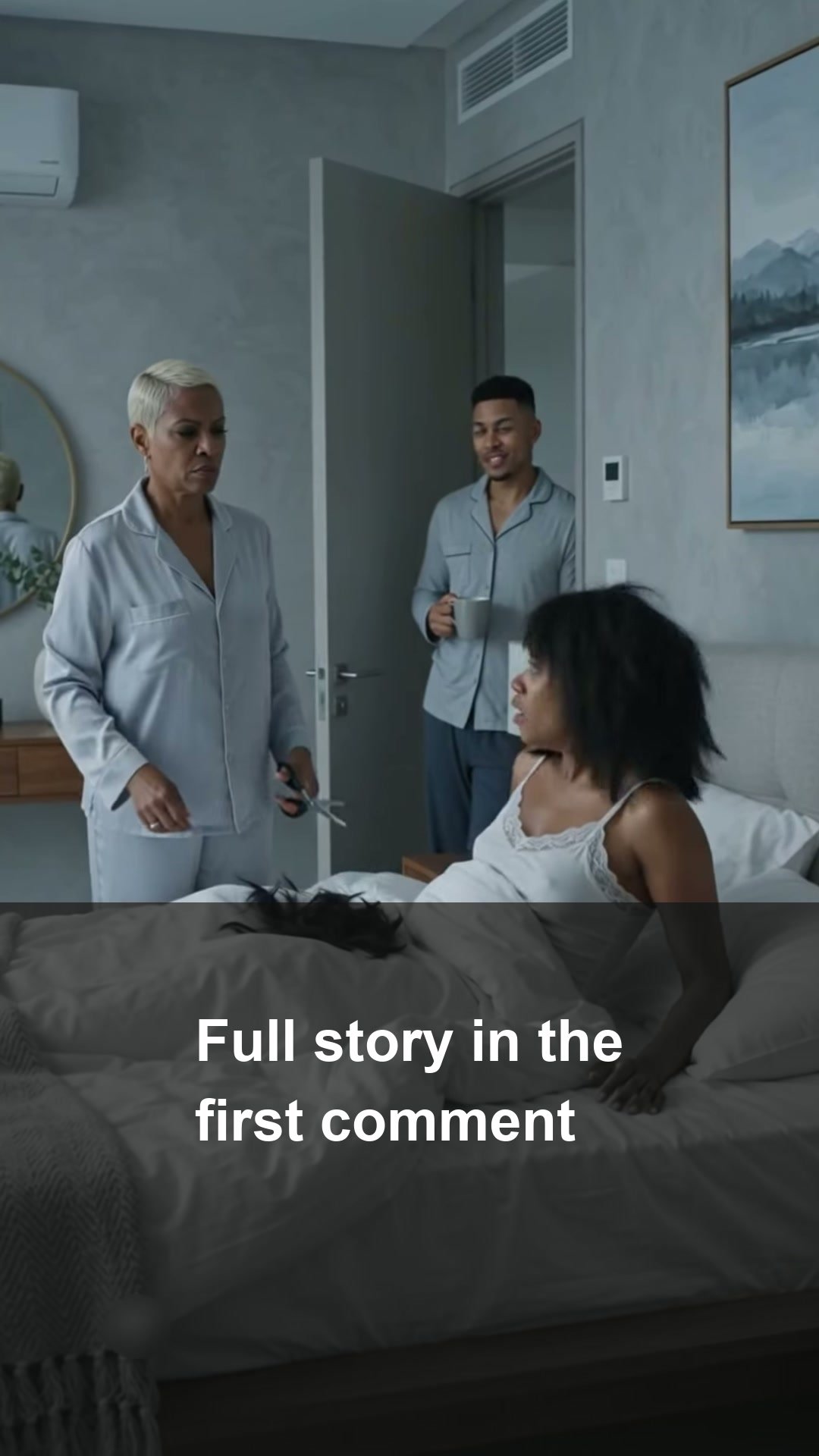
Three days after my husband watched his mother scalp me to teach me a lesson, he was on his knees begging me to delete the footage. The kitchen floor tiles were cold, radiating a subterranean chill through my leggings as I stood over him, my hand hovering near the smart-hub controls. Ryan’s eyes were bloodshot, tracking the red blinking light of the cloud-upload indicator on the wall panel. He smelled of scotch and expensive cologne, a sensory dissonance that made my stomach turn.
“Claire, please,” he rasped, his fingers clawing at the hem of my shirt. “Mom didn’t mean it. It was a lapse in judgment.”
I didn’t blink. I focused on the way his pulse jumped in his neck, a rhythmic marker of his impending obsolescence. My scalp throbbed with a dull, white-hot rhythm where the shears had bitten into my skin, but I felt nothing for him. Not pity. Not rage. Just the clinical satisfaction of a completed threat assessment.
I let my hand drop to the counter, my fingers brushing the cold steel of a backup drive. I had already encrypted the master files. I reached out and tapped the ‘Save’ button.
The digital clock on the bedside table flickered to 5:30 AM, casting a pale, rhythmic pulse against the eggshell walls of the bedroom. I watched the dust motes dance in the sliver of light from the hallway, my eyes tracking their patterns with the same detachment I applied to server logs. The routine was mechanical, a series of pre-programmed actions designed to maintain the equilibrium of a life that felt increasingly like a simulation. I rolled out of bed, my feet hitting the cool hardwood with a precise, synchronized thud.
In the kitchen, the espresso machine groaned, a familiar, grinding protest that preceded the steady drip of dark liquid. I stood at the marble island, watching the steam rise in thin, translucent ribbons. The silence of the house was absolute, punctuated only by the distant, muffled hum of the refrigerator. I stirred the coffee, the silver spoon ringing against the porcelain mug—a clean, sharp sound that served as a metronome for the morning. I drank it black, bitter and hot, letting the heat settle in my chest as I stared out the window toward the manicured lawn of the cul-de-sac.
The drive to the office was an exercise in predictability. I took the same turns at the same intervals, my hands resting at ten and two on the leather steering wheel. The sky was a flat, uninspiring gray, the color of a screen before the OS loads. When I reached the office, I walked past the communal printer, which was currently jamming on a stack of inter-departmental memos.
Hey, Claire, you coming to the team lunch today? Sarah asked, her voice bright and brittle. She was standing by the copier, her fingers stained with blue toner.
I paused, calculating the social cost of a refusal. Maybe, I said, checking my watch. Depends on the backlog.
The office air was recycled, chilled to a constant sixty-eight degrees to keep the hardware from overheating. I sat at my desk, the glow of three monitors illuminating my face in a pale, sterile light. I spent the morning clearing alerts, flagging anomalies, and mapping the flow of data through the network. It was the only part of my day that made sense—everything had a source, a destination, and a reason for being where it was.
By eleven, the small talk in the breakroom had reached its peak. Someone was complaining about the erratic weather, another about the rising cost of property taxes in the district. I sipped my water, nodding in the right places, my expression carefully composed into a mask of mild, professional interest. I was a ghost in my own life, a spectator observing the fragile scaffolding of suburban normalcy.
Back at my desk, I felt the familiar weight of the day pressing down, a dull pressure behind my eyes. I reached for my phone, scrolling through the headlines—the usual mix of market shifts and local news. I was just about to close the tab when the device vibrated against the mahogany surface, a low, persistent buzz that vibrated through the wood.
The screen flashed a notification, a sharp, uninvited intrusion into the quiet geometry of my morning. I stared at the name, my thumb hovering over the glass.
The vibration ceased, leaving the desk feeling unnervingly solid. I did not pick up the phone. Instead, I watched the black screen reflect the sterile, recessed lighting of my home office, a space I had designed for precision, not for this. Diane was in the foyer. I could hear the rhythmic click of her heels against the marble—a sound like a metronome counting down to a deadline I hadn’t set.
She walked in without knocking, the scent of expensive lilies and floor wax trailing behind her. She didn’t look at me; she looked at the walls, at the perimeter of the room, her eyes tracing the line where the crown molding met the ceiling.
Claire, you haven’t finished the signatures for the asset re-allocation, she said, her voice smooth, devoid of the jagged edges I knew were hiding underneath. Ryan is waiting in the study. He’s quite insistent today.
I stood, my chair rolling back with a soft, mechanical whine. The discrepancy in the ledger wasn’t a mistake. It was a pattern. I had spent three weeks mapping the flow of the household accounts, tracing every decimal point until the narrative emerged: a slow, deliberate starvation of my personal liquidity.
I’m not signing, I replied, my voice holding the flat, clipped cadence of a diagnostic report. The numbers don’t align with the initial trust agreement.
Diane stopped moving. She stood in the center of the room, her hands folded over a leather-bound portfolio. The silence stretched, tight as a wire. She turned her head slowly, a predatory movement, and smiled. It was a brittle, sharp thing that didn’t reach her eyes.
You’ve always been so obsessed with the details, dear. It’s such a tiresome trait.
She stepped forward, invading the negative space between us. I smelled copper. Not blood, not yet, but the metallic tang of an electrical short—the sound of the smart-home hub in the hallway cycling through an unauthorized reboot. My cameras were going dark. Every single one of them.
Ryan joined her in the doorway, his face pale, his jaw locked in a way that signaled he had already rehearsed his part in the scene to come. He didn’t look at me; he looked at the floor, his hands shoved deep into his pockets. He was the accessory to his own betrayal, a man leaning on his mother because he lacked the weight to stand alone.
We aren’t asking, Claire, Ryan muttered, his voice cracking on the final syllable.
I looked at the heavy, silver-plated letter opener on my desk. It was an aesthetic choice, a relic of a career I was rapidly being written out of. I calculated the distance to the door, the time it would take for the motion sensors to recalibrate, and the cold, hard fact that I was already trapped.
I reached for the phone. My fingers tapped a pre-configured sequence, a digital flare fired into the dark.
Don’t, Diane whispered, and for the first time, she moved with violence.
The phone buzzed against the mahogany desk, a sharp, incongruous vibration that cut through the stagnant air of the study. I didn’t look at Ryan. I looked at the call display: The Willowbrook Care Facility. Diane’s hand hovered, her knuckles white, before she snatched the phone away. I stood up, my pulse a rhythmic, clinical count against my throat. I didn’t need the device. I had the server logs mirrored on my private cloud. I walked out, the house sensors clicking in sequence as I passed through the hallway, tracking a ghost.
I sat in the driveway, the leather of the driver’s seat pressing against my back like a cold hand. I dialed the head nurse, Elena. The line clicked twice before the silence of a hospital corridor filled the receiver.
She wasn’t here, Claire, Elena said, her voice thin and tired. She was discharged three hours ago. Your husband authorized it.
I gripped the steering wheel until the grain bit into my palms. My father had always told me that memory was a unreliable witness, but data didn’t lie. Ryan told me she was in emergency surgery.
He didn’t sign the papers, Elena continued, a sudden tremor in her tone. Diane signed them herself, but she couldn’t have held a pen. Her tremors were at stage four.
I disconnected. The dashboard clock flickered 03:14 AM. I drove toward the hotel downtown, the tires humming against the damp asphalt of the gated community. I pulled into the valet lane, the fluorescent lights humming overhead. The clerk, a young man with a name tag askew, stared at my reflection in the glass partition.
Mr. Vance checked in alone, he said, his eyes flicking to my scalp, then quickly away. He asked for the bridal suite. He said his wife was at the airport.
I leaned closer, the scent of industrial cleaner biting my nostrils. I didn’t ask about Ryan. I asked about the woman he brought in at midnight.
Oh, the clerk stuttered, the color draining from his face. That wasn’t a guest. That was a delivery. A medical transport van dropped off a pallet of electronics. They told us it was high-end equipment for a private firm.
I walked back to the car, the air heavy with the scent of pine and exhaust. My hands didn’t shake. I pulled up the security feed from the hotel’s outer perimeter on my tablet. The frame was grainy, a ghost-image of a black van with no plates. It wasn’t equipment. It was the server rack from my home office, the one that held the backup of the deed forgery.
I hit the gas. Every contradiction was a breadcrumb. Ryan claimed Diane was in surgery; the hospital claimed she was discharged by a ghost; the hotel claimed my office was now sitting in their basement. I reached for my burner phone and dialed Marcus Thorne.
Claire, he answered immediately, his voice devoid of sleep. I’ve been looking at the property tax records you sent.
They’re changing in real-time, Marcus, I said, watching the city lights blur into streaks of white and red. I’m not just being erased from the house. I’m being erased from the record of my own existence.
He went quiet. The silence was the sound of a lawyer calculating the worth of a sinking ship.
I have a witness, I added, my voice steady, though the road ahead felt like an abyss. A nurse who saw the hand that didn’t hold the pen.
Marcus exhaled, a sharp, jagged sound. Get to the safe house, Claire. If they’re moving that hardware, they aren’t hiding assets anymore. They’re burning the evidence.
I didn’t answer. I hung up and turned the car toward the industrial park where the transport van had originated. The investigation was no longer about the house. It was about the architecture of my own disappearance. I accelerated, the needle climbing, the city falling away into a landscape of cold, hard facts.
The van sat under a flickering sodium light at the edge of the logistics lot, its rear doors agape like a throat. I pulled my sedan behind a rusted shipping container, the smell of damp concrete and ozone biting into the cab. My laptop sat on the passenger seat, the screen radiating a faint, clinical blue glow. I opened the encrypted folder, watching the footage from the smart-home’s master bedroom—the one Ryan thought he had wiped clean forty-eight hours ago. There, in high definition, was the sight of my own scalp beneath his mother’s frantic, trembling hands.
I didn’t blink. I zoomed in on the timestamp, then cross-referenced the server logs I had scraped from the smart-hub. Ryan walked into the frame, his face a mask of performative concern that curdled into a cold, transactional sneer as he handed Diane the shears. I touched the screen, tracing the curve of my own neck, feeling the phantom itch of dead skin and shock. I was a vulnerability in his system, a glitch he had tried to patch with blood.
My phone vibrated. It was Ryan. The ringtone, a song we had chosen together when we were still playing the parts of a functional marriage, sounded dissonant against the hum of the cooling fan. I tapped accept and held the phone to my ear, keeping the laptop screen visible in my peripheral vision.
Claire, he started, his voice thick with the practiced tremor of the betrayed. Where are you? The house is a mess, and the cleaners—they found the security logs. Just come home. We can fix this if you delete the files. We can go back to how it was.
I looked at the image of the shears, then back at the dark, empty lot. He wasn’t apologizing; he was asking me to stop existing.
I have the footage, Ryan, I said.
He went quiet. I watched him through the lens of the data, his hand hovering over a blade. I didn’t love you, he whispered.
The kitchen of my childhood home was always cold, the linoleum pulling heat from my bare soles while my mother stood at the stove, stirring a pot of soup that smelled perpetually of burned onions. She never turned the burner down, a small, reckless oversight that left the kitchen perpetually hazy. I was ten, holding a report card that bore a perfect row of A’s, the crisp paper feeling like a shield in my damp palm. My father sat at the table, his newspaper acting as a physical wall between his chair and the rest of the room. He didn’t look up when the soup boiled over, hissing against the hot element. I stood there, waiting for the recognition that never came, watching my mother scrape the charred residue into the sink with a violence that made my teeth ache. She didn’t look at me either, her focus entirely on the ruin of the meal. I learned then that excellence was not a currency that purchased affection; it was a nuisance that required correction. I walked back to my room, folded the report card into a neat square, and pushed it deep into the drawer under my socks, realizing that if I didn’t announce my successes, I wouldn’t have to witness the disappointment of them being ignored.
Years later, at the university library, the silence felt different. It was heavy, weighted with the expectations of a career I hadn’t yet defined. I was hunched over a server architecture diagram when Ryan leaned over my shoulder. He smelled like expensive cologne and arrogance. He didn’t ask if the seat was taken; he just pulled it out, the screech of metal against tile drawing a glare from the librarian. He asked if I was going to finish the project or just stare at it until it solved itself. I looked at his hands—clean, manicured, the hands of someone who had never had to scrub a pot—and I felt a flicker of annoyance, not attraction. I told him the architecture required a logic I wasn’t sure he possessed. He laughed, a low, resonant sound that felt designed to disarm, and suggested we grab coffee. I went, not because I liked him, but because the challenge of dismantling his confidence seemed like a better use of my time than finishing my homework. We sat in a booth where the light hit his face at an angle that made his eyes look perpetually searching. He told me his mother was a formidable woman, the kind who measured a person’s worth by the company they kept, and he said it like a warning he was proud of. I should have heard the possessive edge in his tone. I should have seen the way he checked his watch every ten minutes, not to see the time, but to ensure he was still the center of the room’s gravity.
My wedding day was held in a garden that Diane had insisted on, despite the threat of rain. The air was thick with the scent of damp earth and forced civility. I wore a dress that felt like a costume, the silk heavy and restrictive against my skin. Diane stood near the altar, her eyes tracking every movement I made, her lips pressed into a thin, white line. When the officiant asked for objections, I saw her hand tighten around her clutch, the leather groaning under the pressure. I looked at Ryan, expecting him to be watching me, but he was looking at her, waiting for a signal, a nod, a permission. My heart did a strange, rhythmic stutter, but I rationalized it as nerves. I stepped forward, accepting the ring, thinking that the institution of marriage was a contract I could optimize, a system I could manage with the same precision I applied to code. I didn’t realize then that I had volunteered for a perimeter breach. I had invited the threat inside the firewall, thinking I was the one holding the administrative credentials.
Six months into the marriage, the first document went missing. It was a lease agreement for my office space, something I’d left on the mahogany desk in the study. I found it in the shredder, the paper confetti mimicking the pattern of a winter storm. When I asked Ryan about it, he didn’t look surprised. He was adjusting his cufflinks, his movements fluid and rehearsed. He told me he’d reorganized the files, that the office wasn’t a place for business, it was a place for us to sit and talk. He said it with a smile that didn’t reach his eyes, a mimicry of intimacy that I had started to recognize as a tactical withdrawal. I went to the desk, opened the drawer, and felt the hollow space where my autonomy had been. I didn’t confront him. I started a secondary folder, hidden behind an encrypted partition on my laptop, logging every small erasure: the missing keys, the redirected mail, the subtle shifts in our bank account access. I was documenting my own disappearance, acting as the auditor of my own life while he played the part of the devoted, slightly clumsy husband who just wanted me to be more present.
I remember a dinner party where the topic turned to finance. Diane was holding court, explaining how a wife’s role was to be the keeper of the hearth while the husband navigated the external world. She looked directly at me, her gaze predatory, and asked if I missed working. I told her I didn’t miss it because I hadn’t left it; I was still consulting, still building. The silence that followed was surgical. Ryan’s hand rested on my knee, his grip tightening until the skin bruised. He didn’t say a word, but his posture shifted, leaning away from me as if I had become contagious. Later, in the car, he told me I had embarrassed him. He didn’t mention the lie I’d told—the lie being that I was still in control—he focused on the social failure. He said I was too much, too sharp, too insistent on taking up space that wasn’t mine to claim. I looked out the window at the passing streetlights, their repetitive flicker matching the tempo of his voice, and I realized he wasn’t teaching me a lesson; he was stripping my wiring.
The warning signs were constant, yet I framed them as technical bugs. When the smart-home thermostat started dropping to forty degrees in the middle of the night, I assumed it was a system glitch. When the cameras would cycle through their reboot sequence at 3:00 AM, I assumed it was a firmware update. I told myself that I was being paranoid, that the security expert in me was looking for vulnerabilities where there were only inconveniences. I even installed an extra layer of encryption on my files, feeling a smug sense of satisfaction that I had accounted for the danger. I was playing a game of chess against an opponent who had already set fire to the board. I was in the library of our home, watching the sun rise, the grey light washing over the leather-bound books that no one ever read. I realized that my life had been segmented into small, manageable traps, and I had walked into every single one of them with my eyes wide open, analyzing the mechanism as it clicked shut around my ankles. I had wanted a partner, but I had married a vulnerability. I had wanted a family, but I had been adopted by a predator. I stood up, walked to the window, and saw Diane’s car pulling into the driveway, her routine as clockwork as the sunrise. I didn’t feel fear. I felt a cold, clinical clarity. The erasure wasn’t a tragedy; it was a process, and I had finally stopped being the subject and started being the observer. I turned back to the laptop, the screen reflecting the pale, determined set of my own jaw, and I began the final backup. It was time to show them exactly what happens when you try to delete a master file.
The kitchen island served as my command center, its marble surface cold against my forearms. I pulled up the metadata logs from the hallway cameras, my fingers dancing across the keys with a rhythmic, mechanical efficiency. Ryan entered the room, his gait loose, the practiced nonchalance of a man who believed his transgressions were invisible. He reached for the coffee carafe, his hand lingering near the spot where Diane had left her floral-print scarf only hours prior. He looked at me, a flicker of genuine confusion crossing his face when he saw the lack of trembling in my hands. I wondered if he remembered his own father, a man who built an empire on transparency, or if he had successfully buried that memory under the weight of his mother’s stifling approval. I kept my gaze fixed on the monitor. You’re up early, he said, his voice dropping into that smooth, condescending register he used when he wanted me to believe I was losing my mind. I didn’t answer. I focused on the footage of Diane, her spine rigid as she moved through the living room, a woman who clung to tradition with the ferocity of a drowning person clutching an anchor. She believed she was protecting her bloodline, oblivious to the fact that her every calculated move was being indexed by the system she had paid to install. I thought of Sarah, my friend, who had once warned me that my independence was a target, a bitter irony from a woman who built her entire career on teaching victims how to hide. I processed a clip of Marcus Thorne, my attorney, whose files were buried deep in my drive. He was a man who lived for the moral gray, someone who viewed the law not as a shield for the innocent, but as a scalpel for the corrupt. He wanted this case for the notoriety, a ladder to climb out of the mid-tier firm where he felt stifled. His motives were as selfish as my husband’s, but his target was larger. I tapped the export command, the progress bar creeping forward like a countdown. Ryan walked closer, his shadow falling over my keyboard. The silence in the room wasn’t peaceful; it was heavy, filled with the static of things left unsaid and crimes currently being committed in real-time. I remembered the day we bought this place, the way he promised me we were building a future, while simultaneously ensuring my name was scrubbed from the deed. He was a man who built his identity on the theft of others, a hollow vessel fueled by the fear of never being enough. I felt a sudden, sharp urge to laugh, but I suppressed it, anchoring myself in the clinical reality of the data. My decision was fixed: I would let them push until the momentum of their own arrogance forced them into the open. I minimized the window, leaving the folder titled “System Vulnerabilities” open on the main screen, and turned to face him. He didn’t look at the screen. He looked at my hair, still jagged and uneven where the shears had caught. Tell me, Ryan, I said, my voice as steady as a heartbeat, do you know what happens when a system detects a breach it can’t patch? He blinked, his composure fraying at the edges. I turned back to the screen, watching as the final file uploaded to the cloud, a silent indictment waiting for its moment to strike.
The fluorescent lights of the police station lobby hummed with a low, nerve-fraying frequency. I pushed the manila envelope across the scarred laminate counter, my fingertips brushing the cold plastic of the intake tray. The officer behind the glass, a man whose name tag read Miller, barely glanced at the file before I spoke. I want to file a report for domestic assault and forgery, I said, my voice clinical and devoid of the tremors that had plagued me for weeks. He sighed, the sound heavy with indifference. He pulled a form from a stack, the paper crisp and demanding. As I detailed the events, the scratch of his pen sounded like a guillotine. He didn’t look up when I described the shears or the night Diane had stood in the doorway, her smile as sharp as the steel she held. I felt the weight of the truth shifting from my shoulders to the bureaucracy. I decided then that I would not wait for an invitation to fight back. I walked out into the humid air, the sudden silence of the parking lot feeling like a reprieve.
By the time I reached the bank, the adrenaline had settled into a cold, focused resolve. I sat in a velvet-lined office, the manager’s nameplate reading Henderson. I slid my laptop across the mahogany desk, opening the banking portal. I need to cancel all joint authorizations and freeze the liquidity on these accounts, I stated. Henderson looked at the screen, then at me. You realize this will trigger an immediate notification to the primary account holder? he asked, his tone dripping with patronizing caution. I checked my watch. That is the objective, I replied. He tapped his keyboard, his lips thinning as he processed the request. I watched the status bars shift from active to restricted, the symbols of our shared life evaporating in a series of digital clicks. I chose to keep my gaze fixed on the window overlooking the street, anticipating the inevitable call from Ryan.
The meeting with Marcus Thorne took place in a glass-walled conference room that smelled of dry-erase markers and expensive leather. I laid the evidence folders out in a perfect grid. Thorne, a man who viewed litigation as a blood sport, flipped through the documents with an appreciative hum. You understand the risk? he asked, leaning back. Once we file the contest to the will and move for an emergency injunction on the deed, there is no reconciliation. I nodded. My decision was absolute. I want them gutted, I said. Thorne smiled, a thin, predatory curve of his mouth. He began drafting the motion, the sound of his printer echoing in the hallway like a countdown. My phone vibrated against the table, a frantic stream of messages from Diane. I didn’t open them. I simply swiped them into the trash.
Back at the office, the HR department felt like a sterile cage. The manager, a woman named Elena who favored beige cardigans and corporate platitudes, sat across from me. I placed the formal complaint on her desk, citing Ryan’s abuse of company resources to surveil me. She looked distressed. Claire, this is a serious allegation against an executive, she whispered, looking toward the glass door. I know, I said. I handed her the encrypted drive containing the logs of his unauthorized access into my secure network. I have documented every instance. She reached for the drive as if it were burning, her hands shaking slightly. I stood up, feeling the immense satisfaction of a breach successfully exploited. As I walked out, I saw Ryan’s assistant hovering near the elevators, looking panicked. I kept my stride even, my eyes fixed on the exit.
The pathology clinic was quiet, the smell of antiseptic pervasive. I signed the release forms for the DNA test, verifying the blood samples taken from the shears against the hair I had saved in a vacuum-sealed bag. The nurse, a woman with tired eyes, checked the labels twice. You understand this is for legal proceedings? she asked. I do, I said, my voice steady. I thought of Ryan, of his insistence that my pain was a misunderstanding, a lapse in judgment. I chose to prioritize the hard, physical evidence over his hollow apologies. The nurse walked away with the samples, and I felt the final lock click into place.
When I pulled into the driveway, Ryan was waiting on the porch. He looked disheveled, his shirt untucked, his face a mask of performative confusion. Claire, stop this madness, he shouted as I stepped out of the car. I didn’t answer. I walked past him, my keys rattling in my hand. I reached the front door and pulled the old, physical key from my pocket, inserting it into the deadbolt I had secretly had installed that morning. The click echoed in the quiet suburban street. He stepped back, his mouth hanging open. I turned to look at him, the sight of his frantic, unraveling ego a masterclass in failure. I have filed the motion, I said, my voice flat. The court will be in touch. He reached for the handle, but the door was dead-bolted from the inside. I walked into the hallway, the silence of the house finally belonging to me, and watched through the frosted glass as he began to pace, his shadow erratic and long against the pavement. The escalation was complete. Now, the aftermath would begin.
The notification ping on my laptop began as a rhythmic tap, then escalated into a relentless mechanical pulse. I sat at the kitchen island, watching the social media mentions bleed into the screen: dozens of tags, requests to follow, and private messages from neighbors who had previously only offered polite nods at the community mailbox. The video of Diane standing over me with the shears had migrated from a secured evidence file to a viral sensation on local neighborhood forums.
I scrolled through the comments. A woman I recognized from the PTA board wrote, *I always knew there was a darkness in that house.* Below her, a local business owner added, *They fired him this morning. Effective immediately. Moral turpitude.*
My phone vibrated against the marble countertop. It was Sarah. I didn’t pick up. Instead, I stood and walked to the floor-to-ceiling windows overlooking the cul-de-sac. Two black SUVs sat idling near the gate, cameras protruding from tinted windows like predatory eyes. The community was no longer a sanctuary; it was a crime scene of social reputation. I watched as a delivery driver hesitated at my driveway, clearly unsure if he should drop the package or flee.
I opened the refrigerator, pulled out a carton of almond milk, and poured it into a glass. My hands were steady. The clinical distance I had cultivated—the same detachment I used to hunt for network vulnerabilities—kept the panic at bay. I wasn’t the victim anymore; I was the architect of the collapse.
A notification from the bank flashed: *Account frozen pending fraud investigation.*
I took a slow sip. The silence of the house was heavy, stripped of the hum of internal smart-home surveillance I had finally severed at the breaker. I realized then that my identity in this neighborhood had been tethered to Ryan’s status. Now that the tether had snapped, I was an anomaly. People didn’t know whether to fear me or congratulate me. A neighbor walked her golden retriever past the front lawn, pointed at the house, and pulled the leash tight, dragging the animal away as if the grass itself were tainted.
I moved to the hallway and looked at the framed family photos lining the wall. Diane’s face, captured in a portrait from last Christmas, looked grotesque, the mask of the doting matriarch stripped away by the public revelation of her violence. I lifted the frame and tossed it into the recycling bin. The glass shattered with a sharp, crystalline pop.
The front door chimed. Someone was knocking—not the frantic pounding of Ryan, but a steady, rhythmic rhythm. A process server, likely, or a journalist looking for a quote. I stayed in the kitchen, listening to the muffled shouting from the street. My internal monitor registered the cost: the loss of the comfortable, quiet suburban life, the severance of mutual friendships, and the permanent stain of public litigation. But for the first time in years, the air in the room felt breathable.
I reached into my pocket and touched the cold, jagged edge of the key. I had to draft the statement for Marcus before the afternoon cycle peaked. I turned back to the laptop, the screen reflecting my own face—calm, precise, and completely untethered. I hit the send button on the preliminary deposition update, watching the progress bar crawl to completion. The fallout was just beginning, and I was finally the one setting the fire.
The courtroom smelled of floor wax and stale coffee. I sat in the hard-backed chair, watching the judge slide the final decree across the mahogany bench. My signature, once forged by Ryan on the deed, was now rendered void by my own authorized stroke of a fountain pen. Diane sat three rows back, her fingers laced tightly enough to turn her knuckles translucent. She didn’t look at me, but I felt the weight of her stare pressing into my neck like a physical bruise. Beside her, Ryan stared at his shoes, the expensive fabric of his suit suddenly appearing frayed and ill-fitting. The bailiff approached them, his handcuffs clicking with the dull, metallic finality of a closing vault.
I walked to the courthouse steps. The air was crisp, stripped of the oppressive humidity that had lingered in our smart-home. I pulled my phone out and deleted the app that controlled the house’s internal network, effectively severing their digital tether to my life. My thumb hovered over the power button for a second, then I slipped the device into my bag. Marcus joined me, his briefcase thudding against his leg. He didn’t offer a congratulatory platitude, just a curt, professional nod. The litigation was over. The assets, the house, and the bank accounts were restored to their rightful owner. I was legally whole, though the silence in my head felt vast, like an empty theater waiting for a new production.
I drove to a salon in the city, far from the gated community where my neighbors had spent months pretending they didn’t hear the screaming. I sat in the chair, looking at my reflection. The uneven stubble left by the scalping was still visible near my temple. I pointed to the clippers on the counter. The stylist hesitated, but I held her gaze until she started the motor. The sound was a sharp, vibrating hum that drowned out the city traffic outside. As the hair fell away, revealing the smooth, pale skin of my scalp, the last of the tension drained from my shoulders. I stood up, feeling the cool air against my skin, and walked out the door without looking back at the mirror. I drove home, pulled into the driveway, and stepped out of the car. I walked to the front door, pulled out the heavy, brass key I had bought that morning, and felt the tumblers shift inside the lock—a mechanical, satisfying click that belonged only to me. The house was finally quiet. I walked to the kitchen and dropped the old smart-home key fob into the trash, watching it settle among the dust. It was done.
The kitchen was no longer a stage for performance. I set a single ceramic mug on the granite island, the sound sharp and unaccompanied by the soft, rhythmic hum of a recording device. The morning sun hit the backsplash at an angle that exposed every microscopic speck of dust, but for the first time, I didn’t feel the need to wipe it away. I was not being watched.
I opened the refrigerator. There was no inventory to track, no mandated calorie counts or specific dietary restrictions written in Diane’s spindly, aggressive script. I pulled out a carton of eggs and a handful of spinach. The pan hit the burner with a metallic clatter, and I didn’t flinch. I poured oil into the iron skillet, watching the golden liquid swirl and shimmer.
I sat on the floor while the butter melted. I leaned my back against the base cabinet, letting the cool wood ground me. My phone sat face-down on the far counter, silent and disconnected from the house network.
Is it going to be like this forever? I asked the empty room.
I didn’t answer myself, but the silence didn’t feel heavy. It felt like a blank page. The toast popped up, a dry, aggressive sound that usually would have triggered a spike in my heart rate, but today, I just smiled. I walked over and buttered it, the blade scraping against the charred surface with a rhythmic, steady cadence. I ate standing up, looking out at the overgrown backyard. The grass was tall, swaying in the wind like a secret.
I needed to buy a shovel. I needed to dig up the patches of weeds I had been told were essential for the aesthetics of the garden. I set my plate in the sink, the water running cold and clear over the ceramic. I was ready to start pulling things out by the root.
I crossed the kitchen floor, my bare feet silent on the cold tile. I pulled the drawer open, the metal sliders gliding without a hitch, and reached for the heavy kitchen shears. They were the same pair Diane had used to carve away my identity, the blades still holding a faint, metallic tang. I didn’t hesitate. I walked to the trash bin beneath the counter and tipped the lid open with my heel. My grip loosened, and the shears dropped, clattering against the plastic basin with a dull, final thud. I turned back to the window. Outside, the early sunlight began to crest over the fence line, striking the discarded steel in the bin, turning the jagged, shadow-cast edges into a sharp, singular line of blinding, unfiltered white.
Leave a Reply