Lake Mead’s Catastrophic Decline: How 34% Capacity Puts Hoover Dam Turbines at Risk and Leaves Las Vegas Reliant on a $1.5 Billion Lifeline
Imagine a future where the lights flicker, the taps run dry, and an entire region teeters on the brink of an unprecedented energy and water crisis. This isn’t a dystopian novel; it’s the chilling reality unfolding right now in the American Southwest, and it’s happening faster than anyone predicted.
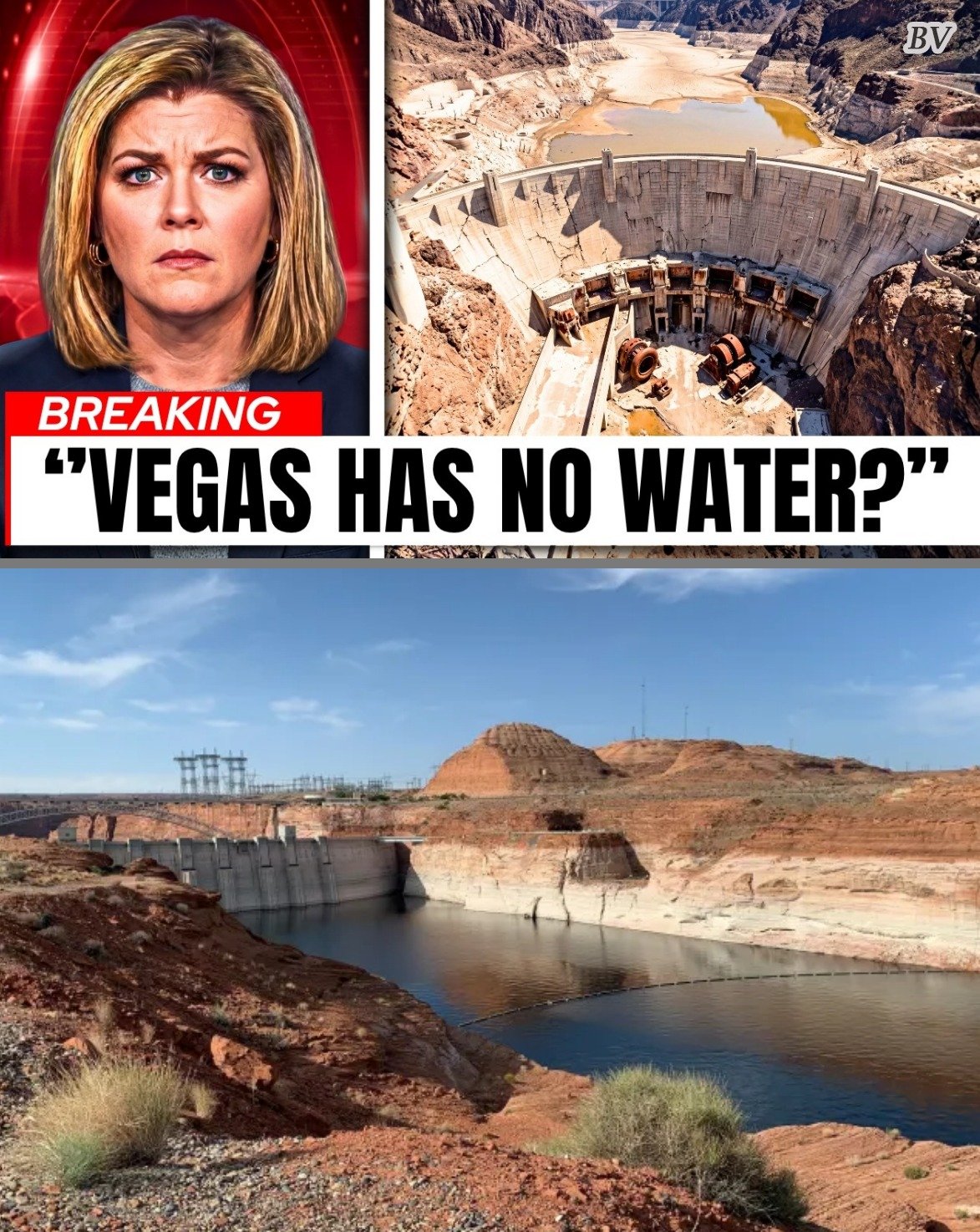
At the heart of this looming disaster is Lake Mead, the colossal reservoir that serves as the United States’ largest and the indispensable lifeblood of the entire Colorado River system. As of March 23, 2026, its waters have receded to a staggering 34% of its full capacity, sending shockwaves across the region.
Currently standing at a perilous 1,064 feet above sea level, the lake’s surface is now a mere three feet away from a critical threshold. Once it dips below this point, a devastating chain reaction will occur: 12 of Hoover Dam’s 17 massive turbines will be forced offline, rendered inoperable due to the destructive phenomenon known as cavitation.
The implications of this shutdown are nothing short of catastrophic. The dam’s overall power output is projected to plummet by over 80 percent, triggering an immense energy shortfall that will cripple millions of homes and businesses across California, Nevada, and Arizona. This is an energy void that simply cannot be filled overnight.
Simultaneously, the rapidly expanding metropolis of Las Vegas—dubbed the fastest-growing major city in the United States—finds itself in an equally precarious position. It now relies almost entirely on a singular, $1.5 billion engineering marvel: an enormous “straw” tunnel, meticulously bored beneath the lake bed. This colossal project was originally conceived as the ultimate emergency backup, a last resort for critical water supply.
Yet, today, it serves no longer as a mere contingency.
Instead, this “straw” has become the city’s primary, indispensable lifeline.
The cold, hard numbers paint an unsparing and brutal picture of this unfolding crisis.
Just weeks ago, on March 1st, Lake Mead’s elevation registered at 1,066 feet.
Alarmingly, by March 21st, it had already plummeted to 1,064 feet—a staggering drop of nearly two feet in a mere three weeks. This decline is particularly concerning as March is typically the month when spring snowmelt from the distant Rocky Mountains is expected to stabilize or even boost the lake’s water levels.
Currently, the reservoir holds approximately 8.75 million acre-feet of water, a stark contrast to its full capacity of 26 million acre-feet.
This current level represents a distressing decline of three feet compared to the same date last year, and it stands a full ten feet lower than its elevation in March 2024.
Any fleeting recoveries observed during 2023 and early 2024—moments that were widely (and perhaps prematurely) celebrated in news headlines—have now been entirely reversed and erased.
The Bureau of Reclamation’s most recent forecast, unveiled in early March 2026, paints an undeniably grim picture: projections indicate the lake will plummet to an astonishing 1,032 feet by November 2027. This level would be a staggering eight feet below the all-time record low that sent shockwaves through the region back in July 2022.
Reaching this catastrophic level would inevitably trigger the permanent shutdown of the dam’s older Francis turbines. Only five newly rebuilt “wide-head” units would remain operational, specifically designed to function under severely diminished head pressure.
Even these five specialized units would only be capable of generating approximately 382 megawatts of power—a meager output representing less than 20 percent of the dam’s original designed capacity of 2,080 megawatts.
The ripple effects of such a dramatic loss in power would be nothing short of catastrophic for the entire region.
Hoover Dam currently serves as a vital artery, supplying electricity to an estimated 1.8 million homes scattered across three key states.
California, with its vast population, claims the lion’s share, receiving 56 percent of this crucial power. Nevada follows, taking 23.4 percent, while Arizona utilizes 19 percent.
Even more critically, rural electric cooperatives throughout Nevada and tribal utilities serving the Navajo Nation rely on Hoover Dam for a staggering proportion of their energy needs—up to 70 percent of their total supply.
The moment those older turbines cease operation, the replacement power will have to be sourced from natural-gas plants, inevitably driving up costs by an astounding two to three times the current rates.
These escalating costs will disproportionately burden the most vulnerable populations: low-income communities, struggling rural districts, and Native nations already facing economic challenges, who are least equipped to absorb such a dramatic financial hit.
Already, the Lincoln County Power District in eastern Nevada has been forced to implement surcharges on customer bills since 2022, a direct consequence of needing to cover increasingly expensive market purchases for electricity.
The Navajo Tribal Utility Authority confronts the exact same grim calculus: each lost megawatt from Hoover Dam translates directly into higher rates for its customers and an array of increasingly difficult choices for the community.
Yet, the scope of this unfolding crisis extends far beyond mere electricity shortages.
The region’s precious water supply, arguably even more critical, now dangles by an even more tenuous thread.
Southern Nevada, home to 2.3 million residents and host to an astonishing 43 million annual visitors, relies on Lake Mead for a staggering 90 percent of its entire water supply.
Under the terms of the historic 1922 Colorado River Compact, Nevada’s legal allocation is a modest 300,000 acre-feet per year—making it the smallest share granted to any basin state.
Despite this seemingly meager allowance, the region has demonstrated remarkable ingenuity, employing aggressive conservation strategies and advanced recycling programs to stretch that allocation far beyond its nominal limits.
A key to this success is that nearly all indoor water consumed within Las Vegas is meticulously treated and then returned to Lake Mead, flowing back through the natural channel of the Las Vegas Wash.
This innovative return-flow credit system grants the state the ability to effectively “reuse” an impressive 85 percent of its water allocation—a conservation rate unparalleled anywhere else within the Colorado River basin.
Reflecting these efforts, per-capita water use has dramatically plunged by 55 percent since 2002, dropping from 222 gallons per day to a mere 89 gallons per day by 2023. This remarkable reduction occurred even as the metropolitan area experienced significant growth, adding nearly 830,000 new residents.
However, even the most rigorous conservation efforts cannot indefinitely outpace the relentless forces of evaporation and the inherent structural losses within the system.
Under current, harsh conditions, Lake Mead tragically loses approximately 1.5 million acre-feet of water annually solely to evaporation.
Coupled with historically low inflows, the reservoir finds itself in an impossible situation, unable to replenish or recover.
Recognizing this stark reality over two decades ago, the Southern Nevada Water Authority embarked on a monumental project, constructing what many consider the single most critical piece of water infrastructure in the entire American West: Intake No.3, universally dubbed the “third straw.”
This engineering marvel is a 3-mile-long, 20-to-24-foot-diameter tunnel, meticulously drilled through solid rock deep beneath the lake bed itself.
It culminates in an intake structure positioned at an elevation of 860 feet—a crucial 35 feet below the “dead-pool” level of 895 feet. This dead-pool mark signifies the point at which gravity can no longer exert enough force to push water through the mighty Hoover Dam.
Further enhancing this system, a companion low-lake-level pumping station, completed in 2020, extends the capacity for reliable water withdrawal down to an even lower elevation of 875 feet.
Combined, these two extraordinary projects demanded an investment of $1.5 billion and required nearly two decades of tireless effort to bring to fruition.
They were explicitly conceived and designed to safeguard against the most extreme, worst-case scenarios imaginable.
Tragically, that grim scenario has now become a harsh reality, arriving years, even decades, ahead of any anticipated schedule.
The first intake, Intake No.1 (situated at approximately 1,050 feet), ceased to be operable as early as April 2022.
Intake No.2 (positioned around 1,000 feet) is still functional, but its viability becomes increasingly precarious and risky with every single foot of the lake’s continuing decline.
Consequently, the “third straw” now bears the immense responsibility of supplying the vast majority of Southern Nevada’s water needs.
Without this critical infrastructure, Las Vegas would undoubtedly already be facing severe water rationing or the logistical nightmare of trucking in emergency supplies.
Indeed, the very existence of this remarkable tunnel is the sole reason the city has, thus far, managed to avert catastrophic water shortages.
However, even this ingenious “straw” cannot resolve the overarching, existential threat: the undeniable and relentless shrinking of the Colorado River itself.
This ongoing mega-drought, which has now stretched into its 26th relentless year, is not just severe; it represents the driest 22-year period observed in at least 1,200 years, a chilling fact corroborated by ancient tree-ring records.
Compounding the natural cycles, research from UCLA indicates that approximately 42 percent of this drought’s unprecedented severity can be directly attributed to human-caused global warming.
Elevated temperatures intensify evaporation from reservoirs and soils, drastically reduce vital snowpack in the mountains, and fundamentally alter crucial precipitation patterns across the basin.
As a direct consequence, the average annual flows on the Colorado River have plummeted by a staggering 20 percent since the year 2000.
The foundational 1922 Colorado River Compact and the subsequent 1944 treaty with Mexico originally allocated a generous 16.5 million acre-feet of water per year to the various stakeholders. Critically, these allocations were based on flow data collected during an unusually wet period in the river’s history.
However, the long-term historical average flow of the river is considerably lower, closer to a realistic 13.5 million acre-feet annually.
This fundamental miscalculation means the river has been significantly over-allocated by more than 4 million acre-feet every single year for the past quarter-century, a deficit that continues to compound.
Now, a critical deadline looms: seven basin states are mandated to negotiate and establish new operating rules for the river system before the current interim guidelines officially expire on October 1, 2026.
Disturbingly, three previous deadlines for reaching such an agreement have already come and gone, leaving the future of the river in a perilous state of uncertainty.
The Upper Basin states—comprising Colorado, Wyoming, Utah, and New Mexico—are steadfastly demanding the protection of their long-held development rights to the river’s resources.
Meanwhile, the Lower Basin states—Arizona, California, and Nevada—are locked in contentious disputes, fiercely debating which among them should bear the burden of the deepest, most impactful water cuts.
Arizona’s vital Central Arizona Project, a massive aqueduct system, faces the most acute and severe exposure to these impending reductions.
California, home to an colossal agricultural economy, remains resistant to accepting proportional reductions that it argues would devastate its farming sector.
Nevada, despite holding the smallest water allocation, boasts the most advanced and efficient conservation system in the basin. The state has firmly signaled its intent to pursue litigation if a satisfactory agreement cannot be reached.
In a rare and unprecedented move, Interior Secretary Doug Burgum convened a meeting of all seven state governors in January 2026, hoping to forge a path forward. However, California’s decision to send deputies instead of its governor underscored the profound and entrenched divisions that plague these crucial negotiations.
The Bureau of Reclamation’s draft environmental impact statement, released in January 2026, meticulously detailed five distinct management options for the river’s future. Yet, in a move that highlighted the political tightrope, the Bureau notably refrained from endorsing any single proposal.
The most aggressive of these proposals calls for a substantial 1.25 million acre-feet in cuts from the Lower Basin states, alongside emergency water releases from the Flaming Gorge Reservoir to bolster critical levels.
Despite the urgency, a clear consensus among the states remains frustratingly out of reach.
Should new operating rules fail to materialize, the system will automatically default to “equal curtailment” under the original compact. This means cuts would be applied proportionally across the board, without regard for a state’s specific water needs or its demonstrated efficiency in conservation.
Such an outcome would prove devastating for Arizona and Nevada, while California, protected by its historically senior water rights, would likely absorb considerably less of the immediate pain.
Lake Mead is far more than just a massive reservoir; it stands as a stark, undeniable barometer, measuring the precarious future of water in the entire American West.
At a critical 1,064 feet and continuing to fall, the question is no longer if the system will ultimately collapse, but rather when that collapse will occur, and precisely how catastrophic the fallout will be.
Twelve of Hoover Dam’s mighty turbines are operating on borrowed time, their impending shutdown a stark certainty.
Las Vegas, a vibrant oasis in the desert, endures only thanks to an extraordinary tunnel—a lifeline built for a catastrophe that has now arrived years ahead of schedule.
Forty million people spanning seven U.S. states and northern Mexico hold their breath, anxiously awaiting a crucial deal that, given the deep divisions, may agonizingly never materialize.
The Colorado River, once perceived as an inexhaustible source of life, is now delivering a harsh, undeniable lesson to humanity: nature, in its immutable power, simply does not negotiate.
Leave a Reply