The wedding photographer caught the exact moment the metal object pierced my cheek, but the police were interested in who planted it.
The conservatory floor was slick with spilled champagne and buttercream. My tongue traced the jagged, metallic intrusion in my right cheek, the taste of copper overwhelming the sickeningly sweet frosting. I watched the photographer’s lens track my collapse, his shutter clicking with rhythmic, predatory precision. Nobody moved to help. They were all staring at the monitors, watching the slow-motion replay of my ruin.
Evelyn gripped my wrist, her fingernails digging into my skin, pulling me toward the side exit. Her perfume, a cloying mix of lilies and antiseptic, choked me.
You need to walk out the back, she hissed, her eyes darting toward the content crew. Do not touch your face.
I looked at the silver jagged edge jutting from my flesh, then at the camera hovering inches from my eye. I felt the cold, clinical distance I used to archive damaged manuscripts rise up to shield me. I reached into my pocket, found my phone, and pressed record. I am not going anywhere, I said. I want the cake.
The hum of the industrial dehumidifier in the basement of the archives was the only sound I truly trusted. It was a low, steady drone that kept the paper from curling and my thoughts from fraying. I pulled a pair of nitrile gloves from the box, the snap of the rubber against my wrists serving as a small, rhythmic punctuation to the start of my day. Beside the worktable, my coffee sat in a ceramic mug that had lost its heat twenty minutes ago. I drank it anyway, the bitter, lukewarm liquid grounding me in the familiar stagnation of a Tuesday.
Outside the narrow, high-set windows, the city was just beginning to stir. I could hear the muffled thrum of tires on wet asphalt and the intermittent chimes of the crosswalk signals. It had been raining since dawn, a fine, grey mist that turned the world into a smudge of charcoal and slate. I preferred it that way. When the weather was bright, the light hit the glass walls of the archives at unforgiving angles, highlighting every speck of dust I had yet to catalog. Today was soft, muted, and perfectly controlled.
I picked up the bone folder and smoothed a crease in a 1920s ledger. My movements were precise, practiced, and entirely devoid of urgency. I liked the way paper felt under my fingertips—dry, fragile, and honest. It never tried to be anything other than what it was. It didn’t hide sharp objects beneath layers of buttercream or expect me to perform for a lens. I spent my mornings existing in the margins of history, far away from the curated chaos of my sister’s wedding preparations or the sharp, performative demands of my mother’s social calendar.
Around ten, the office printer down the hall lurched to life, spitting out a thick stack of reports with a rhythmic, mechanical stutter. I heard Sarah, the junior archivist, walking toward it, her heels clicking sharply against the linoleum. She stopped by my door, holding a stack of color-coded files.
Looks like the humidity levels in the map room are spiking again, she said, leaning against the doorframe. You think we need to recalibrate the sensors?
I looked up, keeping my hands resting flat on the ledger. I think the sensors are fine, Sarah. It’s just the rain. Everything feels a little heavier today.
She laughed, a short, airy sound that didn’t quite reach her eyes. You’re always so clinical about it. It’s just water, Jocelyn.
I returned my gaze to the ledger, tracing the faded ink of a clerk’s handwriting from a century ago. It’s not just water, I thought, but I didn’t say it. I didn’t want to explain the way moisture could silently compromise a document, turning a permanent record into a pulpy ruin. Some things were better left unsaid, tucked away behind a polite, professional silence. I had a rhythm to maintain, a life to curate, and a stack of inventory to finish before lunch.
I turned the page, the sound of the paper shifting like a dry rustle of leaves. The clock on the wall clicked forward. Eleven o’clock. The morning was half-gone, and for the first time all week, I felt a strange, detached sense of peace. There were no cameras, no hidden agendas, and no expectations of me other than to preserve what had already been written. I reached for my coffee, feeling the ceramic cool against my palm, and checked my watch.
Then, the silence of the room was punctured. My phone, resting face-down on the corner of the table, began to vibrate. It wasn’t the sharp, demanding ring of a social notification, but a long, pulsing buzz that rattled the surface of the wooden desk. I hesitated, my hand hovering over the device. It was a private number, the kind that usually meant a cold call or a glitch in the system. I stared at the black screen for a beat, wondering if I should let it go to voicemail. I decided to pick it up.
The wedding reception was a suffocating masterclass in staging. The conservatory walls trapped the late afternoon sun, turning the space into a glass box of humid, floral-scented air. I wiped my palms against the silk of my bridesmaid dress, feeling the grit of spilled champagne beneath my heels. Tessa was already standing by the three-tier cake, her face a mask of practiced, manic radiance. She caught my eye and gestured with a silver knife.
Come on, Jocy, she chirped, her voice cutting through the jazz quartet like a jagged blade. Don’t be a wallflower. It’s the cake-smash. The cameramen were already shifting, their heavy lenses swinging toward us with predatory precision.
I stepped forward, my skin crawling. I didn’t want this. I hated the expectation of the messy, performative spontaneity that defined Tessa’s existence. My mother was standing in the periphery, her hands clasped tightly, nodding with a frantic, silent command to just play along.
I don’t think I should, I said, the words falling flat against the hum of the crowd.
Don’t be such a drag, Miles muttered, stepping up behind his new wife. He gave me a shove toward the table, his hand firm and cold against the small of my back. It’s just for the highlight reel. Just lean in.
I looked at the cake. It was a monolith of white frosting, obscuring whatever lay beneath. Tessa’s eyes were bright, wide, and entirely empty of warmth. She grabbed a handful of the top tier, her fingers sinking into the sponge with a wet, visceral squelch. The air in the room seemed to sharpen, the laughter of the guests morphing into a low, expectant drone.
Okay, I whispered, though my heart was hammering against my ribs, a rhythmic warning I chose to ignore for the sake of the family’s optics.
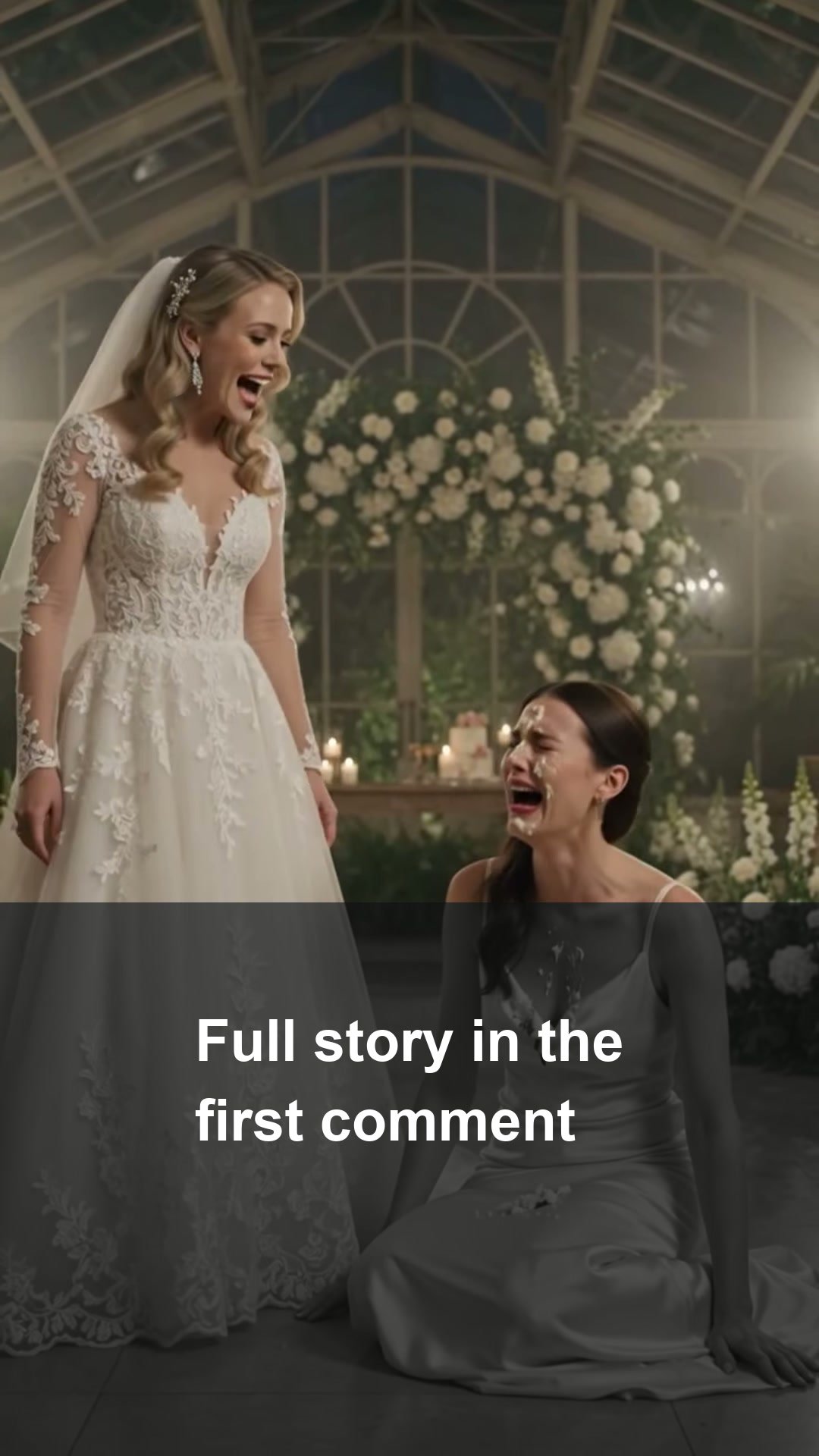
I leaned in, my face inches from the white sugar, trying to find a landing spot that wouldn’t ruin my makeup. Tessa lunged. There was no gentle smear, no playful swipe. She slammed my face into the cake with the force of a hammer blow.
The impact was immediate. A searing, white-hot line of agony ignited in my left cheek, followed by the sensation of something cold and metallic dragging through muscle. I stumbled back, my hands clawing at the air, the world tilting into a blur of spinning light and horrified gasps. I felt the wet warmth of blood bloom across my jaw, dripping onto the pristine white lace of my dress.
I reached up, my fingers meeting something rigid and razor-sharp lodged deep in the soft tissue of my face. The cameraman clicked a rapid-fire sequence of shots, the flash strobing against the gore. I looked at Tessa. She hadn’t moved. She was still smiling, her hands dusted in cake, waiting for the crowd to laugh. I realized then, with a clinical, detached clarity, that the silence in the room was not shock; it was the sound of a trap snapping shut.
The sterile fluorescent lights of the emergency room hummed, a low-frequency vibration that rattled my teeth. I sat on the edge of the examination table, my cheek throbbing with a rhythmic, hot pulse. My mother stood near the sliding glass doors, her silhouette sharp against the hallway’s chaos. I pressed my phone to my ear, listening to the dial tone, my thumb tracing the edge of a stack of medical intake forms.
Mother, I said. I want to know who ordered the custom tiers.
Evelyn didn’t look at me. She was busy smoothing the creases of her silk skirt, her face a mask of practiced agitation. The bakery, Jocelyn. It’s always the bakery. Don’t be dramatic; you know how Tessa gets when things aren’t seamless.
The bakery didn’t put a sharpened steel plate in the frosting, I replied. My voice sounded flat, even to me. I dialed the venue manager next, my hand steady despite the tremors in my gut. Mr. Henderson answered on the first ring, his voice overly polished.
The kitchen logs from Friday, I said. Who signed for the delivery?
Mr. Henderson cleared his throat, a wet, nervous sound. Miles handled the logistics, Miss. We were told it was a surprise structural support for the fondant. Standard procedure for those heavy, gravity-defying cakes.
My stomach dropped. I leaned against the cold wall of the exam room, remembering the way Miles had watched me from across the reception hall, his eyes not on his bride, but on the lighting rigs. I decided then: no more apologies. I called the nurse station, flagging down the woman who had helped me clean the initial blood from my neck.
The object, I said, catching her arm. The metal. Where did you put it?
She pulled away, eyes darting to my mother. The attending surgeon took it, dear. Said it was evidence for the internal report. But the administrator just came by—he said it was an accident involving kitchen equipment. It’s being processed as a workplace hazard, not a surgical retrieval.
An accident. That was the first contradiction. If it was a hazard, why were the photos already being scrubbed from the online wedding portal?
I climbed into my car, the interior smelling of stale perfume and antiseptic. I drove to the venue, the silence of the conservatory at three in the morning feeling heavier than the noise of the party had. The kitchen was dark, but a single light flickered near the loading dock. I found the catering lead, a man named Elias, hunched over a clipboard.
Who gave you the box, Elias? I asked, stepping into the pool of yellow light.
He jumped, shielding his chest with the clipboard. Miles told us it was a prop. A sentimental carving. He said you were in on it, that it was a prank for your toast.
Tessa told me it was a gift from the baker, I lied, testing the weight of the lie.
Elias shook his head, his brow furrowed. No, Miles brought it in a courier bag. No bakery logo. He warned us not to let anyone see it until the moment of the smash. He said it was for the ‘viral impact.’
I pulled out my phone and recorded the final sentence, the digital waveform pulsing like a heartbeat. The contradiction was absolute: Miles said it was the baker, the baker was a ghost, and the venue thought it was a prank. I turned back toward the car, the cold night air biting at my stitched skin. I decided to stop asking and start collecting. The hook was set. I was no longer a victim; I was a witness building a case.
The foyer of my mother’s estate smelled of expensive lilies and the faint, acidic tang of floor wax. I stepped over the threshold, my heels clicking a sharp, rhythmic warning against the marble. The house was unnaturally quiet, a curated vacuum designed to stifle any noise that didn’t fit the narrative of a perfect marriage.
My mother sat in the drawing room, a crystal glass of sparkling water held between thin, manicured fingers. She didn’t look up as I entered. She was busy rearranging a vase of peonies, her movements precise and clinical. I reached into my pocket, my thumb tracing the jagged, sterilized piece of metal I had retrieved from the evidence bag at the station. It felt like a tooth, cold and predatory.
Mother finally looked at me, her eyes flitting over the adhesive bandage that pulled at the corner of my mouth. She didn’t ask how I was. She asked if I had scrubbed the social media comments yet. I ignored her, walking toward the mantle where the framed wedding portraits stood in a pristine row. I picked up the one of Tessa and Miles, their smiles so wide they looked predatory, the cake smeared across their faces in a celebratory smear of white frosting.
I didn’t want to play the game anymore. I wanted to see her break, to see the composure fracture under the weight of the reality she had so carefully paved over for twenty years. I turned the portrait face down on the mahogany table with a slow, deliberate thud.
Mother’s gaze sharpened, her lips thinning into a hard, white line of disapproval. She started to speak, her voice a practiced, velvet whip intended to bring me back into line. She told me that family was the only thing that lasted, that I was being hysterical, and that Tessa was just a girl who didn’t know the limits of her own playfulness.
I took one step closer and spoke into the silence.
Tessa didn’t miss the cake, Mother; she was aiming for my eye.
The air in our childhood kitchen always tasted faintly of lemon polish and the ozone scent of a television left on in the next room. I was ten, sitting on a high stool, watching Tessa, who was seven, methodically dismantle a porcelain doll. She didn’t tear it apart in a rage. She used a pair of precision embroidery scissors to snip the eyelashes off, one by one, watching me with a wide, innocent gaze that she only reserved for when she was doing something irreparable. Mother walked in, carrying a tray of iced tea, and stepped over the pile of plastic limbs and synthetic hair without breaking her stride. She didn’t look at the carnage. She looked at Tessa’s hair, smoothed a stray lock behind her ear, and told her that if she was going to play surgeon, she should at least do it in the playroom where the mess wouldn’t track into the carpet.
I pointed at the doll’s gouged-out eye socket. I told Mother that Tessa had done it on purpose while I was trying to read. Mother just sighed, a sound like dry leaves skittering on pavement. She handed me a napkin and told me that sisters often expressed their affection through teasing, and that I was being overly sensitive about a toy that was past its prime anyway. That was the first time I learned that reality was negotiable if the person in charge decided it was a joke.
Years later, in the humid heat of a high school gymnasium, I stood in the wings of the stage before my valedictorian speech. Tessa was there, supposedly helping me straighten my sash. She smelled of expensive perfume and sharp, cold ambition. She leaned in, her breath hitting my ear, and whispered that my dress looked like it had been salvaged from a thrift store bin. Then, with a flick of her wrist that looked like a friendly adjustment, she unlatched the safety pin holding the back of my bodice together. I walked onto that stage feeling the fabric sliding down my spine, praying it would hold, while Tessa sat in the front row, recording me on her phone, her thumb hovering over the ‘post’ button. When I walked off, she told me it was just a little prank to keep me from getting too big for my boots. She laughed, a bright, musical sound that made the teachers smile at her charm.
I went to the bathroom, locked the stall, and used a paperclip to fasten the dress. I didn’t cry. I cataloged the feeling of the metal digging into my skin and decided that I would never again let her close enough to touch my clothes. I was wrong, of course. I thought distance was a physical act, not realizing that Mother acted as the tether, constantly pulling us back into the same orbit.
The money came later, a trust fund established by our grandfather that was meant to ensure our success but served only to fund Tessa’s theater of cruelty. When I started my work as an archivist, finding a sense of peace in the order of paper and ink, Tessa began her pivot to the digital stage. She needed an audience, and she needed a villain. I was the perfect candidate: the sister who took things too seriously, the one who couldn’t take a joke, the one who didn’t understand the aesthetic value of a good narrative. Every holiday dinner was a scripted event where I was poked, prodded, and mocked, only for Mother to intercede the moment I raised my voice. She would press a glass of wine into my hand and tell me to be the bigger person, which was her code for being the silent one.
I remember my engagement party, three years ago. I had invited a man who was kind, quiet, and entirely unconnected to our social circles. Tessa spent the entire evening whispering into his ear, telling him stories about my childhood that were half-truths twisted into jagged lies. She told him I had a history of nervous breakdowns, that I was prone to fits of paranoia. I watched from across the room, seeing the way his posture shifted, the way his eyes started to track me with a newfound, pitying distance. When I confronted her in the kitchen, she was drinking champagne, her reflection in the glass cabinet distorted and elongated. She looked at me and said that she was only trying to protect him from a lifetime of my misery. She said it with such casual, effortless malice that I felt the floor tilt beneath me. I didn’t say anything. I just walked out of the house and didn’t speak to her for six months.
Mother called me every single day during that silence. She didn’t ask how I was. She asked when I was going to stop punishing my sister. She told me that families were like delicate structures of glass; if you pushed too hard on one side, the whole thing would shatter, and that I would be the one to blame for the shards. She made me feel like my boundaries were a form of violence. I eventually broke. I went back. I sat at the table and smiled while Tessa talked about her new partner, Miles, and how they were planning to build a brand out of their life together. I watched them exchange looks—sharp, hungry glances—that I should have recognized for what they were.
The week before the wedding, I had found a box in the venue’s storage room. It was heavy, wrapped in brown paper, tucked behind a stack of tablecloths. I had touched the edge of it, and a strange, metallic coldness had seeped into my fingertips. I didn’t open it. I thought, *this is none of your business, Jocelyn.* I thought, *if you interfere, you’re just the paranoid sister again.* I walked away from the box, feeling the weight of my own silence pressing against my ribs. I had been conditioned to believe that curiosity was a flaw and that vigilance was a symptom of an unhappy mind.
I look at Mother now, in the present, seeing her grip her handbag so hard her knuckles are the color of bone. The history of the house, the smell of the lemon polish, the sound of the embroidery scissors—it all coalesces into a single, ugly truth. It was never about playfulness. It was about erasure. Tessa couldn’t stand the idea of a world where I existed outside of her shadow, where I had a life that wasn’t a footnote to her own spectacle. Every ‘joke’ was a surgical strike, designed to trim away a piece of my autonomy, to keep me small, frightened, and perpetually reacting to her whims.
I realize now that the metal in the cake wasn’t a culmination. It was a final, desperate attempt to turn me into something she could control: a patient, a victim, a permanent fixture of her own narrative arc. She wanted me scarred so that I would have to look at myself the way she looked at me—as something broken, something flawed, something that needed to be managed.
I look at the portrait on the table again, the face of the girl I was before I learned to stay silent. I decide then that the preservation of this family isn’t a duty; it’s a cage. I won’t be the one to pick up the pieces of this glass house anymore. I will be the one who lets it fall, and I will be the one who walks away from the wreckage without looking back to see if it’s still standing. The silence in the room isn’t heavy anymore; it is the clean, sharp silence of an archive that has finally been purged of its rot. I don’t need to ask why she did it. The why is irrelevant when the what is so clear. I am finally finished with the joke.
The conservatory floor was polished to a mirror finish, reflecting the strained, porcelain smiles of the guests as they milled about the remnants of the cake. My mother, Evelyn, stood near the fountain, her hands smoothing the invisible wrinkles in her silk skirt. She avoided the spot where the blood had pooled, her eyes fixed on a distant point above the treeline. She had built her entire social reputation on the myth of our family’s effortless harmony, treating my injury as a logistical error—a smudge on the lens—rather than an act of violence. She feared that if she acknowledged the razor, the entire structure of our curated life would collapse like a house of cards. I watched her check her phone, her thumb hovering over the delete key for a post she realized might now implicate her. She would trade my safety for a dinner invitation every single time.
Tessa stood by the bar, her white lace train dragging through a spilled default. She was rehearsing her expression in a handheld mirror, shifting from shock to tearful concern, practicing the performance of a grieving sister. She needed the viral fame of this wedding to validate her existence, but the metal sliver had been a bridge too far, a miscalculation in her desire to be the only person in the room with an interesting story. She lived in a world where actions lacked consequences as long as they were captured in high definition. I saw the way she looked at Miles, a flicker of genuine irritation—not because I was hurt, but because the shot had been ruined.
Miles was in the corner, his sleeves rolled up, speaking into a headset. He was the one who had intercepted the delivery, the architect of the surprise that had turned into a crime. He thrived on the cold logic of content metrics, seeing our lives as raw material to be mined for engagement. He thought he was the smartest person in the room, convinced that money and nondisclosure agreements could sanitize the blood off the marble floors. He looked at me then, his gaze flat and calculating, assessing how much I would cost to keep quiet. He didn’t see a human; he saw a liability in a bandage.
Maya, the only person who hadn’t taken a drink, walked toward me through the crowd. She had been the one to call the paramedics before my mother could suggest a private plastic surgeon. She was an outsider who held no stock in the family’s performance, her sharp, observant eyes cutting through the veneer of the conservatory. She knew that loyalty shouldn’t be a suicide pact. She handed me a bottle of water, her touch firm and grounding. She was the witness who would not look away, the one who saw the cruelty for what it was.
I looked at them all—the enabler, the narcissist, the profiteer, and the witness. The archive of my life felt suddenly, mercifully, closed. I turned away from the fountain, my hand brushing the gauze on my cheek, and walked toward the exit. I didn’t need to reconcile their contradictions anymore. I only needed to ensure the truth was recorded somewhere they couldn’t reach. I walked out into the cool evening air, leaving the glass house to its own inevitable shattering. My phone vibrated in my pocket, but I didn’t reach for it. I was finished with the performance.
The police station smelled of floor wax and stale coffee. I sat on a bench that felt designed to induce discomfort, my hand tracing the outline of the bandage on my cheek. Officer Miller gestured for me to enter his office, his desk cluttered with paper forms and a stack of manila folders. When I placed the small, plastic evidence bag on his blotter, the light caught the jagged edge of the metal shard—the object that had been buried in the sponge cake like a landmine. I told him everything, keeping my voice clinical, cataloging the sequence of events as if I were documenting a damaged manuscript in the archives. I didn’t cry. I didn’t ask for sympathy. I simply handed him the USB drive containing the raw, unedited footage from the professional videographer’s secondary camera.
“You realize this will go public,” Miller said, his pen hovering over the statement form.
“It already did,” I replied. “I’m just correcting the caption.”
By the time I reached my car, my mother had left six voicemails. The first was conciliatory, the third was frantic, and the sixth was a sharp-edged command to stop making a scene. I ignored them all, instead pulling up my banking app. With a few deliberate taps, I cancelled the automatic transfers I had set up for the family’s joint property maintenance fund. I didn’t care about the legal protest they would inevitably launch; I had already begun the process of decoupling my name from their vanity projects. The notification of the cancellation pinged on my phone, followed immediately by a frantic text from Miles: *You’re being irrational. This is a family matter, not a bank heist.*
I drove to the office of a firm that specialized in high-stakes civil litigation. The lobby was hushed, smelling of expensive mahogany and cold ambition. Mr. Thorne, a man with skin like parchment, listened to my account without interrupting. When I mentioned the inheritance and the potential tampering with the estate planning documents—a suspicion I’d harbored since the day Tessa took control of the executor duties—he finally leaned forward. We spent three hours drafting a formal challenge to the estate’s current structure. By the time I left, the ink was dry on a petition to freeze the accounts pending a full forensic audit.
The retaliation arrived before I even reached my apartment. My phone screen bloomed with a push notification from a gossip outlet. A new clip had been leaked: me, looking startled and bloodied, captioned with a headline suggesting I had suffered a mental breakdown during the reception and injured myself in a manic episode. They were framing my trauma as a performance art piece gone wrong.
I sat in my hallway, the darkness pressing in, and opened my laptop. I logged into the HR portal of the firm where Tessa worked. I had spent months gathering the emails she’d sent from her work account, detailing how she planned to use the wedding’s virality to boost her firm’s influence. I attached the files to a formal complaint regarding gross professional misconduct and the misuse of corporate assets. I hit send, my finger hovering over the trackpad until the confirmation message appeared.
That evening, I visited a private lab. The DNA test wasn’t for family heritage; it was for the saliva samples I’d collected from the cake platter’s edge, remnants I had swiped into a sterile tube before the cleaners arrived. I needed to prove who had touched that metal before it was buried in the frosting. The technician looked at me with pity, but I just watched the centrifuge spin, a blur of motion that matched the rising panic I felt beneath my ribs.
When I returned home, the locks had been changed. A note from my mother sat on the doorstep, demanding I return the house key. I didn’t reach for the handle. Instead, I pulled out my phone and dialed the number for the county clerk’s office. I filed the paperwork to initiate a discovery hearing, requesting the presence of all parties involved in the wedding’s planning.
My phone hummed in my palm, a constant, rhythmic vibration of incoming threats. I silenced the ringer and walked to the kitchen. I poured a glass of water, watching the light catch the clarity of the liquid. There was nothing hidden here, no jagged edges, no performative joy. I took a sip, the cold water soothing my throat. Outside, the headlights of a car swept across my living room wall—likely Miles, coming to argue, coming to intimidate, coming to demand silence. I looked at the glass, then at the locked front door. I didn’t move. I simply checked the time, calculated the hour the process server would arrive at my sister’s home, and waited for the knocking to begin. The performance was over; the litigation had started. The silence in the room was no longer a peace treaty—it was a weapon.
The knock didn’t come from Miles. It was a rhythmic, frantic thrumming against the wood, followed by the muffled, distorted voice of my mother through the peephole. I stood in the hallway, the hardwood cool against my bare feet, and watched her shadow pace back and forth. She was holding her phone up, the screen light casting a sickly blue hue onto her face, as if she were live-streaming her own desperation. My phone, silenced and shoved into a kitchen drawer, had been vibrating for three hours straight.
I opened the door six inches, the security chain pulled taut. My mother stopped pacing. Her makeup was thick, applied with a tremor that hadn’t been there at the wedding. Behind her, standing at the edge of the driveway, were two neighbors I barely knew, their phones tucked into their pockets, eyes bright with a hungry, invasive curiosity.
Jocelyn, for heaven’s sake, stop this, she hissed, her voice a jagged whisper. The news vans are already parked at the end of the street. Tessa is crying, Miles is being dragged into a lawyer’s office, and you—you’re the one bringing the wrecking ball.
I looked past her shoulder. Across the street, the neighbor’s teenage daughter was filming us with a long-lens camera, her posture stiff with the thrill of proximity to a scandal. It was no longer a family tragedy; it was content. It was a digital feast, and my cheek was the centerpiece.
I don’t want to stop, I said. My voice sounded flat, clinical, a tone I had practiced in the archivist’s workshop for years. I want the record corrected.
Mother reached out, her hand trembling as she grabbed the edge of the door. Do you have any idea what you’re doing to your sister’s reputation? To the firm? Miles has investors, Jocelyn. Real people with real money who don’t care about a cake mishap. They care about optics. They care about stability.
I watched a leaf drift down from the oak tree and settle on the porch. The world felt thin, like a piece of parchment about to tear. I remembered the feeling of the metal sliding into my skin—that cold, precise bite. That was stability, wasn’t it? The expectation that I would hold still for the camera while they ruined me.
The optics are exactly what I’m archiving, Mother, I said. I pulled the door firmly, hearing the chain snap against the metal catch.
As I retreated, the phone in the kitchen drawer gave one final, violent shudder. I didn’t check it. I walked to the living room and pulled the heavy curtains shut, cutting off the view of the street, the neighbors, and the glowing blue screens. The house was quiet, but it wasn’t empty. It was filled with the weight of the investigation, the forensic reports sitting in a manila folder on my desk, and the sudden, terrifying realization that once the truth was out, there would be no going back to being the sister who stayed quiet for the sake of the picture. I sat on the floor, the floorboards hard and unyielding, and began to draft the timeline of the last decade. My hands didn’t shake. I was finally documenting the reality of the sharp edges.
The courtroom gallery smelled of floor wax and stale coffee. I sat in the hard wooden chair, watching the bailiff adjust his belt, his eyes darting toward the gallery. Tessa stood at the defense table, her posture rigid, a sharp contrast to the breathless, performative spontaneity she once weaponized. Beside her, Miles looked smaller, his shoulders hunched as his lawyer whispered into his ear. When the judge entered, the rhythmic rap of the gavel cut through the silence, each strike sounding like the snap of a dry bone. I gripped the edge of the mahogany railing, my knuckles white, feeling the faint, raised texture of the scar tissue on my cheek beneath my fingertips.
The sentencing was delivered in a monotone drone that stripped the violence of its dramatic flair. Two years for conspiracy to commit assault; three years for criminal endangerment. The judge didn’t look at them. He looked at the paperwork. Tessa’s face remained a mask of practiced indifference until the handcuffs clicked, the cold metal biting into her wrists. She glanced toward the back of the room where my mother sat, but Mother stared resolutely at her own manicured nails, her coat buttoned to the chin as if to shield herself from the shrapnel of the verdict.
I didn’t stay for the final dismissal. I walked out into the humid afternoon air, the sunlight harsh and unfiltered. My phone hummed in my pocket—a barrage of notifications, tags, and inquiries—but I didn’t reach for it. Instead, I stood on the concrete steps and pulled the battery pack from the device, listening to the tiny, metallic protest of the casing as it came loose. I dropped the phone into a trash bin near the curb. The lack of a digital footprint felt like a physical weight lifting from my spine.
I arrived at my new house an hour later. It was a small, older build, devoid of the glossy, staged aesthetic of my previous life. I walked through the empty rooms, my boots clicking against the hardwood. I had removed every mirror, replacing them with blank, cream-colored wallpaper. I reached the kitchen and filled a plain glass with cold tap water. As I brought it to my lips, the sun caught the rim, casting a clear, circular refraction onto the table. There was no distortion, no hidden glint of metal, no trap. I took a slow, deliberate sip, tasting only the cool, sharp clarity of the water. For the first time, the silence didn’t feel like a vacuum waiting to be filled; it felt like a foundation. I looked out the window at the garden, where the tall, unkempt grass swayed in the wind. I was finally unrecorded.
I stepped onto the back porch, my bare feet sinking into the cool, damp earth of the yard. The garden was a chaotic tangle of overgrown hydrangeas and stubborn weeds, untouched since I’d severed the last of my mother’s professional landscaping contracts. I carried a rusted trowel, its weight grounding. I knelt in the dirt, the grit working into my fingernails, and began to clear a space for the lavender I’d bought at the roadside stand.
Maya pulled into the driveway, her tires crunching on the gravel. She stepped out, holding a leash attached to a lanky, tan-colored rescue dog that skittered toward the grass. The dog, a shepherd mix with one floppy ear, sniffed the air, then trotted over to rest its chin on my knee.
“He doesn’t have a name yet,” Maya said, crouching beside me. “I thought you might want to choose one.”
I reached out, my fingers tracing the soft velvet of the dog’s ear. There was no performance here, no lens pointed at us, no requirement to smile for a social feed. Just the rhythmic huff of the dog’s breath and the smell of damp soil.
“Barnaby,” I said, the name feeling solid and unadorned.
Maya smiled, a small, tired movement that didn’t demand anything in return. “Barnaby. It suits him.”
I looked at the scar on my cheek, feeling the thin, white line pull slightly as I moved my jaw. It was a map of where I had been, but it was no longer the centerpiece of my face. I realized then that I didn’t need to catalog this moment or justify my presence to anyone. I took a deep breath, the air tasting of ozone and wet grass. I picked up the trowel and started to dig, burying the past beneath a layer of fresh, dark earth, ready to plant something that would actually grow.
The house felt vast without the hum of notifications or the insistent chime of an unread message. I walked to the kitchen, the hardwood cool beneath my bare feet. My mother’s curated life was a museum of brittle porcelain and staged shadows, but here, the light hit the granite island with a raw, honest intensity. I turned the faucet, the water rushing into the vessel with a steady, liquid clarity. There was no residue, no grit, and certainly nothing concealed beneath the surface waiting to tear at my skin. I held the glass up to the window, the morning sun refracting through the liquid until it cast a simple, brilliant circle of light onto the counter. I set the glass down, watching the quiet, still water settle completely.
Leave a Reply