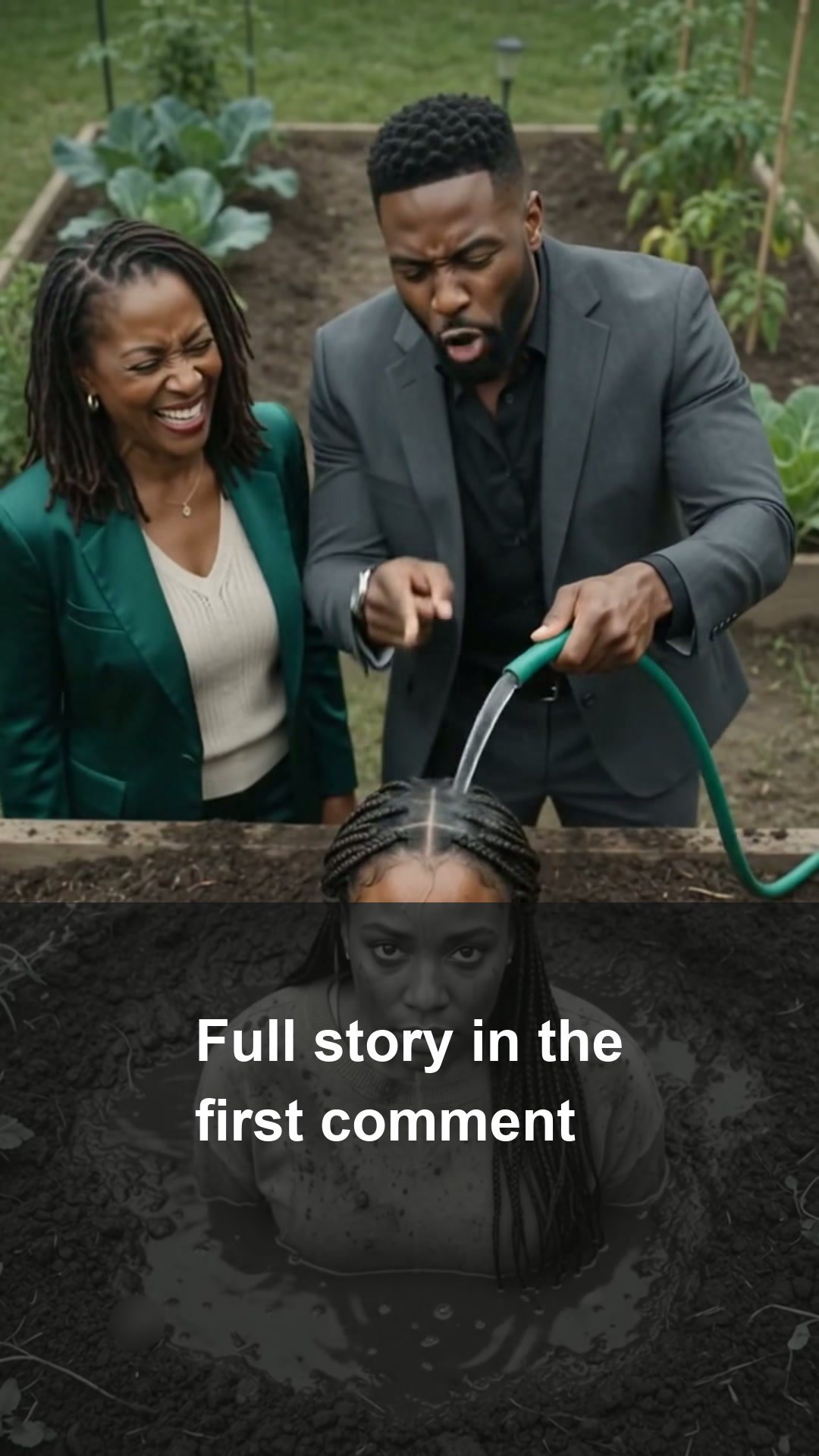
The shovel blade struck the hollow pocket of air above my chest with a dull, sickening thud. The vibration traveled through the packed clay, rattling my teeth and sending a tremor of loose silt cascading onto my face. I didn’t flinch; I stopped breathing entirely, my lungs burning as I pressed the plastic straw deeper into the fissure between the heavy timber planks. Above me, the muffled crunch of expensive leather boots paced across the disturbed mound. Marcus hummed a low, tuneless melody, the sound distorted by three feet of topsoil. He stopped directly over my heart. I reached into my pocket, my fingers finding the cold, jagged edge of the voice recorder. The metal was slick with my own sweat. If he dug three inches to the left, he would hit the beam and realize the cavity was still intact. I held my breath, counting the seconds between his footsteps, mapping the exact geometry of the dirt above me. He kicked the earth once, a sharp, dismissive strike meant to level the ground. I pushed the recorder button. If he wants to bury me in the dark, I will ensure he never hears the end of it.
The kitchen island in our apartment was always covered in a thin dusting of silt, a remnant of my landscape architecture samples that Marcus complained about every single morning. I used my thumb to wipe a clean line through the grey powder, watching the dark granite reappear. The espresso machine hissed, a sharp, metallic shriek that cut through the silence of the room. I measured the grounds with clinical precision, tapping the portafilter twice against the counter—a rhythmic, hollow sound.
Marcus walked in, his footsteps heavy and predictable. He smelled of cold air and expensive wool. He didn’t say good morning. Instead, he leaned over to inspect the ledger I had left open by the sink, his fingers grazing the edge of the paper. I pulled the steam wand away, watching the milk froth into a dense, velvety cloud.
It is the little things, isn’t it, Elena? Marcus asked, his voice smooth and lacking any real default. He gestured toward the overgrown ivy creeping against the windowpane. You really ought to have the gardener trim that back. It’s making the house look neglected.
I poured the espresso, the dark liquid swirling into the white foam. It’s meant to look like that, I said. It’s part of the privacy screen. The geometry of the foliage is deliberate. I need the shade to keep the temperature consistent in the solarium.
He shrugged, picking up a piece of dry toast. Everything has to be a project with you. You’re overthinking the architecture again. It’s just a house.
I looked at him, noting the slight tremor in his left eyelid, the way he avoided the ledger now that I was watching. I thought about the way the soil outside was currently being aerated, the root systems I had planned for the spring. Everything felt structural, balanced, and perfectly accounted for. I decided then that I would finish the site report before lunch. I needed to document the perimeter drainage before the next heavy rain, or the foundation would be compromised. It was a simple, logical task.
I took my mug and moved toward the living room, my heels clicking in a steady, metronomic cadence against the hardwood. I stopped to adjust a stack of blueprints, ensuring the corners were perfectly aligned with the edge of the mahogany desk. My life felt like a series of clean lines and right angles, a blueprint I had drawn up myself. I felt safe in the predictability of it. If I followed the plan, if I calculated the loads correctly, nothing could shift. Nothing could give way.
I sat down, opening the binder to the soil analysis report. The graph showing the compaction density was stable. I traced the line with my pen, satisfied. The wind rattled the windowpane, a soft, insistent tapping that reminded me I needed to check the seals later. I made a mental note to call the contractor, but the thought slipped away as I focused on the slope grade.
Then, the air in the room seemed to sharpen. The quiet was absolute, broken only by the hum of the refrigerator in the kitchen. I looked up, watching a dust mote drift through a shaft of morning light.
The phone on the desk gave a single, piercing ring.
I stood, my hip bumping the mahogany edge of the desk. The phone was a sleek, black weight, its screen illuminating the dust motes with a sterile blue glow. Marcus. I didn’t recognize the number, but the cadence of the ring—insistent, rhythmic—bore his mark. I lifted the receiver.
Elena, he said. His voice was a thin wire. You’re done with the ledger.
It was a statement, not a query. I glanced at the open binder, the compaction graphs mocking me with their ordered geometry. I am finishing the report, Marcus. You asked for the drainage assessment by noon.
Come to the orchard, he interrupted. Bring the binder. Mother wants to discuss the garden’s perimeter alignment before the contractors arrive.
He didn’t wait for a reply. The dial tone hissed in my ear, a flat, mechanical emptiness. I looked at the glass of water on my desk, the surface tension holding a tiny bubble against the rim. My hands were steady, my pulse a measured sixty beats per minute. I closed the binder, the clasp clicking shut with finality. I needed to finish this. If I could show them the soil density calculations, the instability they were worried about would be proven a non-issue.
I stepped onto the porch. The air outside was colder than I expected, the wind biting at my collar. The orchard was a blur of grey bark and tangled, dormant branches. I walked past the row of heritage apples, my boots sinking slightly into the soft, rain-loosened loam of the path.
Marcus stood near the base of the old oak, his back to me. Mara stood beside him, her hands folded neatly over a silk scarf. The hole was already there. It wasn’t a trench for a tree or a drain; it was a perfect, deep-walled rectangle carved into the earth. It looked like a grave.
I stopped, the binder heavy against my chest. You said we were discussing the fence line.
Marcus turned. His eyes were devoid of their usual frantic ambition, replaced by a terrifying, calm clarity. We are discussing stability, Elena. The soil here is too loose. It needs to be held down.
He stepped toward me, his movements fluid and rehearsed. Mara didn’t look at me; she stared at the dark, exposed earth at the bottom of the pit.
I’m leaving, I said, the words hitting the stillness of the garden like a stone dropped in a well.
Marcus reached out, his grip tightening around my wrist. It wasn’t the touch of a husband, but the grip of a technician adjusting a piece of heavy machinery. I felt the sharp bite of his nails. I didn’t scream. I calculated the distance to the house, the thickness of the mud, the futility of resistance.
I have to be in control, I thought. I have to see the geometry of this.
He shoved. The world tilted, a sky of leaden clouds swinging into view before the dark, damp weight of the earth slammed into my lungs.
The hospital room smelled of lemon-scented disinfectant, a sterile attempt to mask the underlying odor of decay I couldn’t quite shake from my hair. I sat on the edge of the stiff mattress, the IV needle a prick of cold reality in my left arm. I reached for the landline on the bedside table, my fingers trembling with a tremor that had nothing to do with weakness and everything to do with the need for data. I dialed Marcus first.
The line clicked open. Marcus? I asked, my voice scraping against the dry lining of my throat.
There was a long, static-filled silence. Elena? he said, his tone shifting instantly from shock to a practiced, breathy relief. Where are you? The police say you ran off. We’ve been searching the perimeter for hours.
The perimeter. I gripped the receiver until my knuckles turned the color of bone. He was still playing the architect of my disappearance. Marcus, I was in the garden. For three days.
I heard the sharp intake of his breath, then a sudden, metallic clatter—the sound of a phone hitting a hardwood floor. He didn’t answer. He hung up.
I dialed the estate next, my rhythm accelerating. Mara picked up on the second ring, her voice clipped, professional. The house is currently being secured by investigators, Elena. You aren’t supposed to be making calls.
Mara, I heard you talking to Marcus by the oak tree. You mentioned the ledger.
There was a pause, so heavy it felt like the weight of the soil against my chest. You’re confused, dear. You’ve been through a trauma. The ledger hasn’t been in the house for weeks. We sent it to the accountants in the city on Tuesday.
But I saw it, I countered, my eyes tracking the rhythmic pulse of the heart monitor. It was in the safe behind the library panel.
The line went dead.
I looked toward the door, where the nurse stood with a tray of medication. Her name tag read Sarah. She tapped her pen against the plastic, her gaze darting to the hallway as if she were waiting for an escort. I leaned forward, my voice lowered to a conspiratorial rasp. Sarah, the police officers who brought me in—did they mention a ledger?
She didn’t look at me; she stared at the floor, adjusting the flow on my IV bag. The officers said you were found in a ravine, Elena. They didn’t mention any paperwork. Just a woman wandering the treeline.
The ravine was three miles from the garden. The geometry didn’t hold. If I had been found in the ravine, the mud on my clothes would have been shale-heavy, not the rich, loam-black topsoil of the estate. I felt a cold spike of clarity. They were already rewriting the map.
I pressed the call button, not for the nurse, but for the detective I’d seen in the lobby. I needed to see the evidence log. I needed to know who had signed for my jewelry. I reached for the phone one last time, my thumb hovering over the dial pad. I had to move before they closed the loop on the narrative. I stood up, the IV pole rattling against the tile, and realized the room wasn’t a refuge; it was just a different kind of hole. I pulled the needle from my arm, the bead of blood a small, dark testament to my movement. I had to reach the garden before they scraped the truth away.
The hospital corridor was a vacuum of sterile light, smelling of floor wax and antiseptic. I walked with a stiff, unnatural gait, my hand clamped over the gauze bandage on my forearm where the needle had been. Every footfall felt like a violation of the silence they had imposed on me. I reached the garden gate, the iron cold and biting against my palm, and found the landscape transformed. Crime scene tape crisscrossed the rhododendrons like yellow scars.
Marcus was standing by the fountain, his posture deceptively relaxed, his hands tucked into the pockets of his tailored coat. He didn’t turn when the gravel crunched under my boots. He was watching the forensic team methodically excavate the mound of earth where I had spent those three days counting the rhythmic thud of insects against the straw. The air was thick with the scent of freshly disturbed loam, a smell that made my throat tighten with the phantom weight of four feet of dirt.
I stepped into his peripheral vision. His shadow didn’t flicker, but his fingers stopped fidgeting with his cufflinks. He looked at me, his eyes scanning my hospital gown, the pallor of my skin, and the smear of dried blood on my wrist. He looked for a fracture, a tremor, any sign that the girl they had interred was still shaking inside. He wanted a victim who would collapse into a hysterical heap, someone he could lecture into silence again.
I stopped three paces from him, letting the sound of the metal shovels hitting rocks fill the space between us. My heart rate was a slow, metronomic beat, clinical and precise. I watched the way his jaw tightened, the way he calculated the distance to the nearest officer. He leaned in, his voice a low, rehearsed whisper meant only for me.
I hope you know I never intended for you to actually wake up.
The scent of the hospital room—bleach and ozone—dissolved, replaced by the suffocating, heavy musk of the damp soil in my father’s study. I was twelve, and the room was a geometry of mahogany and secrets. My father sat behind a desk that occupied half the floor space, his hands clasped over a ledger that looked exactly like the one I would find in Marcus’s safe fifteen years later. The pattern was a closed loop, a perfect circle of containment. He was explaining the necessity of the fence he had just commissioned for our estate, using a ruler to draw a perimeter on a map of the property. He didn’t look at me, but I knew he could see my reflection in the window glass, a silhouette trembling against the encroaching dark of the garden. He said that a house was only as strong as the secrets it kept behind its own borders. I nodded, not because I understood, but because the silence he demanded was a tangible weight, something I had to balance on my shoulders like a yoke. I left the room, the door clicking shut with a finality that sounded like a lock engaging, and spent the next hour mapping the exact placement of the shadows in the yard, measuring the distance between the roses and the edge of the property, as if calculating the exact space where a person could disappear without leaving a ripple.
In the hallway, I bumped into my sister, Mara, who was standing outside the door, her ear pressed to the wood. She pulled back, her face smooth and vacant, hiding the jagged edges of her curiosity. She reached out and smoothed my hair, her touch cold and clinical. She told me that if I ever wanted to be as protected as he was, I needed to learn to keep my mouth shut before the questions even formed in my throat. I remember the way the hallway lights flickered, casting her shadow long and distorted against the floral wallpaper. I thought about the physics of the house, the way the sound traveled through the vents, and I decided then that the only way to survive was to become the architecture of the space, to be as immovable and indifferent as the walls themselves. I went to my room, took out my compass and protractor, and drew a blueprint of my own life, marking the escape routes that I would later find were nothing more than traps, carefully placed at the intersections of my own expectations.
Years later, when I met Marcus, he looked at me with that same, practiced intensity. We were in a café in the city, the air thick with the smell of roasted beans and rain. He didn’t talk about his feelings; he talked about the stability of the land, the way his family’s estate had remained untouched by the chaos of the world outside the gates. He reached across the table and traced a line on the mahogany, a gesture that mirrored my father’s ruler. He told me that he was tired of the unpredictability of other people, that he wanted someone who understood the value of a foundation that didn’t shift under pressure. I sat there, watching the way he gripped his coffee cup, his knuckles white against the porcelain, and I felt a strange, chilling familiarity. I should have walked away when he started talking about the height of the perimeter fencing, the way the iron bars were designed to withstand a siege. Instead, I found myself agreeing, admiring the symmetry of his logic, the way he promised to build a world where the noise of the outside could never touch us. I was twenty-two, and I was so desperate to escape my father’s house that I didn’t see I was simply moving into a better-constructed cell.
On our wedding night, we stood in the center of the garden, the moonlight turning the flowerbeds into a landscape of grey and black. Marcus took my hand, his grip tight enough to leave bruises I wouldn’t see until morning. He told me that this place was our fortress, and that everything inside the perimeter was ours to shape, ours to bury, and ours to burn. I remember the wind pulling at my veil, the sound of the leaves like dry bones rattling in the dirt. I felt a surge of pride, a foolish, dangerous belief that I was the co-architect of this kingdom. I didn’t see his mother, Beatrix, watching us from the terrace, her shadow stretching across the lawn like a stain. She was holding a glass of wine, her gaze fixed on me with a terrifying, hollow precision. When she joined us later, she didn’t congratulate us. She spoke about the history of the soil, the way the ancestors had kept the earth fertile by tending to it, by pruning back the parts that had grown wild or unruly. She looked at me, then at the dirt, and laughed a sound that lacked any warmth, a dry, rhythmic clicking.
The warning signs were there, mapped out in the daily failures of my own judgment. There was the afternoon I found the first ledger, the one detailing the embezzled funds that kept the estate from collapsing under the weight of its own debt. I sat on the floor of the study, the numbers swirling into a dizzying array of deceit. When Marcus walked in, I didn’t hide the book. I asked him why he was siphoning money from his own blood, why the instability I had feared was the very foundation he was building on. He didn’t shout. He didn’t panic. He walked over, took the book from my hands, and placed it on the desk. He told me that if I couldn’t see the necessity of his actions, I was a liability. He didn’t raise his voice, but the threat was so clear it vibrated in the air between us. I stood there, feeling the structural integrity of my life fracturing, and I chose to stay. I chose the lie because the truth was a void I wasn’t prepared to inhabit. I went to the kitchen, poured myself a glass of water, and watched the garden through the window, already calculating the depth of the earth if I had to dig myself out of the hole I had allowed them to prepare.
I remember the day they installed the shutters on the bedroom windows, the heavy, iron-clad slabs that sealed us into a permanent twilight. I asked Marcus why we needed them, why the light had to be blocked out in the middle of the day. He stood in front of the window, his back to me, and said it was for our safety, to ensure that no one could look in and see the cracks in our resolve. I watched his reflection in the dark, polished surface of the shutter. He looked like a statue, a man carved from the very material he used to keep me contained. I felt the walls closing in, the air becoming thin and stale, but I didn’t scream. I went to the closet, took out my notebook, and began to sketch the dimensions of the room, identifying the weak points in the frame, the places where a crowbar might find purchase. I was preparing for an eventuality I hadn’t yet admitted was inevitable.
I recall the night before they buried me, the silence in the dining room so profound I could hear the scratching of silver against china. Beatrix was talking about the garden again, her voice a low, monotonous hum that seemed to vibrate in my marrow. She was telling a story about a woman who had been buried for her defiance, a cautionary tale disguised as dinner conversation. She smiled at me, her eyes devoid of light, and asked if I understood the beauty of such a complete surrender. I looked at Marcus, and he was staring at his plate, his expression a mask of indifference. I looked at Mara, who was watching me with a mixture of pity and terror. I realized then that I wasn’t a wife to them, or even a person. I was a structural problem that needed to be resolved. I stood up, excused myself, and walked out into the garden, my feet finding the path in the dark with a precision that was almost supernatural. I walked to the spot I had measured months ago, the place where the earth was softest and the drainage was best. I stood there, listening to the hum of the house behind me, and I felt a cold, hard clarity bloom in my chest. I didn’t know then exactly how I would survive, but I knew that when they came for me, I would be ready. I stood in the dark, counting the seconds, the earth under my feet feeling like a promise I was finally keeping.
Marcus stood on the terrace, his silhouette a jagged geometry against the moonlit hydrangea. He adjusted his cufflinks, a nervous, repetitive friction that betrayed his poise. He held the ledger, the weight of it pressing against his thigh like a confession. He wanted to be the heir who built empires, yet he spent his evenings forging signatures to pay off debts he swore never to mention. He turned to face the glass doors, his mouth set in a thin, practiced line. If he could simply prune the garden of its irregularities, the soil would finally hold his secrets. I watched him from the shadows of the trellis, noting how his hands trembled only when the lights were off. He was a man drowning in a shallow pool of his own design.
Beatrix sat in the parlor, her fingers rhythmically stroking the velvet armrest. She looked at her reflection in the dark window, searching for the girl she had been before she traded her autonomy for this estate’s cold prestige. She believed that order was the highest form of virtue, a belief she hammered into everyone with the terrifying precision of a judge. She sipped her tea, her gaze drifting toward the cellar where she kept the family’s true history under lock and key. She hated the messiness of emotions, yet she lived in constant, suffocating fear that her own daughter might one day expose the rot behind the masonry. She was the architect of my containment, but she was a prisoner of her own architecture.
Mara leaned against the kitchen island, flicking a paring knife at a crate of apples. She was the sibling who played the clown to hide the fact that she was the only one who saw the entire mechanism of our destruction. She laughed at the absurdity of my disappearance, her eyes scanning the garden with a hunter’s intensity. She knew exactly where I had gone, not because they told her, but because she had been the one to map the soft spots in the silt years ago. She loved the chaos of it, a secret thrill that made her feel alive in this stagnant house. She wasn’t just watching; she was waiting to see if I had the stomach to win.
Dr. Aris sat in his study, the smell of formaldehyde clinging to his tweed jacket. He was the one who signed the false medical reports, a man who traded his oath for the luxury of a private practice shielded by the family’s wealth. He stared at his diploma, feeling the familiar, acidic bile of regret rise in his throat. He could have been a healer; instead, he was the silent witness to the slow erasure of a woman he had once secretly admired. He reached for his pen to sign another forged death certificate, but stopped, his hand hovering over the paper. He wondered if I would ever reach out, or if he would be the one to bury me for good.
I heard the back door creak open. Footsteps crunched on the gravel, shifting closer to the spot I had chosen. The pattern was deliberate—a heavy, dragging gait. It was Marcus. He was coming to check the perimeter, his flashlight beam slicing through the dark like a blade. I pressed my back against the cold stone of the fountain, my pulse steadying into a rhythmic thrum. I didn’t feel fear; I felt the cold, sharp edge of calculation. He thought he was burying a burden, but he was actually planting the evidence that would pull his entire world down around him. I waited for the precise moment he would turn his back to the soft earth. I breathed in, slow and deep, and stepped into the light.
The gravel crunched under his boots, a distinct, rhythmic sound that mapped his position even in the pitch of the garden. Marcus stopped. He swung the flashlight beam in a wide, frantic arc, the light catching the jagged edges of the hydrangeas. I stood perfectly still behind the shadow of the stone fountain, my fingers tracing the cold, mossy surface. I had calculated the angle of his vision; from where he stood, the mound of dirt—the one he believed held my breath, my heartbeat, my existence—was obscured by the tall, overgrown ornamental grasses I had spent all afternoon flattening. He let out a ragged, impatient sigh, the sound vibrating in the damp air. He was sweating; I could smell the sharp, metallic tang of his anxiety. He walked to the mound, his shadow stretching long and thin, like a parasite feeding on the earth. He reached down, his fingers brushing the loose topsoil, and I saw the exact moment his composure fractured. He expected a grave. He found, instead, the small, silver casing of my voice recorder, which I had carefully unearthed and tucked into a fold of the soil just minutes before he arrived.
I didn’t wait for him to process the impossible. I turned and sprinted toward the perimeter gate, my lungs burning with the sharp, clean air of a life he thought he had extinguished. The lock on the service entrance was rusted, but my training as a landscape architect had taught me the weaknesses of iron. I used a length of rebar I had cached earlier, prying the gate just wide enough to slip through. The moment my feet hit the public road, I didn’t run into the dark. I walked. I walked until I reached the illuminated safety of the 24-hour clinic three miles down the road.
The intake nurse looked at me, her eyes widening as she took in the dirt matted in my hair and the dry, flaking soil under my fingernails. I didn’t sob. I didn’t beg for comfort. I sat on the sterile plastic chair and placed a handwritten ledger—stolen from his desk weeks ago—on the counter. I spoke in a voice that felt like gravel grinding against glass. I told her I wanted the police. I told her I wanted a formal report filed for attempted murder. When she hesitated, I leaned forward, my pulse a steady, clinical drum. I told her that if she didn’t call the authorities, the evidence of his embezzlement, which I had carefully curated and left at the scene, would be destroyed by the very people who wanted me silenced. She picked up the phone.
Two hours later, the station was a chaotic blur of fluorescent lights and the scent of burnt coffee. A detective sat opposite me, his face a mask of practiced skepticism that dissolved the moment he saw the digital files I had transferred from the recorder to a cloud drive. I gave him the locations. I gave him the names. I watched him listen to the audio of Marcus describing the burial, his voice thick with a chilling, proprietary calm. My hands were steady as I signed the sworn statement. Every ink stroke felt like a suture closing a wound. I wasn’t just a victim; I was the architect of his ruin.
By dawn, I was in a lawyer’s office, the air smelling of stale paper and expensive mahogany. I didn’t ask for protection; I asked for a complete freeze on the joint accounts. I watched the paralegal’s face as I dictated the list of assets—the offshore accounts Marcus thought were ghosted, the shell companies tied to his mother’s estate. I signed the power of attorney over to the firm, instructing them to contest the family will the moment the police sweep hit the estate. The lawyer, a man with thin lips and a predatory grin, nodded. He knew a goldmine when he saw one. He agreed to move on the HR complaint at Marcus’s firm before the morning sun reached its zenith. I was dismantling his life in layers, stripping away his reputation, his finances, and his impunity, one document at a time.
I felt the weight of my decision pressing down on my chest, a physical pressure that echoed the soil I had escaped. But there was no turning back. I contacted the DNA laboratory, scheduling the test that would prove the paternity of the child they had tried to bury with me. I wasn’t just fighting for my life; I was creating a biological trail that would tether him to his crimes with the precision of a scalpel.
The next afternoon, I stood behind the police cordon. The garden was a wreck. Heavy-duty tires had churned the flowerbeds into a slurry of mud and broken stems. I saw Marcus emerge from the house in handcuffs, his face a ghostly, hollowed-out mask of realization. He looked toward the garden, his eyes scanning the space, searching for me in the wreckage. He didn’t see me until I stepped into the line of his sight. I watched the color drain from his face. He opened his mouth, but the officer shoved him into the back of the cruiser before he could speak.
My phone vibrated in my pocket—a notification from the bank. The accounts were frozen. I looked at the garden, at the hole they had dug for me, now surrounded by yellow crime-scene tape. It looked small, pathetic, and entirely insufficient. I turned away, the wind whipping my hair across my face. I had one more step to take, the final filing in the local superior court, to ensure that when he walked into that courtroom, he would look not at a ghost, but at the person who had orchestrated the very ground he stood on to swallow him whole. I reached for my bag, pulled out a pen, and felt the sharp, intoxicating thrill of the next move.
The lobby of the courthouse smelled of industrial lemon cleaner and dry, recycled air. I sat on a bench of polished oak, my fingers tracing the jagged edge of my fingernail where a splinter of root had wedged itself deep under the cuticle three days ago. My phone, a cheap burner I’d purchased at a gas station, hummed against my thigh. It was a deluge. Notifications piled up in a vertical scroll: a missed call from my mother, a flurry of texts from a former colleague asking if the news reports about the embezzling charges were true, and a screenshot from a local community Facebook group. The photo showed the front gate of our estate, now plastered with “Trespassing” signs and a scattering of bouquets left by strangers who seemed to think the burial was a macabre spectacle meant for their entertainment.
I tapped the screen, opening the group thread. *I always thought they were a bit odd,* one neighbor had commented. *She was so quiet,* another replied, *maybe she deserved a bit of discipline.* My stomach tightened—not with fear, but with a cold, geometric precision. They were choosing sides based on which version of the truth felt more comfortable in their own suburban living rooms.
The courtroom doors creaked open. A young lawyer, hired on a pro-bono basis through a clinic that specialized in domestic survivors, stepped out, his tie loosened. He looked exhausted, his shirt clinging to his back with sweat. Elena, he said, his voice barely a murmur. The media has circled the back exit. They have the drone footage of the garden dig. It’s… it’s a circus out there.
I stood up, the movement feeling heavy, as if I were still dragging a layer of topsoil with me. I didn’t care about the drone footage. I cared about the ledger. Did the judge grant the motion for the discovery of the secondary accounts? I asked.
He hesitated, rubbing his eyes with the heel of his hand. It’s being reviewed. But the fallout is immense. The estate’s board is already distancing themselves. Beatrix’s name is being scrubbed from the charity gala listings as we speak. You’ve effectively unspooled their social architecture in forty-eight hours.
I looked at his tired face and realized he saw me as a victim of a crime, a tragic piece of history to be cataloged and filed away. He didn’t see the architecture of the trap I had built. He didn’t understand that the social annihilation of the family was the final structural support I had kicked out from under them.
I stepped toward the elevator, ignoring the chime of a text from Marcus’s brother, a threat buried in a string of emojis. I looked at my reflection in the brushed-steel doors—the dark circles under my eyes, the pale, translucent quality of my skin, the absolute lack of trembling in my hands. I was no longer the wife who lived in the shadow of their gated perimeter. I was the one who had written the final chapter of their relevance.
I pressed the button for the lobby. If the public wanted a spectacle, I would give them a masterpiece of forensic accounting. I took a deep breath, the air cool and devoid of the metallic tang of damp earth, and decided that when I walked out those doors, I wouldn’t shield my face. I would look directly into the cameras, and I would make sure the world saw exactly what a woman looked like when she finally stopped being silent. I stepped into the elevator, the heavy doors sliding shut on the sound of the courthouse bustling with the ghosts of my past.
The marble lobby of the courthouse smelled of floor wax and frantic bureaucracy. I stopped near the heavy oak doors, watching my reflection in the polished glass. My skin was still the pale, translucent shade of a basement fern, but the tremor in my hands had settled into a calculated stillness. When I pushed the doors open, the assault of camera flashes felt like lightning in an enclosed room. I did not raise my arm to shield my eyes. I walked down the stone steps, my heels clicking a steady rhythm against the concrete, the sound sharper than the grinding of gravel against my fingernails in the dark.
Marcus stood by the black sedan, his wrists bound in heavy, silver-linked steel. The suit that had once defined his arrogance hung loose on his frame, his shirt collar stained with the grime of the holding cell. He looked at me, his mouth opening to form a plea, then clamped it shut as the officers shoved him toward the transport van. Beatrix stood a few feet away, her head held high, though her eyes tracked the investigators pulling boxes of ledger files from the trunk of the car. She didn’t look at me. She refused to acknowledge that the woman she had intended to bury was the one holding the shovel.
I reached the bottom step where my lawyer waited. He held out a leather-bound folder—the final settlement agreement, the one that stripped the estate of its land and the family of their name. I took the pen, the plastic casing cool against my skin. The ink flowed black and permanent, a weightless stroke that severed the last tether between my pulse and their greed. I felt a strange, hollow sense of geometry; the architecture of their lives had been built on a foundation of sand, and I had simply shifted the weight.
I thought of the garden. By now, the excavators would have cleared the perimeter, turning the curated beds into jagged trenches of upturned clay. The soil that had once been my tomb was now evidence, a witness to their failure. I handed the folder back to my counsel and turned toward the waiting car. I didn’t glance back at the courthouse, nor at the shuttered windows of the estate visible in the distance. The sun was dipping toward the horizon, casting long, sharp shadows across the pavement. I took a breath, the air clean, biting, and entirely mine. The silence that followed was not the suffocating pressure of dirt, but the quiet of a room after the last guest has left. My life was finally empty enough to start building something new.
The rental cottage in Mendocino smelled of lemon oil and salt spray. I stood on the porch, my skin still mapped with the pale, fading lines of where the earth had pressed hardest against my ribs. I ran a thumb over the rough grain of the cedar railing, grounding myself in the texture of wood that was not rotting.
Dr. Aris sat in the wicker chair behind me, her notebook open but unused. The ocean hammered against the cliffs below, a rhythmic, violent sound that I no longer confused with the heartbeat of the soil.
I think I would like to plant something, I said. My voice sounded thin, like dry leaves skittering on pavement.
She leaned forward, her expression neutral, avoiding the pity that usually soured my stomach. What kind of something?
Lavender, I think. It is resilient. It thrives in poor, rocky conditions.
She nodded once, a sharp, surgical movement. That sounds like a beginning.
I walked to the patch of garden at the side of the house. The earth was cold under my fingernails, dense and yielding. I dug a small hole, not for a tomb, but for a root. The sensation of dirt beneath my skin no longer triggered the urge to claw at the air. It was just matter—nitrogen, clay, moisture. It was inanimate. I pressed the soil down firmly, my movements measured and clinical.
I caught my reflection in the window glass as I stood. My face was sharper, the geometry of my cheekbones more pronounced, but the terror was gone, replaced by a cold, architectural clarity. I had been dismantled and reassembled by violence, and now, I was the one holding the trowel. I stood up, wiping my hands on my jeans, and looked out toward the horizon where the sun was beginning to bleed into the Pacific. I wasn’t waiting for the next catastrophe anymore. I was waiting for the roots to take hold.
I walked to the patch of garden behind the guest house where the excavation had torn the earth into jagged, exposed scars. The rain had settled the backfill, turning the chaotic mounds of clay into a slick, dark basin. My boots sank into the mud, the resistance familiar, pulling at my heels like a tether I no longer needed to cut. I stopped where the perimeter fence sagged, its iron joints rusted and weeping orange streaks into the grass. I knelt, pushing aside a clump of sodden, uprooted ivy that had served as my only ceiling. There, centered in the churned sediment where they had thought to bury my life, a single white crocus pierced the crust. It was fragile, translucent, and perfectly upright. I reached down and brushed the dirt from its petals, leaving my thumbprint in the mire.
Leave a Reply