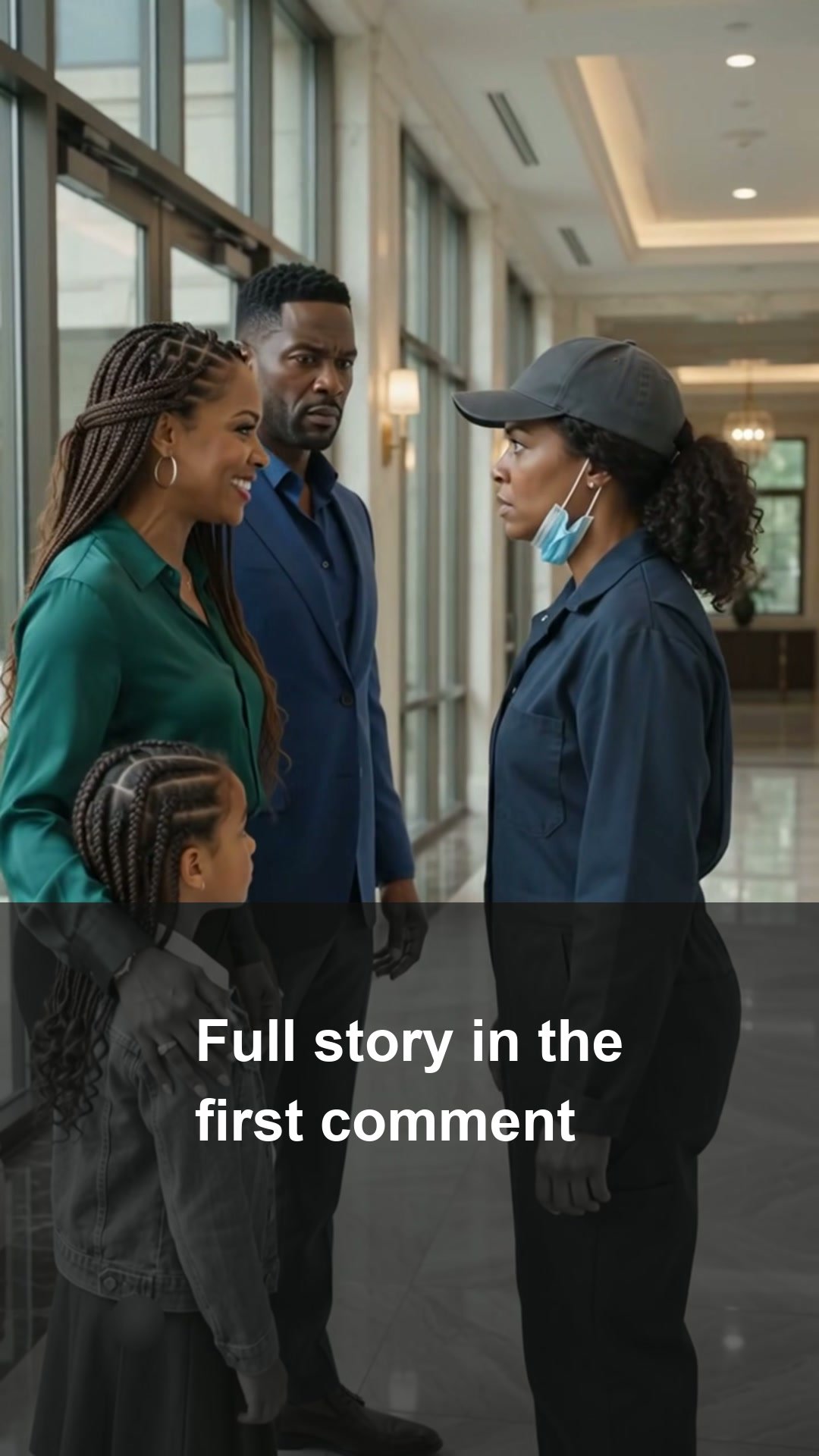
The heavy mop bucket tipped, spilling grey water across the pristine marble of the lobby as I stood frozen. The clatter echoed against the high ceilings, but no one turned, their focus locked on the center of the room.
Marcus stood by the reception desk, his hand resting possessively on the small of a woman’s back. Victoria leaned into him, her smile a thin, practiced line of porcelain. Chloe gripped the woman’s manicured fingers, her head tilted at that specific, rehearsed angle she only used for strangers who held power.
Marcus laughed—a low, melodic sound that used to make me feel safe. He pulled Chloe closer, his eyes scanning the room with the easy authority of a man who owned the air he breathed.
“This is Sarah,” Marcus said, his voice ringing through the cavernous space. “My wife.”
The mop handle slipped through my wet, trembling fingers, hitting the floor with a dull thud. My own daughter stared right through me, her eyes dead and vacant, failing to flicker even as I stood three feet away. I took a breath that felt like swallowing broken glass. I had to disappear before he looked down.
The kitchen clock hummed a steady, rhythmic pulse that filled the silence of the house. I sat at the granite island, the surface cold against my forearms, staring at the steam spiraling off a ceramic mug. The scent of dark roast and toasted sourdough felt aggressively domestic. Marcus was already in his study, the muffled rhythm of his keyboard tapping out the cadence of our morning. Outside, the Greenwich fog clung to the hedges, muting the world into a soft, grey smear.
I reached for my phone, scrolling through the local weather report. Rain expected by three. I needed to pick up the dry cleaning before the sky opened up. My thumb hovered over a photo of Chloe from last year, her face bright with a gap-toothed grin before I remembered Marcus had requested I move those files to the cloud—to save space, he had said. I didn’t question it. I didn’t question much of anything then.
The printer in the hall whirred to life, a frantic, mechanical chattering that signaled the start of his day. I stood, my legs stiff, and walked toward the office door to bring him his second cup. I knocked lightly, three times, the wood grain rough against my knuckles.
Marcus didn’t look up. He was staring at his monitor, his tie perfectly knotted, his posture rigid. He was drafting an email to the board, something about quarterly projections and community outreach.
Everything is under control, he murmured without turning his head. I set the coffee down on a coaster, noticing a stack of glossy invitations for the upcoming school gala sitting near his elbow. I traced the edge of the heavy cardstock.
Do we have a firm count for the seating? I asked, my voice sounding thin, like paper folding.
He finally looked at me, a polite, vacant smile touching his lips. It’s handled, Elena. You focus on your painting today. You were so tired last night. I don’t want you overexerting yourself before the event.
I nodded, the routine comfort of his words acting as a sedative. It was easier to be tired. It was easier to let the gears of our life turn without my interference. I walked back to the kitchen, the floorboards groaning under my weight, and began clearing the breakfast dishes. The domesticity was a heavy cloak, insulating me from the sharp edges of the world outside our gates. I thought about the errands, the grocery list, the way the light would hit the patio at noon—a string of predictable, harmless events.
I picked up the dish towel, folding it into a perfect square. The house felt solid, impenetrable. I believed, with a quiet, hollow sort of certainty, that I was exactly where I was meant to be, participating in a life that belonged to me.
Then, the landline on the wall mounted cradle rang.
The sound was jarring, a sharp, metallic shriek that tore through the morning hum. I froze, the towel still in my hands. We rarely used that line; it was for the house security, the alarm company, the rare, pre-planned logistics. I took a step toward it, my heart hammering a sudden, erratic rhythm against my ribs, and stared at the blinking light on the console. I reached out, my fingers hovering just inches from the plastic, as the house seemed to tilt on its axis. I picked up the receiver.
Hello? I whispered, and the line went deathly, suffocatingly still.
A static hum hissed in my ear, a rhythmic, pulsing sound that mimicked the thrum of my own pulse. I gripped the cord until my knuckles turned ivory.
Is anyone there? I asked again, my voice trembling.
The voice on the other end was not the alarm company. It was Marcus, his tone clipped and clinical, the way he sounded when he was closing a merger. He wasn’t talking to me. He was laughing, a low, smooth sound that made my skin crawl. Beneath his voice, I heard the muffled, unmistakable chime of the school bell—the one at St. Jude’s, three blocks over.
Victoria, sweetheart, stop fussing with her hair, Marcus said, the words cutting through the line like a dull blade. She looks perfect. Just like her mother, before she… well, before things became complicated.
My breath hitched, a dry, jagged sound. I leaned against the cold kitchen tile, the world narrowing until there was only the smell of lemon floor wax and the static.
Victoria’s voice drifted in, high and saccharine, draped in that practiced, maternal warmth she wore like an expensive silk scarf. It was the same voice she used when she told me I was too unstable to handle a parent-teacher conference.
She needs to impress the headmaster, Marcus, Victoria chirped. If she wants that scholarship, she needs to look like she comes from a home that actually exists.
I looked up at the wall clock. 8:15 AM. Chloe should have been at her desk, but the background noise—the bustle of parents, the shuffle of expensive leather loafers on marble—told me they were in the lobby. I saw them in my mind’s eye, the way Marcus would place a possessive hand on Chloe’s shoulder, a gesture that signaled ownership rather than love.
I’m the mother, I whispered, though the words died before they could escape the receiver. I am right here.
Don’t look so nervous, Chloe, Marcus continued, his voice hardening, losing its public sheen. If you mess this up, we’ll have to discuss your piano lessons. We both know what happens when you disappoint me.
The line went silent. I heard the sharp *click* of a bag being snapped shut, the rustle of a heavy wool coat, and then the sound of my daughter’s voice—a small, hollow sound.
Yes, Father, Chloe said.
My stomach dropped, a sickening, weightless sensation that threatened to bring me to my knees. The lie wasn’t just a secret anymore; it was a physical weight, a cage they were locking around her small, narrow shoulders. I didn’t think about the consequences or the fragile invisibility I had maintained for weeks. I didn’t think about the janitorial uniform I wore or the rules I was breaking by being in the house.
I reached out and slammed the receiver back into the cradle, the plastic cracking under the force of my hand. I stared at the door. I had to see it. If I didn’t see the lie, I couldn’t tear it down. I turned and ran.
The sterile scent of antiseptic clung to the hallway of the Riverside Medical Center. I leaned against the cold tile, my fingers trembling as I punched Marcus’s mother’s number into my burner phone. The connection clicked, heavy with static.
Evelyn, I said, keeping my voice a low, rhythmic monotone. When did Marcus move Chloe’s primary care records to the private facility in Stamford?
There was a sharp intake of breath on the other end, followed by the clink of a tea spoon against china. Elena? You shouldn’t be calling. Marcus told me you were in a facility in Vermont for your nerves. He said you were resting.
I pushed off the wall, my knuckles white against the black plastic. He’s lying, Evelyn. Who is the new woman at the house?
The line went silent, save for the hum of the hospital ventilation. I don’t know who you’re talking about, she whispered, her voice tightening into a brittle knot of fealty. If Marcus says you’re resting, then you are resting. Do not call this number again.
She hung up, leaving me with the dial tone. I felt the phantom weight of the seven years I had lost, the years spent believing my own mind was the enemy. I walked toward the front desk, my boots squeaking on the linoleum. The receptionist was young, her eyes glued to a monitor. I tapped the counter, keeping my head bowed.
I need the check-in logs for the Sterling family, I said, adopting the clipped, authoritative tone I used when I worked in design. My husband, Marcus, mentioned an appointment this morning.
The receptionist didn’t look up. They don’t take private appointments on Tuesdays, ma’am. Dr. Aris is only in the city on Thursdays. And Mr. Sterling hasn’t been here since the quarterly review in January.
My heart hammered against my ribs, a frantic, trapped bird. If they weren’t here, where were they? I turned toward the exit, my mind racing through a list of names. I stopped at the payphone near the vestibule and dialed the number for the nurse who had been on duty during Chloe’s last fall.
Nurse Miller? I asked, my grip tightening on the receiver. You remember me. I’m the mother of the girl who broke her arm last spring.
The line crackled. You aren’t the mother, the woman replied, her voice flat and bored. The woman who came in with him was tall, blonde, and kept her hair in a tight braid. She signed the forms as Victoria Sterling.
The world tilted. I slammed the phone back into the housing and stepped out into the humid Greenwich air. The parking lot was a sea of polished steel. I pulled my janitor’s jacket tight around me, the coarse fabric a reminder of the life I had been forced to adopt. I needed to see the house. Not the school, not the doctors, but the place where they were building their new reality.
I climbed into my beat-up sedan and gripped the wheel, my knuckles aching. Every witness pointed in a different direction, a kaleidoscope of contradictions designed to leave me blind. I put the car in gear, my eyes fixed on the horizon, toward the gates of the estate where my daughter was currently living a life that didn’t belong to her. The engine roared, a jagged, discordant sound in the quiet of the afternoon, and I began the drive.
The iron gates of the estate stood like sentinels, painted in that aggressive, pristine white Marcus favored. I killed the engine a block away and walked, my boots crunching on the manicured gravel of the driveway. Through the living room’s floor-to-ceiling windows, the interior glowed with a warmth that felt like a surgical incision.
I stopped behind a thick hydrangea bush, the scent of damp earth and rot clinging to my sweater. Inside, the scene was perfectly staged. Chloe sat at the mahogany piano, her spine rigid, her small fingers dancing over the keys with a frantic, forced precision. Victoria stood behind her, one hand resting on the girl’s shoulder. It wasn’t a comforting touch; her nails dug into the fabric of Chloe’s dress, anchoring her in place. Marcus leaned against the fireplace, swirling a glass of amber liquid, his face a mask of effortless domestic contentment.
My pulse hammered against my throat, a frantic, rhythmic beat that threatened to choke me. I wanted to shatter the glass, to scream until the carefully constructed silence of the room collapsed into dust. Instead, I stood motionless, my breath hitching as Victoria leaned down to whisper something into Chloe’s ear. Chloe winced, then nodded, her face devoid of the spark I had spent years nurturing. She looked like a doll—hollow, polished, and ready to break.
The back door slid open, and a catering assistant emerged to toss a bag of refuse into the bin. I ducked into the shadow of the brick chimney, my hand finding the cold, jagged edge of a brick. I watched as Marcus walked over and placed a hand on Victoria’s waist, pulling her into a kiss that stole the air from my lungs.
I stepped out, the gravel crunching under my boot, and they turned as one. The shock on Marcus’s face was sharp, then hardened into a sneer.
“Who are you?” he asked, his voice dripping with practiced disdain.
“I am the one you couldn’t kill.”
The kitchen in our first apartment was barely large enough for a card table, but Mother insisted we keep the good silver polished. I remember the smell of vinegar and Windex, the sharp, acidic sting that always preceded a reprimand. When I was seven, I dropped a fork on the linoleum. It made a dull thud, not the chime she demanded. She stood over me, her shadow eclipsing the light from the overhead bulb, and told me that if I couldn’t learn to handle things with grace, I would eventually be discarded for someone who could. I spent the next twenty years proving her wrong, or so I thought.
Marcus came into my life during a gallery opening, a man who spoke in absolutes. He didn’t just want to date me; he wanted to curate me. We were at a gala in the city, the champagne tasting like expensive copper. He touched my elbow—a light, possessive pressure—and told me I had a brilliant eye for design, but that I suffered from a lack of focus. I remember the way he leaned in, his breath cool against my ear. He said, Elena, you are a masterpiece in the making, but you need a frame. I thought he meant protection. I didn’t realize he meant a cage.
The house in Greenwich was the first step toward the erasure. We moved in when Chloe was barely a year old. The walls were cream, the floors polished to a mirror finish, and the silence was heavy, like a held breath. One Tuesday, I found a pile of our wedding albums in the trash chute in the garage. I pulled them out, the leather binding cold against my skin, and walked into the study. Marcus was behind his desk, the glow of the monitor illuminating the hard lines of his jaw. Why, I asked, my voice trembling. He didn’t even look up. He told me the photos were cluttered, that they distracted from the house’s aesthetic. He told me that my presence in those pictures made the room look cheap. I felt a chill that started at my spine and settled in my marrow. I didn’t argue. I put the albums back in the dark of the closet, believing that if I was just quieter, just more efficient, the clutter would disappear on its own.
Seven years ago, the breakdown wasn’t a crack—it was an explosion. It happened after the dinner with the Vances. Victoria was there, her laugh like shattering glass, her eyes always measuring the value of my silverware. I had spent hours preparing a risotto, the steam curling my hair, my hands shaking from the effort of making everything perfect. When I tripped, sending the bowl sliding across the marble, Victoria didn’t help. She sighed, a low, pitying sound, and exchanged a look with Marcus. It was the look of two architects observing a structural failure. I collapsed on the kitchen floor, the heat of the food burning my palms. I didn’t scream. I just stopped being able to translate the world into words.
Marcus used that moment like a scalpel. He didn’t take me to a therapist; he brought a specialist to the house. A man with expensive shoes and a soft, condescending voice who asked me about my childhood until I felt like a cadaver on a table. Marcus stood in the doorway, his arms crossed, watching the proceedings with the detached satisfaction of an auditor. By the third week, they had agreed on a narrative: I was unstable, prone to outbursts, a danger to the girl who was the future of his social standing. They put me on a regimen of sedatives that turned my dreams into gray static. I woke up each day in a fog, trying to remember who I was before the medication, but the memories were like sand slipping through my fingers.
My sister, Sarah, tried to reach me once. She came to the front gate, her hair windblown, her face creased with a frantic, beautiful worry. I watched from the upstairs window as Marcus met her at the driveway. He didn’t raise his voice. He didn’t have to. He stood there, tall and immaculate, and I saw him hand her an envelope—money, I assumed—and whisper something that made her face crumble. She didn’t look up at the house. She just turned around and walked away, her shoulders slumped. I pressed my forehead against the cool glass of the window, the pane vibrating with the sound of a lawnmower, and realized that my isolation was total. He had made me a ghost while I was still drawing breath.
The piano practice became the final theater of my erasure. Chloe would sit at the Steinway, her small fingers hitting the keys with a frantic precision. Marcus would pace the perimeter of the room, his hand hovering over her shoulder, ready to correct a posture or a tempo. One day, I walked in to bring her a glass of water, and he blocked my path. He told me that my presence was causing her performance anxiety. He said, Elena, you are a shadow, and she needs to be a star. He guided me out of the room, his palm against my back, a gesture that felt like a shove. From the hallway, I watched them through the crack in the door. I saw him grab her wrist—too hard, a flash of red skin—and I heard him whisper that if she played one wrong note, she would end up like her mother.
I started keeping a journal in the back of a hollowed-out book on the bottom shelf of the library, hidden behind a row of encyclopedias no one ever opened. I wrote in tiny, cramped letters, recording the dates of his absences, the changing names of his secretaries, the way Victoria Vance began to leave her coat in the foyer as if it belonged there. I watched the way the household staff looked at me—with a mix of pity and fear—and I began to mirror their movements. I learned to disappear into the periphery. I learned to watch the way Marcus clutched his phone, the way he would step into the garden to take calls, the way he looked at his own reflection in the hallway mirror, admiring the man he had successfully manufactured.
The night I realized I had to leave was the night of the charity gala. I was sitting in the dressing room, wearing a gown Marcus had chosen, a dress that felt like a costume for a funeral. I looked in the mirror and didn’t recognize the woman staring back. She was pale, hollow-eyed, perfectly composed, and entirely dead. I saw Marcus walk past the door, his arm linked with Victoria’s. They were laughing about a mutual friend’s divorce, the casual cruelty of their words echoing off the marble floors. I realized then that I wasn’t being protected; I was being dismantled, piece by piece, until there would be nothing left to bury.
I decided that night. I didn’t scream. I didn’t throw a vase. I simply started to move objects. I took a small, silver brooch from my jewelry box and tucked it into the lining of my coat. I took a handful of documents from the safe while Marcus was occupied with the guests. I walked out the back door, the autumn air biting into my skin, and for the first time in seven years, I didn’t look back at the house. I left the life they had built for me, shedding the skin of the woman who had been too afraid to break, and stepped into the dark of the driveway. I had no money, no plan, and no safety, but I had the clarity of the discarded. I knew then that the only way to save the girl was to burn the mask that had kept me invisible. I stood by the stone wall, watching the lights of the house flicker, and I promised the silence that I would return, not as the wife who was broken, but as the ghost who had come back to finish the haunting.
The library of the Greenwich Historical Society smelled of dry rot and expensive, unread leather. I pushed a heavy rolling ladder aside, the metal screeched against the parquet floor, echoing like a gunshot in the vaulted room. Marcus, my husband, was somewhere across town, likely smoothing his silk tie in a mirror, convinced his ghost had finally stopped haunting his hallways. He was a man who measured his life by the thickness of his stock portfolio, yet he was hollowed out by a desperate, pathetic need to be admired by people he secretly despised. I tucked a folder of his bank statements into my janitor’s apron, the paper crisp against my skin. He thought I was the broken one because I had once wept over a burnt roast, but he didn’t know that my grief had been the only honest thing in our house.
Sarah, the head custodian, leaned against the mahogany desk, her fingers tapping a rhythm on her smartphone. She had three jobs and a daughter who needed braces, yet she was the only one in this town who looked me in the eye without measuring the label on my sweater. She was a woman of survival, hiding a sharp, cynical intellect behind a subservient nod.
Did you get it, Elena? she asked, her voice a low scrape of sandpaper.
I nodded, my hand resting on the spine of a ledger. I needed her to believe I was composed, even as my internal compass spun wildly toward the terror of losing Chloe. If I failed, I wouldn’t just be the erased wife; I would be the cautionary tale they whispered about at the country club. I watched a spider crawl across the desk and decided then: I would not just dismantle Marcus’s empire, I would dismantle his vanity.
Victoria Vance was currently at my kitchen table, serving Chloe tea with the practiced grace of a predator. She was a social climber who saw motherhood as a performance piece, a way to accessorize her ambition. She likely thought she was winning, but she was a woman whose cruelty was her only true talent. She would hate the taste of real consequences.
I looked at Sarah, the fluorescent light casting deep shadows under her eyes. I had to tell her about the bruises I had seen on Chloe’s wrists, the way the girl flinched when a door slammed. My heart hammered against my ribs—a frantic bird in a cage I had spent seven years cleaning.
We move tomorrow, I said.
Sarah’s expression didn’t flicker, but she reached out and squeezed my arm, her grip firm and grounding. She was risking her livelihood for a stranger, a contradiction that defied the cold, transactional nature of Greenwich. She believed in justice, a concept most of these people only used to threaten others.
My decision solidified. I would no longer play the part of the invisible woman. I would step into the light of the gala, not as a guest, but as the wrecking ball they had invited in. I pulled my phone from my pocket, the screen glowing with a photo of Chloe, my daughter whose eyes were growing wider, more terrified, by the day. She was the anchor in my storm, the only person for whom I was willing to commit the final, irreversible act of destruction.
I took a deep breath, the air tasting of dust and cold intention. Across town, Marcus was probably pouring a drink, unaware that the ghost he had buried was currently drafting his obituary. I stepped toward the exit, the heavy oak door looming, and felt the weight of my own life shifting. I was ready to burn it all.
The fluorescent lights of the precinct lobby hummed with a headache-inducing frequency. I stood before the desk sergeant, my knuckles white against the edge of the laminate counter. I handed him the thumb drive—the one containing three months of audio logs where Victoria Vance instructed Chloe on how to “forget the woman who gave birth to you” and described the exact pressure points required to make a child stop crying in public.
Officer Miller watched me, his eyes flicking over my oversized janitor’s jacket and the frayed cuffs of my trousers. He didn’t see a woman who owned a home in Greenwich; he saw a nuisance in work clothes. I didn’t care. I listed the dates, the times, and the names of the private pediatricians who had falsified medical records to hide the bruising on my daughter’s arms.
The report was filed. As the clerk stamped the document, I heard the faint *thwack* of the ink hitting the page—a sound of finality. My phone vibrated in my pocket. Marcus. He was calling from the office. I ignored it, feeling a jolt of adrenaline as I walked out into the cold Connecticut night. The first domino had tipped.
By the following morning, the ripple hit. I sat in a booth at a diner two towns over, my laptop open to the online portal of our joint bank account. My finger hovered over the ‘Transfer’ button for the emergency fund we’d shared for a decade. I moved every cent to a private account Sarah had helped me set up in my name only.
Ten minutes later, my phone pinged. A notification from the bank: *Security Alert: Your access has been restricted.* Marcus had frozen the accounts. He was reacting, just as I’d anticipated. He was trying to starve me out, believing I was still the woman who couldn’t balance a checkbook without asking his permission. He didn’t know I had already moved the liquid assets before his morning coffee.
I met Julian Vane, the lawyer, at his office in Stamford. He was an older man with the predatory posture of someone who fed on high-society scandal. I placed the dossier on his desk. It wasn’t just the audio; it was the photographic proof of Marcus funneling client funds into the school board’s “discretionary fund,” essentially paying for the administration’s silence regarding Chloe’s distress.
Vane turned a page, his eyebrows rising. “This will trigger a corporate audit, Elena. He’ll be under federal scrutiny within forty-eight hours. You understand this means there is no going back to the marriage. No reconciliations. You are effectively detonating his career.”
“I’m not looking for a marriage,” I said, my voice steady, stripped of the trembling doubt that had defined my seven years of sequestration. “I’m looking for a custody hearing.”
He nodded, already picking up his phone to signal his paralegal. “We file for emergency custody at 9:00 AM tomorrow.”
I left the office and drove to the school. I had one more task before the legal storm broke. I walked into the main office, catching the administrator, Mrs. Gable, off guard. I handed her a formal written complaint—a document that would force an internal HR investigation into the school’s handling of Chloe’s file. Her face went ashen as she read the legal headers. She tried to stammer out a defense, but I silenced her with a look.
“My daughter is being abused,” I said, my voice low enough that the teachers in the hallway couldn’t hear. “And you have been facilitating it. Choose your next words carefully, Mrs. Gable.”
She looked at the phone on her desk, then back at me. She didn’t call security. She sat down, her hand shaking as she reached for a pen to sign the receipt of the complaint.
That afternoon, the escalation turned personal. I arrived at the neutral testing center I’d booked three weeks ago. I wasn’t there for a court-ordered test; I was there for a private, preemptive strike. I had secured a sample of Chloe’s hair from the brush she’d left in the car the one time I’d managed to catch her alone. I watched as the technician processed the kit. By the time I walked out to my car, my phone was ringing incessantly. It was Marcus.
I didn’t answer, but I opened the text he’d sent. *Where are you? The lawyers are calling about a freeze on the accounts. What have you done?*
I felt a cold, sharp thrill in my chest. He was panicking. For the first time in seven years, I wasn’t the one looking over my shoulder wondering if my behavior was “rational” enough to keep him happy. I was the one setting the tempo.
I started the engine. Ahead of me, the road to Greenwich looked different—less like a cage and more like a map. I knew he would try to move Chloe. He would try to hide her in a private facility or ship her to his mother’s estate in Maine. I checked the glove box, where I’d hidden the spare key to his safe. Inside was the passport he didn’t know I knew about, the one he used for his “business trips” with Victoria.
I realized then that the fight for Chloe wouldn’t happen in a courtroom alone. It would happen on the streets, in the quiet corners of the school, and in the sudden, violent shattering of his reputation. I pulled onto the highway, watching the rearview mirror. No one was following yet. I pressed the accelerator. The next move was his, but for the first time, I was the one dictating the board. The glass was breaking, and I was the one holding the hammer.
The local news vans parked on the perimeter of the school grounds like vultures circling a fresh kill. I stood behind the service entrance of the cafeteria, pressing my forehead against the cool, industrial steel of the door. My phone vibrated against my palm, a steady rhythm of notifications that felt like a swarm of hornets. A DM from a mother in Chloe’s grade flashed on the screen: Is it true? The video of Victoria at the gala—is that really what happened? I didn’t reply. The fallout wasn’t a singular explosion; it was a slow, agonizing erosion of the life Marcus had carefully curated.
I walked toward the trash compactor, my mop bucket clattering in the silence of the empty hallway. Mrs. Gable, the school secretary who had once ignored my existence, stood near the bulletin board, her hand trembling as she peeled down a glossy flyer featuring Marcus and Victoria. She saw me and didn’t look away. Her eyes were hard, scrubbed clean of their usual polite deference. You’re the one, she whispered, her voice barely audible over the hum of the HVAC. The board is meeting in an hour. They’re tearing his name off the donor plaques.
I stopped, the mop handle slippery in my grip. Why are you telling me this?
She looked toward the front office, then back at me. Because my daughter is in Chloe’s class. She told me about the bruises. We all saw them, Elena. We just didn’t want to see them.
The weight of her admission hit me harder than any physical blow. It wasn’t just Marcus and Victoria; it was the entire system of polite silence that had allowed them to operate. I didn’t say thank you. I just nodded, a sharp, mechanical movement, and turned back toward the utility closet. The guilt of the collective was a heavy, suffocating thing, but I couldn’t afford to carry it. I had to be cold. I had to be a ghost who could finally touch the world.
I reached the closet and pulled out the small digital recorder I’d hidden beneath a stack of paper towels. The footage of Victoria shouting at Chloe in the parking lot was already trending on social media. The comments were a wildfire of outrage—people who had never met us were suddenly experts on our trauma. My own face, captured in a blurry screenshot from a bystander’s phone, was circulating on Instagram under the hashtag #WhereIsElena. I looked at the image and barely recognized the woman staring back. She looked tired, frayed, but her eyes were fixed on the camera with a terrifying, absolute clarity.
I pushed the phone into my pocket and walked out the back door. The afternoon air in Greenwich felt thin. A black SUV—Marcus’s car—idled at the far end of the parking lot, surrounded by two reporters. I watched from the shadows of the dumpster as Marcus stepped out. He looked smaller, his suit jacket rumpled, his face a mask of practiced, crumbling indignation. He tried to speak, but a reporter shoved a microphone toward his mouth, and he recoiled as if it were a weapon.
I felt a phantom tug in my chest, a remnant of the years I’d spent trying to protect him from his own failures. I forced myself to watch him drown. I turned away, walking toward the subway station, deciding then that I would not be the one to rescue him. I was going to finish the work I started. The hook was in, and the line was pulling tight.
The courtroom air tasted of floor wax and stale coffee. I sat on a hard wooden bench, my fingers tracing the hem of my borrowed blazer. Marcus stood at the defense table, his shoulders hunched, refusing to make eye contact with the gallery. The judge’s gavel fell with a finality that made the heavy oak doors vibrate. The restraining order was granted, a physical tether of paper and ink binding his malice behind a fence I had built with my own evidence. Victoria, seated two rows back, wore a beige coat that looked like a shroud. She caught my eye, her jaw tight, but she didn’t offer her usual rehearsed, pitying smile. She just looked tired. I didn’t feel triumph, only a hollow, vibrating relief. I thought about the thousands of hours I had spent being invisible, a ghost in my own marriage, and how easily that ghost had finally spoken. I stood up, my heels clicking on the tile, and walked toward the exit without looking back at them.
The apartment was a fourth-floor walk-up in a neighborhood that didn’t know or care about Greenwich. It smelled of citrus and rain. I hung my keys on the hook by the door, the metal clinking softly—a sound that no longer signaled impending criticism. In the corner, Chloe sat on the floor, surrounded by a mess of glitter glue and construction paper. She didn’t look up when the door opened, but her shoulders dropped three inches, the tension draining out of her frame like water from a sieve. I walked over and sat down on the rug beside her. She pushed a blue crayon toward me. We colored for an hour, the only sound the rhythmic scratch of wax against paper. There was no piano, no performance, no expectation of perfection to be met. I watched her hand—small, steady, and finally unburdened—move across the page. She wasn’t watching the door. She wasn’t waiting for the heavy tread of her father’s shoes or the sharp, corrective voice of the woman who had tried to erase me. I stood up and walked to the closet, pulling out the blue janitor’s uniform I had kept in a plastic bag. It was stiff with starch and memories of a life that felt like it belonged to someone else. I dropped it into the trash bin beneath the sink. My hand hovered over the lid for a second, then I pressed it shut. My life was small, quiet, and entirely mine. The front door was locked, not to keep someone out, but to keep the peace safely inside.
I moved the kitchen table near the window, chasing the afternoon light. Sunlight pooled on the floorboards, warming the spot where our new golden retriever, Barnaby, lay sprawled in a heavy, snoring sleep. I wasn’t waiting for a text or checking the security feed. I was just peeling carrots. The rhythmic *scrape-scrape* of the peeler against the orange skin was the loudest thing in the room.
Chloe sat across from me, her coloring pencils scattered like confetti. She hadn’t looked at the door in three hours.
“Do you think he likes carrots?” she asked, gesturing toward the dog.
“He likes anything that falls on the floor,” I said, dropping a chunk near his nose.
She laughed, a small, tentative sound that didn’t hold the jagged edges of the past. It was just a laugh. She didn’t flinch when the neighbor’s car backfired in the driveway. A few months ago, that sound would have sent her diving under the table, her breath hitching in a way that shattered my chest. Now, she just tilted her head and went back to her sketch.
I felt the silence in my bones. It wasn’t the lonely, suffocating silence of the Greenwich house, where every word was curated and every gesture a performance. This was porous. It breathed. I reached for the pot, the water inside already beginning to shiver with heat. I was making a simple stew—nothing fancy, no wine reductions, just broth, root vegetables, and time.
“Hungry?” I asked.
“Starving,” she replied, picking up a bright blue pencil.
I watched her, the way her hair fell over her eyes, unbrushed and beautiful. I didn’t need to fix her, or explain her, or hide her. I just needed to feed her. I turned back to the stove, the steam rising to meet my face, and for the first time in years, I didn’t feel like a ghost haunting my own life. I was just a mother, standing in a kitchen, waiting for the water to boil.
The screen door creaked open, admitting a slice of the humid Connecticut afternoon. Outside, the park was a mosaic of manicured lawns and splintered wood chips. Chloe darted past the slide, her sneakers kicking up dust as she sprinted toward the swings where I waited with a water bottle. She didn’t look back at the polished SUV idling near the curb, nor did she scan the perimeter for the shadows of bodyguards or the cold, critical gaze of her father. Marcus’s influence had evaporated in the harsh light of the morning’s deposition. Near the rusted base of the jungle gym, partially buried in the damp earth, a pair of heavy gold cufflinks caught the sun. They were engraved with his initials, dull and tarnished in the grit. Chloe ran right over them.
Leave a Reply