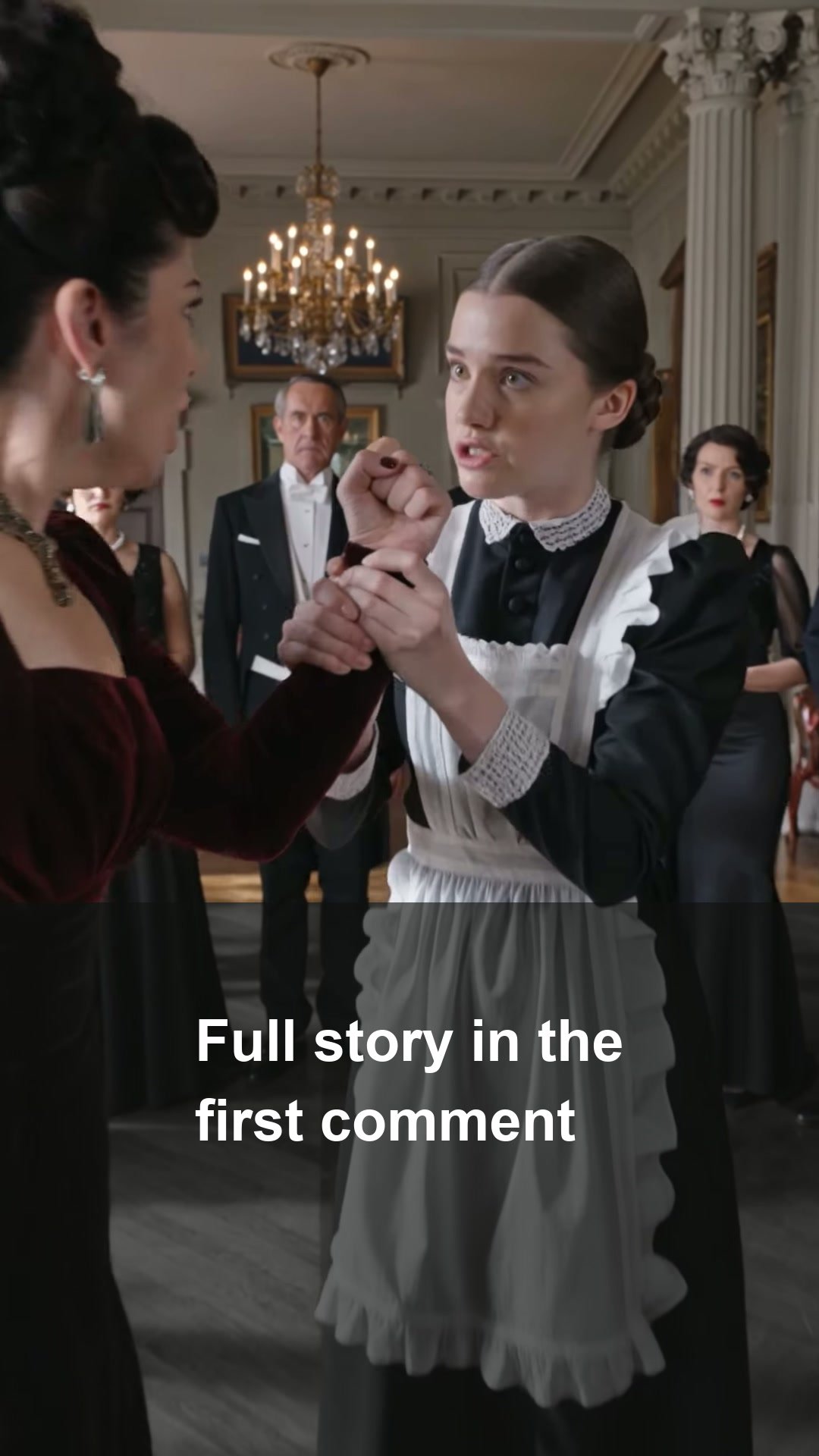
The heavy velvet curtain behind the podium didn’t just fall; it surrendered, revealing the original, blood-red founding charter embossed with Eleanor Cole’s authentic seal.
The ballroom air curdled. Victoria’s fingers locked onto the lectern, her knuckles turning the color of bleached bone. A single drop of champagne slid down the crystal flute she still clutched, marking the mahogany like a slow, dark wound.
Alexander stepped forward, his shadow stretching long and jagged across the marble. He didn’t look at the crowd; he looked at the woman he had been told was a ghost.
Is this it, he asked, his voice barely a murmur beneath the hum of the air conditioning. The silence that followed was thick, suffocating, and absolute.
I have spent twenty years curating a fiction, I thought, watching the board members shrink into their silk lapels. My career, my reputation, and my very skin felt like cheap polyester beginning to fray. I reached for my phone, my thumb hovering over the delete key for every press release I’d ever drafted.
If I don’t move now, I will be buried with the debris. I stood up and walked toward the side exit.
The office was a kingdom of beige and recycled air. Tuesday morning arrived with the same rhythmic predictability as the city’s transit schedule. I sat at my desk, the mahogany surface polished to a dull, mirror-like sheen that caught the harsh glare of the fluorescent lights. My routine was a religion of small, precise movements: the ceramic mug positioned exactly two inches from the edge of the blotter, the pen aligned parallel to the keyboard, the screen glowing with a spreadsheet that meant everything and nothing all at once.
Outside, the Manhattan sky was a bruised, uninspiring gray, promising the kind of persistent drizzle that turned umbrellas into weapons on the sidewalk. I watched a courier struggle with a stack of boxes across the street, his movements frantic and uncoordinated. It was a chore to look at him. I preferred the internal logic of the foundation, where every press release was a structural beam in a cathedral of managed perception.
Victoria tapped on my door frame, the sharp click of her heels announcing her presence before she spoke. She looked as she always did: tailored, expensive, and entirely devoid of warmth. She held a stack of brochures bound in heavy, cream-colored cardstock.
The printer in the hallway jammed again, emitting a grinding, mechanical shriek that set my teeth on edge.
Those need to go out by noon, Julian, she said, dropping the pile onto my desk. Her perfume—a sharp, citrus-heavy scent—lingered in the air, clashing with the smell of my stale coffee. Did you clear the copy with Marcus?
I haven’t had the chance yet, I lied. It was a reflex, a habit of deferring the inevitable.
Well, make it a priority. We need the narrative tight. The gala is three weeks away, and I won’t have any loose threads regarding the early years. She paused, her eyes skimming my desk with a clinical appraisal that made me feel like an exhibit. You look tired. Get a tea or something. We need you sharp.
I nodded, my voice a practiced, neutral instrument. I’ll have it handled before lunch, Victoria.
She didn’t smile. She never did. She simply turned and marched back toward the executive wing, her silhouette disappearing into the glass-walled corridor. I stared at the brochures. The paper was textured, heavy, designed to feel like history. I picked one up, my fingers brushing the embossed logo—the false crest of a family I had helped erase through careful, surgical PR. I felt nothing but the familiar, detached satisfaction of a job well-oiled. It was an ordinary day. I was an ordinary man serving an extraordinary lie, and the world was quiet, orderly, and entirely predictable.
I reached for my coffee, turning the ceramic mug until the handle faced exactly north. I thought about the weekend, about the book I hadn’t finished, about the way the light hit my apartment window at five in the afternoon. I was considering whether to order takeout or cook for myself when the phone on my desk let out a sharp, sudden trill. It was a jarring sound, too loud for the stillness of the room, piercing through the hum of the air conditioning like a warning bell. I stared at the screen, watching the caller ID blink, and for a second, I didn’t recognize the number.
I answered on the fourth ring. The connection hissed with a dry, static static that felt like sandpaper against my ear. Victoria’s voice wasn’t the polished, practiced instrument I heard in boardrooms; it was thin, brittle, like glass vibrating under too much pressure. Julian, she whispered, there is a woman at the north entrance. She’s wearing a coat that looks older than my career, and she’s demanding to speak with Alexander. Do not call security. Just come down here.
I hung up before she could provide an excuse, the plastic receiver slick with a sudden sheen of sweat in my palm. The office felt smaller, the walls closing in as the air conditioning groaned, struggling to keep up with the rising heat. I remembered the brochures I had drafted three months ago, the ones where I described Alexander’s mother as a tragic figure, an alcoholic who had squandered her inheritance before vanishing into a haze of regret. I had written those words at Victoria’s insistence, my fingers dancing over the keyboard, burying a woman in printer ink and gilded lies.
I stood up, my chair scraping against the hardwood with a screech that set my teeth on edge. I walked to the window. Outside, the Manhattan skyline was a jagged row of teeth against the darkening sky, and down below, the gala was beginning to churn with the low, expensive hum of the city’s elite. I caught sight of Victoria near the revolving doors, her posture rigid, her hand clutching a glass of champagne so tightly her knuckles were white. Standing opposite her was a woman who looked like a shadow cast in living, breathing form. Her hair was pulled back with a sharp, silver clasp, and her gaze, even from four stories up, felt like a scalpel.
It was her. The ghost I had helped exorcise from the foundation’s history.
My stomach turned, a cold, heavy sensation that made me want to sit back down and pretend the phone had never rung. My professional life was a house of cards, and the wind had just arrived. I straightened my tie, checking my reflection in the dark glass. I looked exactly as I was meant to: an accessory to a fiction.
I crossed the room and stepped into the hallway, the carpet muffling my footsteps. I needed to see if the woman was real or if my own mounting guilt was finally projecting onto the sidewalk. If I reached the lobby, I could see the truth for myself. I walked toward the elevators, my hand hovering over the call button, feeling the weight of the next ten minutes pressing down on me. I realized then that my life as a spectator was effectively over. I took a breath, pressed the button, and waited for the doors to slide open, ready to step into the collapse.
The lobby was a cavern of marble and dying orchids. I pulled my phone from my breast pocket, the screen casting a harsh, blue light against the mahogany desk where a night clerk stared at a monitor. I dialed the first number on my list: Marcus Thorne.
He answered on the second ring, his voice thick with the synthetic calm of a man who practiced his panic in the mirror. When I asked him about the woman in the ballroom, he didn’t hesitate. She’s a vagrant, Julian, a relic of the old staff who had a nervous breakdown twenty years ago, he barked, his breathing shallow. Forget her. If she’s there, call security.
I looked at the clerk, who was busy buffing a smudge on his keyboard. He didn’t look like a man guarding a secret, just a man counting minutes. I walked over and showed him the blurred photo I’d snapped from the mezzanine. He squinted, then shook his head. That’s not a guest, he said, his tone flat. No one by that name checked in. We don’t have anyone fitting that description in the building tonight.
My fingers tightened around the phone. If she wasn’t a guest and she wasn’t a stranger, she was a ghost. I stepped outside into the biting Manhattan air and dialed the hospice nurse who had signed the death certificate two decades ago.
She picked up on the fifth ring, the sound of a television flickering in the background. Eleanor Cole? The name sounded like an accusation. She died in the facility, Julian. I held the chart myself. The cremation was documented, the urn is in the foundation’s archive. You’re dreaming.
I leaned against the brick facade, watching the valet navigate a sea of taillights. The nurse was wrong; the clerk was wrong; Thorne was terrified. Each denial felt like a jagged piece of a puzzle that refused to lock. I thought of Victoria’s face back in the ballroom—the way her eyes had glazed over, turning to obsidian when she realized the woman was standing right behind her.
I needed a witness who wasn’t on the payroll. I dialed Sarah, a junior archivist I’d fired three months ago under Victoria’s direct order. She answered immediately, her voice sharp with residual spite. The archive? she repeated, her laughter brittle. Julian, there is no archive. I spent six months shredding those boxes. Victoria told me they were moldy, useless tax records from the eighties. I burned the ledgers myself in the back lot.
I stared at the streetlights, the truth coalescing into a singular, ugly reality: I had been the mouthpiece for a vacuum. I hung up and looked at the black SUV parked at the curb. I knew the driver, a man who worked for the firm, not the foundation. He sat behind the wheel, his silhouette rigid. I walked over and tapped on the glass. He lowered the window, his eyes refusing to meet mine.
Where is she? I asked.
He looked at the ballroom doors, then back at the road. Mr. Cole took her out the service entrance ten minutes ago, he muttered, his voice barely audible over the idling engine. They’re headed to the private hangar at Teterboro. He didn’t look like he was escorting a vagrant, Julian. He looked like he was holding onto a saint.
I turned away, the cold air hitting my lungs. I had a choice: stay here and keep the lie warm, or get in my car and find out where the ghosts go when they finally decide to stop haunting the living. I started walking toward my car.
The first time I understood that truth was a liquid currency, I was eight years old, sitting in the back of my father’s Buick as he practiced his pitch for the local zoning board. He was a man of cheap suits and cheaper intentions, a real estate developer who built houses with foundations of sand and promises of granite. He would lean into the rearview mirror, eyes wide with a practiced, desperate sincerity, and tell me that if he said the house was solid enough times, the inspectors would stop bringing their levels. I watched his reflection, the way he tweaked his tie until the knot looked like it belonged to a man who owned a bank. I learned then that if you are loud enough, people will mistake your volume for honesty. By the time I hit my teens, the pattern was cemented. We were a family of improvisers, living in a suburban limbo where the rent was always two months late and the dinner table conversation was a rotating sequence of fabricated successes. My sister, Clara, was the only one who didn’t play along. She would sit at the edge of the kitchen table, her fork scraping against the ceramic, staring at our mother with a look that wasn’t quite pity—it was worse. It was the look of a witness. One evening, after the landlord had pounded on the door for the third time that week, Clara pushed her chair back and said, Why do we pretend the money is coming when it’s already gone? My father’s hand didn’t tremble, but his face went perfectly, terrifyingly smooth. It was the same look I would see on Victoria’s face twenty years later when she realized a reporter was digging into the Cole Foundation’s tax filings. My father stood up, walked over to Clara, and whispered that if she ever spoke the truth in public, we would all starve together. I watched her swallow her defiance, her throat working against the dry air, and I realized then that survival wasn’t about being right. It was about being useful to the lie.
I took those lessons into university, where I studied the mechanics of reputation. I didn’t care for the history of the world; I cared for the history of how the world was told. I spent my afternoons in the archives, not reading the records, but reading the press releases about the records. I saw the way powerful families would scrub the grit from their lineage, turning alcoholics into temperance advocates and bankruptcies into calculated risk-taking. I was an apprentice to the illusionists. When I landed the job with the Cole Foundation, I thought I had finally reached the peak of the craft. Alexander Cole was the perfect canvas: a man so haunted by his mother’s disappearance that he was willing to let anyone paint whatever portrait they wanted over the empty space she left behind. Victoria was the primary artist. I remember the day she brought me into the boardroom, her heels clicking on the marble like a metronome. She laid out the narrative: Eleanor Cole was a flighty, unstable socialite who had abandoned her son to satisfy her own hedonistic impulses, leaving the business to crumble until Victoria stepped in to save it. It was a clean, sharp story. It had everything a board of directors wanted: a villain to blame, a victim to pity, and a heroine to worship.
I wrote the brochures. I drafted the press releases. I spent five years polishing the tarnished brass of Victoria’s ego, convincing the public that the Cole Foundation was built on her vision. Every time Alexander would start to ask questions, Victoria would intercept him with a folder of doctored documents or a reminder of how close the foundation had come to collapse. I watched her manipulate him with the same rhythmic predictability my father had used on the zoning board. She made him feel small, then she gave him a title to make him feel tall again. It was a symbiotic toxicity. Alexander grew colder, more detached, his eyes becoming mirrors that reflected nothing but the PR scripts I handed him. I stood in the back of the room during every gala, watching the guests drink champagne and toast to the salvation of the Cole legacy, and I felt nothing but a dull, rhythmic thrum of boredom. I was the architect of his prison, and I was proud of how well I had reinforced the walls.
The warnings were always there, buried in the margins. There was the accountant who wouldn’t sign off on the 2018 audit and was fired within the hour for ‘personal reasons.’ There were the emails from the original legal counsel that Victoria deleted before Alexander could ever see them. I saw it all. I cataloged the inconsistencies, the sudden shifts in the timeline, the way Victoria’s voice would drop an octave whenever a potential donor asked about the foundation’s origins. I should have walked away. I should have walked away when I found the first photograph of Eleanor, tucked into a box of old invoices, showing a woman with eyes that didn’t look like an abandonment risk—they looked like a map of a strategy. But the money was good, and the lie was comfortable. My father’s ghost lived in the back of my mind, reminding me that the truth is a luxury for people who don’t have to worry about the mortgage.
I once sat in a bar with Clara, long after she had moved out and started a life that didn’t require deception. She asked me, over a beer that tasted like copper, if I ever got tired of writing fiction for a living. I told her that everyone lies; I just happen to be paid better for it. She looked at me, and for a second, I saw that same look she’d given our mother in the kitchen. She said, One day, the person who actually owns the truth is going to show up at your door, and you won’t have a script for that. I laughed it off. I told her that people like the Coles don’t show up; they exist in the past, static and silent. I went back to the office the next morning and finished the copy for the annual gala. I made Eleanor sound like a phantom, a smudge on the record that needed to be wiped away so the future could shine.
The pattern of my life has been one long exercise in looking away. I have spent decades in the service of people who build towers on illusions, convinced that if the structure looks right from the street, the foundation doesn’t matter. But as I sat in that car, my hands gripping the wheel, the smell of the parking garage air—stale gasoline and damp concrete—brought back the exact scent of my father’s Buick. The realization hit me then, sharp and cold: Victoria wasn’t the anomaly. She was the culmination. I hadn’t been working for her; I had been working for the same fear that had fueled my childhood. The fear that if the truth were actually spoken, if the floorboards were ripped up and the rot underneath was exposed, we would all realize we had been standing on nothing at all. I shifted the car into gear. I wasn’t going to find Eleanor because I wanted to save her. I was going to find her because I needed to know if, just once in my life, I could be the one who finally stopped pretending the house was solid. I turned the key, the engine coughing to life, and drove out into the dark, leaving the ballroom and its lies to settle into the silence of the night.
The gala ballroom floor was a mosaic of spilled champagne and discarded silk napkins. I walked toward the VIP lounge, my heels clicking with a hollow, rhythmic monotony that felt like a gavel striking. Victoria sat at the mahogany bar, her back rigid as a spine of glass. She was obsessively aligning the coasters, her diamond-encrusted bracelet catching the chandelier’s dimming light. She had built this empire on the back of a ghost, terrified that if she stopped moving, the vacuum of her own emptiness would swallow her whole. When she saw me, her eyes didn’t flare with rage; they simply went dull, the way a mirror loses its luster when the silver backing peels away. She thought she was the protagonist of a tragedy, when in reality, she was merely the stagehand who had tripped over the scenery.
Alexander stood by the arched window, his silhouette dark against the city lights. He was gripping a glass of water so tightly his knuckles had turned the color of bone. He had spent twenty years apologizing for his mother’s absence, building a fortress of discipline to mask the fact that he felt like a fraud in his own skin. He didn’t want the money or the prestige; he wanted the right to be human. He looked at the reflection of the ballroom in the glass, watching the remnants of his carefully curated life dissolving. He was a man who had finally realized that his stoicism hadn’t been a strength, but a cage, and the key had been in his pocket the entire time.
Eleanor sat in the corner armchair, draped in a simple shawl that looked like a shroud compared to the couture gowns surrounding her. She was tracing the embroidery on her sleeve, her fingers steady despite the chaos she had unleashed. She had been the architect of the foundation, the woman who traded her identity for her son’s safety, hiding in the periphery while Victoria turned her legacy into a marketing brochure. She had been called a martyr by some and a coward by others, but in her silence, she had possessed the iron-willed patience of a glacier. She wasn’t seeking revenge; she was performing a restoration.
Marcus Thorne, the board chairman, paced near the service exit, checking his watch with a frantic, twitching thumb. He was a man whose entire morality was indexed to the stock price. He had known about the offshore accounts and the fabricated medical files, burying them under piles of legal jargon because he feared the instability of the truth more than the corruption of the lie. His contradiction was his cowardice; he preached fiduciary duty while actively facilitating the theft of a legacy. He looked at me, his mouth opening to offer a bribe or a threat, but the words died in his throat.
I stopped a few feet from the bar. I thought about the files in my briefcase—the paper trail that proved Victoria’s embezzlement—and realized I didn’t care about the promotion I had been promised. I cared about the silence. I decided then that I would hand the documents to Alexander, not to destroy Victoria, but to finally complete the script I had been hired to write. My life had been a series of professional betrayals, but for once, the words weren’t mine; they were the truth. I stepped forward, the floorboards creaking under my weight, signaling the end of the performance.
Leave a Reply