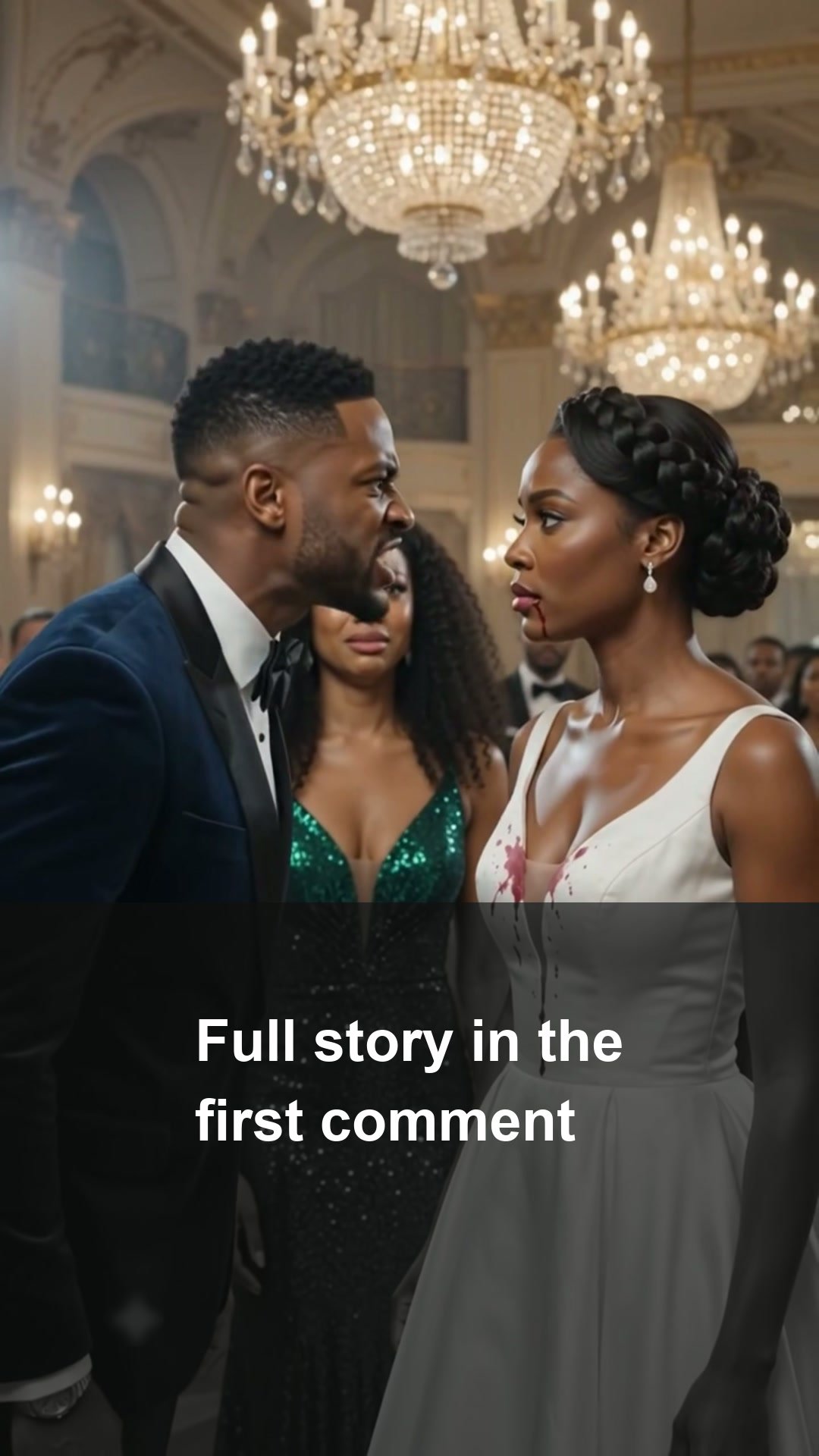
The slap echoed louder than the string quartet, leaving my wedding dress ruined and my life irrevocably changed in a single, stained heartbeat.
The Mediterranean sun glared off the terrace, blinding me as Vanessa stood over me, her chest heaving under a dress that cost more than a mid-sized sedan. Red wine dripped from my bodice, soaking into the silk like an arterial bleed. The guests frozen in the pews were a blur of tuxedos and panicked whispers.
I reached up, my fingers tracing the stinging heat rising on my cheek. I looked at Adrian. He didn’t move to help me; he was already checking his watch, his face a mask of calculated annoyance. He wanted this over. He wanted me broken so he could play the grieving husband while the lawyers dismantled my father’s empire.
I am not a victim, I am a trap. I felt the cold, hard weight of the tablet hidden beneath my bouquet, holding the digital evidence of every lie he had whispered into my ear.
I stood slowly, ignoring the ruin of my gown. It was time to stop pretending. I looked at Mara, watching from the wings, and nodded once. The game had begun.
The espresso machine hissed, a sharp, mechanical shriek that cut through the silence of the penthouse kitchen. I watched the dark liquid pool into the ceramic mug, the steam curling into the filtered morning air. Outside, the city was a grid of grey steel and shifting fog, the kind of Tuesday that feels like an erased slate. I stood there in my silk robe, listening to the rhythmic ticking of the wall clock, a sound so hollow it felt heavy.
Adrian walked in behind me, his footsteps silent on the marble. He leaned down, planting a calculated kiss on the nape of my neck, his stubble grazing my skin.
You’re up early, he murmured, his voice thick with sleep and the lingering scent of sandalwood.
I’m finalizing the merger documents, I said, pulling away just enough to maintain the space I had learned to guard. The board meeting is at nine.
He chuckled, reaching past me to snag a slice of fruit from the breakfast platter. You’re always working, Evie. Take a breath. It’s just signatures.
I nodded, staring at the reflection of the office skyline in the darkened window. It was a comfortable routine, one that had lulled me into a state of benign neglect. I thought of the printer in the lobby, the way it jammed every morning at eight-fifteen, the low-level irritation of the staff, and the mundane predictability of the stock market projections. Everything felt like it was in its proper place. The world was orderly, governed by contracts and expectations, and Adrian was the final piece that made the picture look complete.
I sat at the mahogany table, the tablet glowing in front of me, its screen a mirror of my own careful life. I checked the weather for the gala that evening—clear skies, a slight drop in temperature, perfect for the champagne reception. It felt like a lifetime ago that I had worried about the possibility of rain. I scrolled through the itinerary: the string quartet, the seating charts, the toast. I had spent months ensuring that every detail was flawless, a fortress of normalcy designed to protect what I had built.
I looked at him again. He was leaning against the counter, scrolling through his phone, a slight, smug smile playing on his lips. He looked like the man I had intended to marry, a partner who shared the weight of the Vale name. I felt a surge of affection that I now recognized as a diagnostic error, a malfunction in my own internal logic.
Is the car ready? I asked, snapping the tablet shut.
Adrian looked up, his eyes bright and empty. Waiting downstairs. I’ll meet you there after I drop off the final briefs.
I turned back to my coffee, the heat of the mug seeping into my palms. I felt the sharp, sudden need for things to remain exactly as they were, to keep the veneer of the marriage intact for just a few more hours. I wondered if he could see the hesitation in my hands, or if he was already looking past me, toward the board seats he hadn’t yet stolen.
The silence between us lengthened, not strained, but heavy with the weight of things unsaid. I took a final sip of the espresso. The office would be waiting, the printer would be jammed, and the world would turn on its axis with the brutal, indifferent precision of a machine.
The phone on the counter suddenly shattered the quiet, a jagged, discordant ringtone that vibrated against the stone, pulling me into the present.
The phone vibrated against the polished marble, a rhythmic, staccato buzz that sounded like an insect dying in a glass jar. I didn’t reach for it. I watched the caller ID flicker—a private number, the same one that had been pinging my inbox with encrypted files for the last month.
I picked it up, my thumb hovering over the glass. My skin felt cold, despite the Mediterranean sun baking the terrace. Behind me, the string quartet struck a chord, a soft, anticipatory tremor of violins that signaled the procession was beginning.
Adrian stepped into the doorway, his tuxedo jacket fitted with the surgical precision of a tailor who knew exactly how much room I needed to breathe. He looked at the phone in my hand. His smile didn’t reach his eyes; it remained a thin, practiced line of porcelain.
Evelyn, he said, his voice a low, melodic hum. Everyone is waiting. Don’t be difficult.
I looked at the screen, then at him. The message wasn’t a text; it was a photo. Vanessa, draped in the heavy velvet curtains of our own library, her eyes reflecting the flash of a hidden lens.
Is this why you were so insistent on the guest list, Adrian? I asked. The question was a scalpel, thin and sterile.
He stiffened, his jaw tightening into a hard, white knot. He didn’t answer. He simply reached out, his fingers closing around my wrist with a grip that left no room for movement.
Put the phone down, he whispered, his proximity bringing the scent of his cologne—sandalwood and expensive, hollow ambition. You’re shaking.
I am not shaking, I said. I was, but it wasn’t fear. It was the adrenaline of an equation finally balancing itself out.
He didn’t wait for me to comply. He snatched the device, his thumb fumbling to silence it. In that moment of distraction, the mask of the doting groom slipped. I saw the calculation behind his pupils, the sudden realization that I wasn’t playing the part he had scripted. He raised his hand, not to strike, but to silence me, the palm coming down hard against my cheek.
The impact was loud, a wet, sickening thud that cut through the music like a guillotine. My head snapped to the side. The silk of my bodice caught on his cufflink, the delicate fabric tearing with a sound like a held breath escaping. A drop of red wine from the glass I’d been holding splattered across the bodice, darkening the white lace into a bruised, ragged stain.
The quartet stopped. The silence that followed was absolute, a vacuum waiting to be filled.
I stood still, tasting the copper tang of blood in my mouth. I didn’t cry out. I didn’t shrink away. I looked down at the ruin of the dress, then up at his face, which was already shifting from aggression to panicked, public-facing contrition.
He had made his move. Now, I could make mine.
I retreated to the bridal suite, the heavy oak door clicking shut like a lock on a vault. I pulled my phone from the hidden silk pocket of my gown, the screen cold against my feverish palm. My father’s office number was my first call. It was a reflex, a phantom limb reaching for an anchor that had been dead for six years. I dialed the private line for his former executive assistant instead.
Arthur answered on the second ring, his voice reedy and thin. When I asked about the offshore wire transfers to the Cole estate, he didn’t hesitate. He claimed the board approved the consulting fees for the new Mediterranean expansion last month. The board had met three weeks ago; I was chairing it. I thanked him and hung up, the silence of the room pressing against my eardrums. My father had taught me that a lie is only useful if it has a kernel of truth. The board hadn’t met, but Arthur was certainly paid to believe they had.
I shifted to the hotel’s internal logs. The concierge, a man named Henri who usually bowed low enough to kiss the carpet, sounded breathless. I asked for the guest registry for the East Wing. He stammered, insisting that the suite remained empty until our arrival. I looked at the floor where a single, discarded earring—not mine, a cheap gold hoop—glinted in the dim light. I told him I had a video of Vanessa entering the suite at dawn. He went silent, the line crackling with his sudden, frantic intake of breath. He abruptly claimed the log was corrupted by a server surge. I decided then that Henri was not a witness; he was an accomplice.
I changed into a charcoal blazer, my movements precise and devoid of hesitation. I drove to the local clinic where the nurse, a woman who had allegedly treated Adrian for a minor hand injury the day before, lived in a cramped apartment above a bakery. She opened the door with a chain still in place. Her eyes were rimmed with red. When I asked about the patient record, she wept, telling me she never saw Adrian at all; she claimed he had called in a prescription for a sedative under a pseudonym. She swore she refused him.
I looked past her shoulder to the small kitchen table, where a prescription pad sat, open, displaying a signature that matched the one on the insurance forms Adrian had filed for my own medical file. She hadn’t refused him. She was terrified of him. I didn’t press; I left a business card with a number that led to my private investigators. I knew she would call them within the hour.
I sat in my car, the engine idling, watching the sun crest the horizon. The narratives were splintering. Arthur said the board authorized the theft; the board didn’t exist. The concierge said the room was empty; the jewelry proved it wasn’t. The nurse said she denied him; the signature proved she fed him. They were all lying, but they were lying in different directions.
I reached into the glove box and pulled out a burner phone. I sent a single text to Mara Singh: The web is tangled. Cut the strands, starting with the concierge. I stared at the dark screen, my reflection ghost-like against the black glass. The investigation was no longer about finding the truth. It was about choosing which lie to shatter first.
The marble foyer of the estate was cold, radiating a subterranean chill that seeped through the soles of my heels. I stood before the mahogany doors of the library, the weight of the burner phone still burning in my palm. Behind the heavy wood, the muffled sounds of the Cole family caucus leaked out—the frantic clinking of crystal, the sharp, jagged cadence of Celeste’s voice debating liquidation assets. I pressed my ear to the grain, catching the precise moment Adrian laughed. It was a hollow, rhythmic sound, stripped of the tenderness he had mimicked for three years. I straightened my blazer, smoothing the lapels with clinical precision, and pushed the door open. The conversation died instantly. Adrian stood by the fireplace, his glass held at a casual, arrogant angle. He didn’t look like a man facing ruin; he looked like a predator who had forgotten the trap was already sprung. Celeste sat on the velvet sofa, her pearls tight against her throat, her eyes darting toward the document spread across the coffee table—a modified ledger of the Vale voting shares. I walked to the center of the rug, my footsteps muted by the Persian weave. I didn’t acknowledge the others. I only looked at Adrian, watching the flicker of annoyance cross his face as he realized I had interrupted his conquest. I could feel the pulse in my wrist, a steady, rhythmic drumbeat of absolute clarity. Every lie he had spun about my incapacity, every whispered suggestion that I was unfit to lead, coalesced into a single, jagged point of clarity. I reached into my bag, pulled out the printed surveillance logs, and dropped them onto the table. The paper whispered as it hit the wood. Adrian glanced down, his face paling as he recognized the timestamps. He looked up, his mouth opening to spin another tactical deception, but I leaned in, my shadow eclipsing his. I don’t love you, and I never did.
The library at Vale Manor smelled of cedar and the sharp, metallic tang of my father’s fountain pen. I was ten, sitting on the mahogany floor, tracing the grain of the wood while my father stood at the window. He was watching the gardeners, his posture rigid, the suit jacket pulled tight across his shoulders. He didn’t turn around when he spoke, his voice a flat, measured instrument of correction. Trust, Evelyn, is a ledger item. You never put it in the asset column unless you have a corresponding liability to offset the risk. I didn’t understand the accounting, but I understood the tone. It was the sound of a man who viewed the world as a series of hostile takeovers. I stood up and tucked my hair behind my ears, mimicking his stillness, mirroring the way he held his breath before delivering a final verdict. That was the first time I learned that if I stood perfectly still, I became invisible to the storms he created.
Years later, the boarding school infirmary was a sanctuary of antiseptic and silence. I was sixteen, nursing a twisted ankle from a mandatory field hockey match, when I saw my mother’s name appear on the wall-mounted telephone in the hallway. She didn’t call to ask if I was in pain. She called because the headmistress had requested a donation for the new science wing, and she needed me to manipulate the board into approving it. I held the receiver, the plastic warm against my ear, and listened to her voice—a brittle, practiced cadence that never betrayed a flicker of genuine concern. You’ll handle the negotiations, Evelyn, she said, her tone suggesting that my injury was merely a logistical inconvenience. I looked down at my swollen, purple ankle, then at my reflection in the glass of the infirmary door. I didn’t cry. I simply agreed, the words coming out as polished and professional as a CEO’s quarterly report. I decided then that I would never be the person who needed comfort; I would only be the person who gave the orders.
The betrayal began in the small, unspoken moments of my early twenties, long before I met Adrian. I was sitting in my father’s study, reviewing a merger agreement, when he leaned over my shoulder. He smelled of scotch and expensive, stale tobacco. Your brother doesn’t have the stomach for this, he whispered, gesturing toward the door where my brother sat, oblivious and laughing with a friend. You have to be the wall, Evelyn. If you let them touch the foundation, the whole house collapses. I looked at the papers, the ink blurring into a map of my future, and realized he wasn’t talking about business. He was talking about me. He was teaching me that everyone, even family, was a potential saboteur. I took the pen from his hand, the weight of it feeling like a weapon, and signed the document. I ignored the warning that the house was already built on a fault line.
When I met Adrian, I was looking for a distraction, not a partner. We were at a gala in Zurich, the champagne bubbles stinging the back of my throat. He was charming in a way that felt choreographed, his smile too symmetrical, his compliments too rehearsed. He touched my elbow to guide me through the crowd, a small, possessive gesture that I mistook for chivalry. You shouldn’t have to carry the weight of that company alone, he told me, his eyes searching mine for a crack in the armor. I laughed, a short, brittle sound that startled the woman next to me. I liked the way he looked at me—not as a person, but as a prize. I ignored the way he checked the time on his watch every five minutes, the way his attention drifted toward the wealthy, elderly board members circulating near the terrace. I wanted to believe that someone could see me, and not just the shares I controlled. It was a tactical error I would pay for with every year of my life that followed.
The first time I saw Vanessa, she was standing in the periphery of a dinner party I hosted for the Vale board. She wasn’t on the guest list, yet there she was, holding a flute of champagne with the ease of someone who belonged to the scenery. Adrian introduced her as a consultant. She didn’t look at me; she looked at the room, cataloging the art, the silver, the faces of the men who held the power. I watched them from the end of the table, noting the way Adrian’s posture shifted when she moved—a slight, unconscious realignment of his body toward hers. I felt a cold, sharp spike of awareness in my chest, a sensation I buried under a smile and a polite inquiry about the catering budget. I told myself it was paranoia. I told myself that I was merely hyper-vigilant, a byproduct of my father’s lessons. I was wrong. I was just refusing to read the data that was staring me in the face.
The prenuptial negotiations were a war of attrition. Adrian sat across from me in the boardroom, his sleeves rolled up, his face a mask of wounded pride. It’s insulting, he said, his voice rising just enough to be heard by the lawyers waiting in the anteroom. We’re building a life, not a corporate merger. I looked at his hands, those slender, capable hands that I had once trusted, and saw them as tools for extraction. I didn’t speak. I let the silence stretch, watching his eyes flicker with frustration, then desperation. He reached across the mahogany table and took my hand, his skin cool, his touch devoid of warmth. I promise you, Evelyn, he said, his gaze intense, steady, and entirely hollow. I promise you that you’re the only thing that matters. I squeezed his hand, my grip firm, and felt nothing but the cold realization that he was already gone. I knew he was lying. I knew the prenup was the only thing standing between my legacy and his ambition. I signed the documents, knowing exactly what I was setting in motion.
I remember standing in front of the mirror in our shared bathroom, weeks before the wedding, adjusting my veil. The house was quiet, the staff gone for the night. I could hear Adrian talking on the phone in the bedroom, his voice low, rhythmic, the tone one of a man conspiring. He thought I couldn’t hear him through the heavy oak door. He was laughing—a sharp, triumphant sound—about the ease with which he had managed to manipulate the voting shares. I stared at my reflection, the diamonds at my throat catching the light like shards of ice. I looked older than I was, the skin around my eyes tight with the exhaustion of constant surveillance. I didn’t walk into the bedroom and confront him. I didn’t scream. I simply turned off the light, plunging the room into darkness. I decided that night that I would let him believe he was winning. I would give him all the rope he needed.
Every insult he had ever leveled at me, every time he had questioned my judgment in front of the board, surfaced in my mind like debris after a flood. He would call me cold when I was being cautious, heartless when I was being strategic. He spent years eroding my confidence, trying to make me feel small enough to fit into the cage he was building around my company. I thought back to the schoolyard, the way the other children would ostracize me for my father’s reputation. I thought of the way my mother had looked at me when I failed my first board exam—not with sympathy, but with a cold, detached disappointment. Adrian wasn’t an anomaly; he was a continuation. He was just the latest man who thought he could use my vulnerabilities to bypass my intellect. He thought I was a girl playing at business. He didn’t realize that I was the business.
I sat on the floor of the walk-in closet, surrounded by the scent of silk and dry cleaning, and pulled out the small, hidden recorder I had taped beneath the vanity weeks ago. I played back the audio—his voice, Vanessa’s laughter, the specific, damning details of their plan to dilute my shares immediately following the ceremony. I listened to it until the words lost their meaning, becoming nothing more than sound waves, data points in a larger, more complex equation. The betrayal wasn’t the affair; the betrayal was the assumption that I would never notice, that I was too blinded by the performance of love to see the mechanics of his greed. I wiped the device, returned it to its hiding place, and stood up. I smoothed my dress, checked my lipstick, and walked out of the closet. I felt like a machine, perfectly calibrated, devoid of the messy, impulsive emotions that had nearly cost me everything. I was ready. The trap was set, the triggers were hidden, and all that remained was the final, inevitable collision.
The balcony of the estate smelled of sea salt and expensive, desperate perfume. I stood by the stone railing, watching the guests below, a collection of human assets currently miscalculating their own net worth. Celeste Cole was holding court near the fountain, her posture a masterclass in performative grace. She preached the sanctity of the union to a cluster of socialites, her fingers clutching a flute of champagne like a weapon. She wanted the Vale voting shares as much as Adrian did, but her history was one of calculated survival, having married three times to keep the Cole name afloat. She didn’t realize that by endorsing Adrian’s infidelity, she had handed me the leverage to bankrupt her entire lineage. I looked at her and saw only a ledger entry waiting to be zeroed out. She thinks she owns the board; she doesn’t know the board is already mine.
Adrian leaned against the marble pillar, his face flushed with the kind of smug confidence that only comes from deep, wilful ignorance. He was checking his watch, likely counting the minutes until he could corner me to demand the final signing of the asset transfer papers. His motive was simple: liquidity. He saw me as a temporary obstacle to his long-term play for the CEO seat. He didn’t know that every ‘consulting’ invoice he forged was currently being cross-referenced by my auditors. His contradiction was his charm; he believed that because I loved him, I was fundamentally blind to his theft. I felt a flicker of pity—not for him, but for his lack of imagination. I decided then that I would let him sign the papers, right up until the moment I tore them in half.
I caught Vanessa standing in the shadow of the hibiscus bushes. She was clutching a silk clutch, her eyes tracking Adrian with a predatory intensity that she mistook for devotion. She had spent months playing the part of the scorned woman, feeding the press rumors of my instability to clear a path for herself. Her history was one of borrowed status; she needed me to be the failure so she could be the savior. She didn’t know that I had been paying her stylist for the last six months, and every secret she whispered to the press had been recorded for my legal files. She thinks she is the main character in this drama; she is merely an extra I’ve scripted for the final scene. I adjusted my veil and stepped into the light.
Mara Singh stepped out from the shadows of the doorway, her suit sharp enough to cut glass. She was the only person here who didn’t lie to me. Her loyalty was a contract, bound by an unwavering belief in the law, yet she spent her life cleaning up the filth of people like my father. She held a tablet against her chest, her expression unreadable. She knew what I was about to do to the Coles, and she wasn’t judging the cruelty of it; she was auditing the efficiency. I looked at her and felt the only genuine connection I possessed—a shared understanding that morality was an internal metric, not a social one. I nodded at her once, a silent signal that the endgame had begun. She didn’t blink. She simply checked her watch, her gaze steady, confirming that the legal trap was armed and waiting. The sound of the string quartet shifted into a minor key, and I began the walk toward the altar, a predator draped in white, ready to dismantle the world that had built me.
The police station in the village smelled of mildewed paper and stale coffee, a sharp contrast to the antiseptic efficiency of my office. I sat on a hard wooden bench, my fingers tracing the jagged edge of my torn lace sleeve. When the officer finally gestured for me to enter the back room, I didn’t hesitate. I slid the flash drive across the scarred metal desk. It contained the high-definition footage of Adrian shoving me into the champagne tower, the audio of Vanessa’s confession in the bridal suite, and the timestamped emails detailing his attempt to siphon Vale Industries’ research funds.
The officer, a man with tired eyes and a stained uniform, scrolled through the files. He looked up, his expression shifting from bored routine to something sharper. He knew my name, and he knew my father’s reputation. When I spoke, my voice was devoid of the tremor the witnesses expected. I am filing a formal complaint for domestic battery, I said, watching his pen hover over the intake form. I require a restraining order immediately, effective for both the island estate and my residence in London.
His hand shook slightly as he stamped the document. A copy will be sent to the Cole estate within the hour, he promised, but he looked like a man who regretted knowing the contents of that drive. I left the station without saying goodbye, feeling the cold air of the Mediterranean night bite through my silk bodice. This was the first domino.
By the time I reached the hotel balcony, my phone was a litany of frantic notifications. I ignored the missed calls from Celeste Cole. Instead, I opened the banking portal for the joint venture account Adrian and I had established for the wedding expenses. With a few calculated taps, I canceled the pending transfer for the Mediterranean holding company’s quarterly tax payment. The funds were instantly frozen, the maneuver triggering an automated alert to his personal account.
I didn’t have to wait long for the reaction. Adrian burst through the suite doors, his tuxedo jacket missing and his face pale with a mixture of rage and terror. You’ve locked me out of the liquidity accounts, he shouted, his voice cracking. Do you have any idea what you’ve done? The board is already calling, asking why the quarterly tax filings are bouncing.
I stood by the vanity, methodically removing my diamond earrings. They felt like lead weights. I didn’t look at him. I looked at his reflection in the glass, watching him pace like a cornered animal. I am not the one who signed a betrayal clause, Adrian, I said, the words landing with clinical precision. Check your inbox. My lawyer has sent the formal notice of the prenup’s breach. Every asset tied to your name—the offshore holdings, the family estate in Provence, your personal stake in Cole Logistics—is currently under audit.
He lunged forward, but stopped short when he saw Mara Singh standing in the doorway, her arms folded, a digital recorder pulsing with a soft red light in her hand. Mara didn’t speak. She didn’t have to. Her presence was a barrier he couldn’t cross.
I turned to face him then. The silence in the room was heavy, a vacuum where his arrogance used to thrive. You’re not just losing the company, I told him. You’re losing the fiction of your life.
He didn’t scream this time. He slumped against the doorframe, his hands fumbling for his phone. I watched him dial, his thumbs moving with desperate speed. He was calling his mother, his lawyers, his creditors—the chorus of vultures who had enabled him. But they wouldn’t answer, or if they did, the news would be worse than he feared. I had already spoken to our lead equity partners. The board of Vale Industries was meeting at dawn to vote on the forfeiture of his voting shares.
I walked past him, the silk of my dress rustling like dry leaves. I needed to see a doctor for the bruising on my arm, not because I was hurt, but because I needed the medical record for the court file. I needed the paper trail to be absolute.
As I stepped into the elevator, my phone chimed again. A private number. I answered it without hesitation.
Ms. Vale, the voice on the other end was cold, unrecognizable. I have the results of the paternity test you requested regarding Vanessa’s child.
I leaned my head against the cool metal wall of the elevator. The air was thin, smelling of ozone and ozone-scented cleaner. Send the encrypted file to Mara, I commanded. Do not put it on the company server.
I exited the hotel lobby into the harsh glare of the paparazzi. They swarmed, their camera flashes blinding, a staccato rhythm of invasion. I didn’t shield my face. I walked with my head high, the queen of a ruin I had meticulously engineered. I was no longer the heiress who played at love. I was the architect of their erasure. As I climbed into the waiting black sedan, I saw Celeste Cole standing near the fountain, her face a mask of ruined vanity. She looked at me, her eyes searching for a crack, a moment of weakness, a plea for mercy. I gave her nothing. I rolled up the tinted window and pulled the document file from my bag. The next step was filing the motion to contest the estate’s testamentary trust. It was time to strip them of their final defense. I opened my laptop, the screen glow illuminating the path forward, and began to draft the final blow.
The digital flicker of the stock exchange dashboard on my screen was a steady, rhythmic pulse of red. Vale Industries was shedding value, a controlled burn I had anticipated but not entirely controlled. Outside the tinted glass, the island was no longer a retreat; it was a crime scene. Reporters huddled behind the security cordon near the docks, their long lenses catching the frantic, erratic pacing of Adrian’s sister on the terrace. I watched her drop her phone. It clattered against the stone, a small, hollow sound that barely registered over the hum of the sedan’s air conditioning.
I didn’t blink. My fingers moved across the keyboard, executing the first of three automated transfers that would pull our capital out of the Cole-backed logistics venture.
Mara sat in the passenger seat, her reflection in the darkened window looking like a ghost. She checked her watch. She said, The board is requesting an emergency session. They are panicked, Evelyn. They think the instability will invite a takeover.
Let them panic, I said, my voice clinical and devoid of the tremor the situation demanded. Tell them the instability is a cleansing fire. I want the share repurchase plan initialized before the markets close in London.
She looked at me, a brief, sharp assessment of my state. You’re being watched by everyone, she murmured. The school, the clubs, the social registries—they’re already scrubbing our names from the gala committees. You’re becoming a cautionary tale.
I turned my head, watching a drone hover just outside the perimeter, its rotors a mosquito whine in the humid air. I don’t care about the gala committees, Mara. I care about the voting shares.
The phone in my lap buzzed. It was a message from an old friend, one of the few who had been inside the ballroom. *Are you safe?* The simplicity of the question felt like an insult. Safety was a commodity I had long ago traded for power. I deleted the message without opening it. The cost of this dismantling was not my reputation; I had prepared for that. The cost was the silence that now followed me. My phone, usually a lifeline of social obligation and professional noise, was dead quiet. The people who had sipped my champagne and toasted my future were now busy drafting distance.
I thought of the wine-stained silk dress I had discarded in the suite, now undoubtedly being photographed by the estate’s cleaning staff for a tabloid payout. The image of it—ruined, heavy, useless—felt like a phantom limb. I had spent years curating a persona that was palatable, soft, and worthy of the Vale name. I was stripping that down to the studs.
A notification pinged. A prominent venture capitalist had publicly severed ties with Adrian, citing his ‘reprehensible conduct.’ The dominoes were falling faster than I had projected. My strategy was working, but the efficiency of it made my skin itch. I felt hollowed out, a vessel for the machine I was operating.
I looked at my own hands, steady and pale against the black leather of the car seat. I had won the board, the assets, and the autonomy. I had also ensured that for the rest of my life, every conversation would be a negotiation and every invitation a tactical maneuver.
I leaned back, closing my eyes for a fraction of a second. I am the architect of this silence, I thought. I have to live in it.
I opened my eyes and looked at Mara. Do we have the signature on the dissolution of the partnership?
She handed me a tablet. It’s waiting for your final verification.
I tapped the glass. The deed was done. The fallout would bury them, but it would leave me in a kingdom of ash. I adjusted my jacket, checked my reflection, and prepared to walk into the boardroom. The world was watching, and I had a performance to finish.
The boardroom mahogany felt unnaturally cool under my palms as I stood. I smoothed the lapels of my charcoal blazer, a sharp, armor-like contrast to the silk monstrosity I had worn just days prior. Outside the floor-to-ceiling windows, the island sun burned with an indifference that matched my own.
Mara placed the final printed settlement on the polished surface. Adrian’s signature was a scrawl of desperate ink, a jagged line that signaled the total forfeiture of his equity. Celeste, seated at the far end of the table, watched me with eyes that had lost their luster, her hands trembling as she adjusted a pearl necklace that was likely already mortgaged.
I didn’t offer a parting word. I simply slid the document toward the clerk, the sound of paper dragging across wood acting as the final gavel.
“The accounts are being liquidated,” Mara whispered, her voice a flat, clinical drone. “They have forty-eight hours to vacate the estate.”
I watched Adrian’s face, which had collapsed into a map of grey fatigue. He looked at me, not with the arrogance of a predator, but with the hollow hunger of someone realizing the game had been rigged from the inception. I felt nothing—not triumph, not pity, just a distinct, clinical relief. My father’s lesson had been correct, though he had neglected to mention the cost of the tuition.
I walked to the window, watching the yacht in the harbor begin to disconnect from its mooring. My reflection caught in the glass: eyes sharp, posture rigid, the architecture of a sovereign. I reached into my pocket, pulling out the small, velvet box that had held my engagement ring, and dropped it into the wastebasket near the door. It made a dull, heavy thud.
I turned back to the room. The silence was absolute. My decision was to finalize the acquisition of the Cole voting blocks immediately, ensuring that by sunset, their name would exist only in the historical records of the SEC.
“Meeting adjourned,” I said.
I turned my back on them, walking toward the heavy oak doors. My heels clicked against the marble, rhythmic and precise. I didn’t look back to see if they were still there. As I pushed the heavy doors open, the scent of sea salt and ozone rushed in, clean and unburdened. The hall stretched out before me, leading toward the private terminal where my own jet waited, fueled and ready to carry me back to the city that actually belonged to me. The heavy air of the estate was already thinning behind me. I stepped into the sunlight, my phone buzzing with the first of a thousand congratulatory emails I would never bother to read.
The Amalfi sun caught the edges of my shears as I sat on the terrace of the villa. The white silk of the wedding dress was stained a deep, permanent violet at the bodice. I didn’t hesitate. I drove the blades through the heavy fabric, the sound of tearing thread sharp and clean in the morning air. It was just cotton and lace; it had never been a symbol of anything but a strategic error.
“Evelyn, are you coming in for breakfast?” Mara asked, standing in the doorway with a tray. She didn’t look at the ruin on the floor.
“I’m done,” I said, dropping the shears. They clattered against the stone tiles.
I walked to the table and sat. Mara had laid out toasted sourdough, salted butter, and a bowl of fresh figs. I spread the butter thick, the yellow cream melting into the warm, rough edges of the crust. I took a bite. It was simple, unadorned, and tasted better than any five-course gala dinner I had endured in the last year.
“The lawyers are asking if you want to be present for the final inventory of the estate,” she said, pouring my coffee.
“No,” I replied, watching a stray tabby cat weave through the lavender bushes near the garden wall. “Let the auditors do their work. I’m finished with the inventory.”
I felt the sudden weight of silence settle over my shoulders, not as a burden, but as a space I finally owned. I wasn’t waiting for a text or a check-in. I wasn’t performing for a board of directors or a husband who treated me like a line item. I looked at my reflection in the window glass—my hair pulled back, my skin pale, my eyes steady. I recognized her. She was the one who survived the wreckage. I finished the toast and stood up. It was time to go home.
The mahogany desk in my office felt different under my palms, no longer a stage for negotiation but a foundation. I set my glass of Pinot Noir down, the stem clicking sharply against the polished wood. My gaze drifted to the side table where the velvet box lay open, its hinges stiff from disuse. I didn’t reach for the heavy, platinum bands or the weight of the promise they once represented. Instead, I stood over the glass, swirling the remaining liquid until the dark, fermented stain coated the sides. I plucked the two diamond rings from the velvet lining and dropped them, one by one, into the deep, crimson pool. They sank through the thick, stagnant red, coming to rest at the very bottom, obscured by the wine and the dark.
Leave a Reply