The envelope dropped into the mud, its seal broken, revealing the precise, incriminating numbers of a leveraged buyout that shouldn’t have existed. My boots sank into the damp earth of the gatehouse perimeter, the scent of pine needles sharp and suffocating against the damp fog. I stared at the papers, the ink bleeding into the slurry.
“You’re standing in the wrong place, Elias,” Celeste said. She didn’t look at me; her eyes were fixed on the security camera lens, her posture perfect, her tone terrifyingly hollow. “Move aside before the car arrives. Adrian hates tardiness.”
My grip tightened on the flashlight. The steel casing bit into my palm, grounding me as the weight of her betrayal settled in my gut like cold lead. I wasn’t just a gatekeeper anymore; I was a man watching a predator circle his son.
I didn’t answer. Instead, I stepped into the spill of the floodlights, blocking her path to the estate gates. If she wanted the Vale fortune, she would have to get through the man who built it from the dirt up. I pulled the radio from my belt, my thumb hovering over the silent alarm.
The alarm clock did not buzz; it hummed a low, synthetic tone that signaled 5:30 AM with the precision of a Swiss movement. I sat up, the sheets sliding away to reveal the cool air of the bedroom. My routine was a ritual of subtraction: no ties, no cufflinks, no titles. I moved to the kitchen, the floorboards groaning under my bare feet in the exact spots they had groaned for twenty years. The coffee machine hissed, spitting out a dark, bitter stream that smelled of burnt earth and efficiency. I drank it standing by the window, watching the coastal fog roll off the Atlantic, turning the world into a gray, featureless blur.
I took the sedan, not the company car. The commute was forty minutes of silence, punctuated only by the rhythmic thumping of the wipers against the windshield as a light, aimless rain began to fall. At the office—the smaller, satellite branch I frequented to keep my pulse on the ground—the lobby smelled of floor wax and stale newspapers.
The printer was jammed again. It always was on Tuesdays. I stood by the machine, listening to the frantic whir of plastic gears grinding against a stubborn stack of paper. Karen from Accounting walked by, clutching a stack of files.
Morning, Elias, she said, not breaking her stride. Humidity is supposed to spike by noon.
I nodded, my eyes tracking the way the paper had curled deep inside the feed tray. It is always the humidity, I replied.
She laughed, a sharp, nervous sound, and disappeared around the corner. I reached into the guts of the printer, my fingers tracing the sharp edge of a paper jam. It was a simple, mechanical failure—a piece of cardstock blocking the path. I pulled it free, the paper tearing with a clean, satisfying sound. I thought about the logistics contracts I had reviewed the night before. Everything was in order. The numbers lined up, the vendors were vetted, and the expansion into the Midwest was proceeding with the dull predictability of a clock. I felt a rare, quiet satisfaction in the smallness of it all. There were no secrets in a paper jam; there were only obstacles, and obstacles could be removed.
I decided to skip lunch. I spent the afternoon at my desk, organizing the files for the new gatehouse security protocols—a tedious, bureaucratic update that Adrian had insisted on. He was obsessed with modernization, with sealing every potential breach in the estate’s perimeter. I had humored him, signing off on the new cameras and the biometric scanners because it made him feel like a man who could protect his own world. I didn’t tell him that a gate is only as strong as the person standing in front of it.
I looked out the window. The rain had intensified, drumming a steady, relentless beat against the glass. The sky was darkening prematurely, casting long, bruised shadows across the carpet. I checked my watch. It was nearing six. Time to head back to the estate, to put on the uniform, to slip back into the role of the man who watched the world from the edge of the driveway.
I stood up, adjusting my jacket. I felt calm, almost detached. My life had become a series of perfectly calibrated circles, each one reinforcing the next. I picked up my keys from the desk, the metal cold and heavy in my palm. The office was quiet now, the hum of the air conditioner fading into the background. I took a deep breath, readying myself for the drive home, for the familiar routine of the gatehouse, and for the evening ahead.
Just as my hand touched the door handle, the phone on the desk gave a sharp, jarring trill. It was the landline, a device I rarely used, its ringtone shrill and aggressive in the empty room. I stopped, my hand hovering over the receiver, a sudden, inexplicable coldness creeping up my spine. The phone rang again, a piercing, insistent sound that shattered the silence of the office. I didn’t recognize the number on the caller ID, but the rhythm of the ring—urgent, frantic—told me that the day of quiet, unremarkable order had come to an end. I picked it up.
I pressed the receiver to my ear, the plastic smelling faintly of dust and old, stale coffee. Before I could offer a professional greeting, a man’s voice—thick with the kind of practiced, frantic desperation I had dismantled in a dozen boardrooms—spilled through the line.
It was Marcus Marrow. He didn’t waste time on pleasantries.
Can you let her through, or is the gate broken? he demanded, his breathing hitching. She’s on a schedule, and I don’t have time for the common security theater you people love to play.
I leaned back, my chair groaning under my weight. My eyes drifted to the security monitor, where Celeste’s silver coupe sat idling against the iron perimeter. She was checking her reflection in the rearview mirror, her lips parted in a mock pout. My fingers tapped a rhythm on the mahogany desk.
The protocol for unauthorized after-hours arrivals is clear, Mr. Marrow, I said, keeping my voice flat, stripped of the cadence of the boardroom. She needs an escort code.
There is no code, you idiot. Just open the gate. There’s an envelope in the glove box of your patrol car. Take it and stop pretending you’re protecting something that already belongs to us.
The line went dead with a wet click.
I set the receiver down, feeling the heavy, metallic taste of bile at the back of my throat. It wasn’t the bribe that stung; it was the casual, effortless way they had already partitioned my life, treating my son’s home like a warehouse waiting to be looted. I looked at the monitor again. Celeste had stepped out of the car. She stood in the rain, her designer heels sinking into the wet earth, looking at the security camera with a gaze so devoid of warmth it felt like a physical blow.
I stood up, the movement slow and deliberate. My heart hammered against my ribs—a dull, rhythmic thud that reminded me of the night Adrian’s mother had told me she was pregnant, the same terrifying, exhilarating edge of a precipice. I wasn’t the gatekeeper anymore. I was the architect of the collapse.
I walked to the patrol car parked behind the shed. I didn’t need to look for the envelope; I knew exactly where he’d tucked it. I slid it from the glove box—a thick, cream-colored square of heavy cardstock. I opened it, my thumb brushing the crisp edges of the cash inside, and tucked it into my jacket.
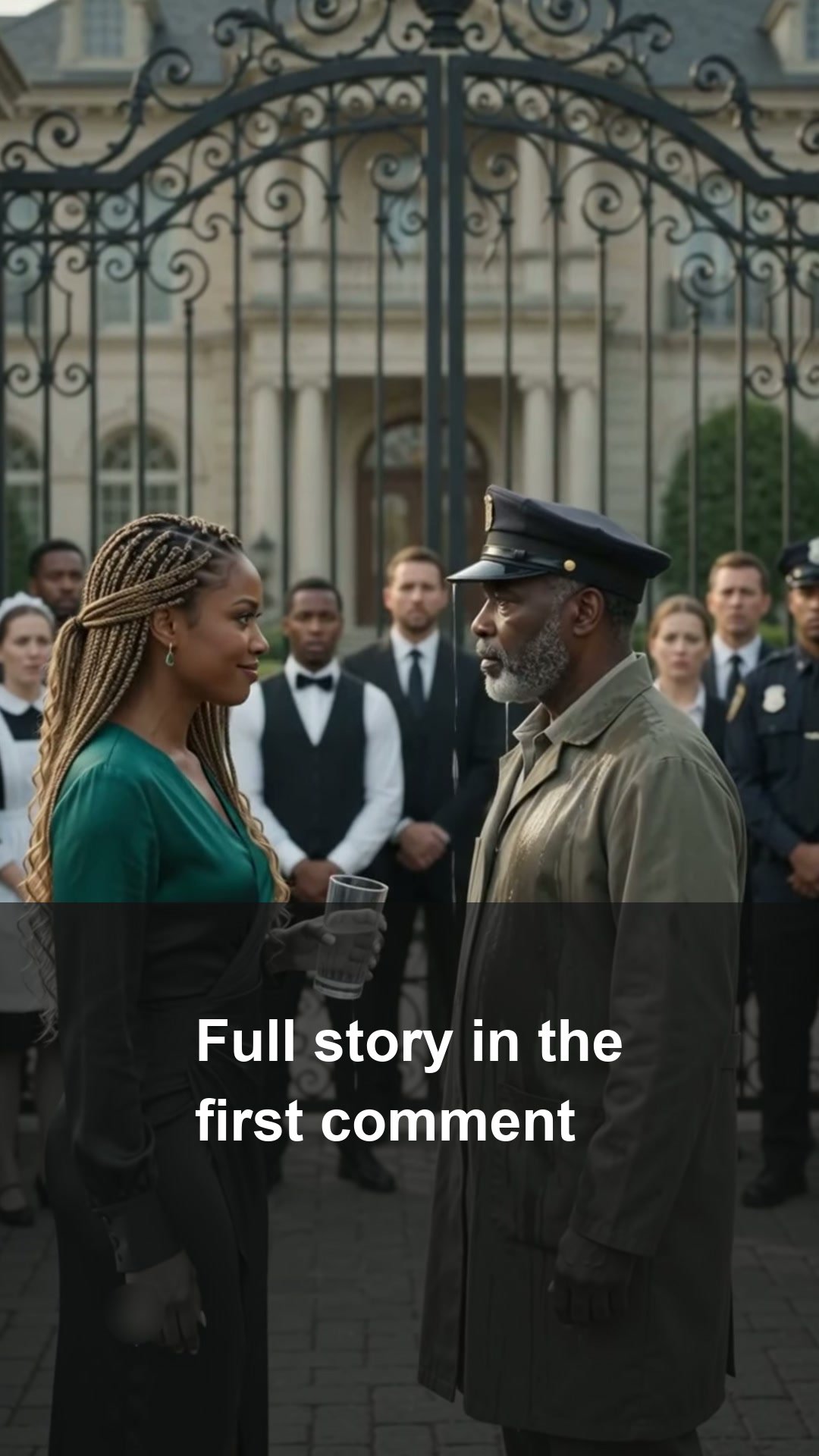
I walked toward the gate, the rain soaking into my coat, turning the soil into a treacherous slurry. Celeste saw me approaching and crossed her arms, her expression shifting from impatience to a sharp, predatory sneer.
Finally, she said, her voice cutting through the patter of the rain. Open it.
I stopped three feet from her, the gate standing like a barrier between our worlds. I didn’t reach for the keypad. Instead, I held up the envelope, let it drop into the mud at our feet, and watched the grey water seep into the paper.
I’m afraid the price has gone up, I said.
Celeste’s eyes flared, a flicker of pure, unadulterated venom that she smoothed away with a practiced pull of her silk scarf. She didn’t look at the ruined money; she looked through me, her gaze sliding toward the estate’s main house as if measuring the distance to Adrian. I turned my back on her before she could offer a rebuttal, walking toward the gatehouse where the internal phone sat waiting. I needed to see who else was playing in the dirt.
I dialed Marcus Marrow’s private line. The ringing was rhythmic, hollow, echoing against the glass walls of the booth. When he answered, he didn’t wait for a greeting. His voice was a thin, tight wire. Everything is moving on schedule, Elias, he snapped, assuming he was speaking to a contact he’d paid to hold the line. The shipment logs for the logistics merger are already encrypted. Just keep the boy occupied for another forty-eight hours. My skin crawled with the familiarity of his tone; he wasn’t talking to a gatekeeper, he was talking to an accomplice. I stayed silent, the breath rattling in my chest, and hung up.
I walked to the estate’s medical wing, where the nurse, Mrs. Gable, was adjusting a drip line in the guest suite. She looked up, her hands trembling as she smoothed her apron. She had been with the family since before Adrian was born, but today she avoided my eyes, focusing intently on the monitor. Did you see Miss Marrow enter the study last night, I asked, my voice hitting the floorboards like a lead weight. She shook her head, the movement too stiff, too rehearsed. She was in the garden, sir, all night, she whispered. I didn’t say aloud that I had seen her on the security feed slipping into the digital archives. I turned on my heel, the cold weight of the knowledge pressing against my ribs. I needed a third perspective.
I found Julian, the butler, polishing silver in the pantry. He held a butter knife like a surgical instrument, his knuckles white. I asked him about the missing procurement files. He didn’t look up, the soft rhythmic *clink* of the metal echoing through the room. The files were moved at Miss Marrow’s request, he said, his voice devoid of its usual warmth. She claimed the accounts were mismanaged by your staff. I stopped. The discrepancy was absolute—the nurse insisted she was outside, the butler insisted she was reorganizing, and Marcus Marrow believed she was already inside the servers.
I stepped outside, the rain turning into a stinging mist. The gravel crunched under my boots, a lonely, abrasive sound in the silence of the grounds. I moved toward the garage, my hands shoved deep into my pockets, feeling the hardness of the burner phone I carried as a precaution. I realized then that the infiltration wasn’t a singular act; it was a web, and everyone in this house was a silken strand. I climbed into the sedan, the leather interior still smelling of Adrian’s cologne, and gripped the steering wheel. I decided to drive to the logistics office; if the house was a theater of lies, the numbers would have to tell the truth. I pulled out of the driveway, the tires spinning momentarily in the mud, leaving the gatehouse behind. As I reached the main road, my phone buzzed. It was an anonymous ping—a location request for the Vale Global server room, logged from inside the house, five minutes after I had left.
The dashboard clock glowed a sterile, unblinking green as I pulled onto the shoulder of the coastal highway. The location ping was not a glitch; it was a heartbeat, steady and rhythmic, echoing from the very heart of my company’s encryption core. I watched the digital tracker move in real-time, a blue dot drifting through the corridors of my own building, deeper into the sub-levels where the trade secrets lived.
I didn’t call security. Instead, I pressed the internal link that bypassed the primary firewalls, opening the audio feed from the server room’s air-conditioning vent. The static hissed, then smoothed into the crisp, cultured cadence of a voice I had spent months learning to loathe. Celeste was speaking, her tone devoid of the saccharine warmth she reserved for Adrian, replaced by a clinical, biting efficiency. She wasn’t just downloading data; she was rerouting the entire logistics chain to a shell company.
I shifted my grip on the steering wheel until my knuckles turned the color of bone. I had spent twenty years building a fortress to keep the world away from my son, only to realize I had left the front door unlocked and invited the wolf to dinner. I pictured Adrian back at the estate, probably nursing a glass of scotch, waiting for her return with that fragile, open-hearted smile that reminded me so much of his mother. He believed he had found his equal. He believed in a future that was, in reality, a liquidation sale.
I reached for the burner phone, my thumb hovering over the call button to Sarah Jenkins. I could stop this now. I could end the masquerade and bring the whole house of cards crashing down. But as I looked at the blue dot flickering on the screen, a final, jagged truth took root in my chest.
I leaned forward, my breath fogging the glass, and spoke to the empty passenger seat.
“She doesn’t love you, son; she’s just waiting for you to die.”
The smell of the gatehouse, a mixture of wet wool and stagnant coffee, dissolved into the sterile, antiseptic scent of the hospital ward in Boston, thirty years ago. I was sitting in a vinyl chair that stuck to the backs of my thighs, my knees pressed together, watching the rhythmic rise and fall of Elena’s chest. The monitor chirped, a metronome for a heart that was already deciding to stop. My father, a man who built skyscrapers out of sheer, unadulterated ego, stood by the window, his back to me. He was adjusting his cufflinks, the sharp click of metal against metal the only sound in the room. He didn’t look at her. He didn’t look at me. He was checking his watch. We have the gala at eight, Elias, he said, his voice as flat as a balance sheet. Your mother is dying, I whispered, the words catching on the dry lint of my throat. He turned then, his eyes two cold, grey stones behind expensive frames. She is, he agreed, and that is a tragedy, but the board meeting tomorrow is a necessity. Do not let sentimentality bankrupt your obligations. I stared at his polished shoes, realizing then that for him, people were merely assets that eventually depreciated to zero.
I stood up, the vinyl chair groaning under my shift in weight, and walked toward the window. I wanted to punch the glass until my knuckles were shredded, but I only smoothed the fabric of my own suit. I had learned the rhythm of his indifference by the time I was seven. It was a lesson taught in increments: the missed soccer games, the tutors who were paid to be my only friends, the birthday cards signed by secretaries. I didn’t cry. I simply retreated into the silent architecture of my own mind, building walls that were higher than any he had ever erected. I decided then that I would never be a guest in my own life. I would own every brick, every lock, every secret. But as I watched him step out of the room to take a call about a merger, leaving Elena to face the dark alone, I felt a tremor of something worse than grief. It was fear. I was terrified that his blood, cold and predatory, was the only inheritance I had actually received.
Twenty years later, the pattern repeated itself in a gilded dining room in London. Adrian was six, sitting at the mahogany table, his small hands struggling with a fork that was far too heavy for him. Beside me, my wife, Clara, leaned in to help him, her touch light as a moth’s wing. She was the antithesis of my father—warm, messy, alive. She looked at me, her eyes bright with the foolish, beautiful hope that I might actually be present. Elias, she said, tilting her head, you’ve been looking at the report for twenty minutes. The wine is breathing, and so are we. I looked up, the numbers on the screen blurring into meaningless ink. I was calculating the risk of a logistics acquisition in Singapore, but in that second, I saw the exact silhouette of my father in the way Adrian hunched over his plate, trying to be perfect, trying to be enough. I closed the laptop. I forced a smile that felt like a ceramic mask. I am here, I lied. I was always somewhere else—in the future, in the data, in the next defense. I was protecting them by preparing for disasters that hadn’t happened yet, failing to realize that by constantly fortifying the perimeter, I was suffocating the interior.
The marriage fractured not with a bang, but with a series of quiet, efficient withdrawals. Clara stopped asking me to notice her. She stopped expecting me to be the man who sat at the table; she began to look at me like a landlord who was rarely home. I watched her from the doorway of our library, her silhouette framed by the garden lights, and I felt the old, familiar weight of my father’s legacy. I was a gatekeeper in my own home, vetting every emotion, every vulnerability, measuring the cost of intimacy against the potential for betrayal. When she fell ill, the ghost of my mother’s hospital room returned to haunt the hallways. I doubled my work hours, throwing money at the best surgeons, the rarest treatments, the most exotic specialists, believing that if I simply out-spent the inevitable, I could hold time still. I treated death like a competitor to be out-maneuvered, and in the process, I missed the final, quiet months where she just wanted me to hold her hand. She died in a house that was perfectly secure, perfectly maintained, and utterly devoid of the man she had married.
Adrian survived it, but he grew up with the shadow of that silence. He saw me building a fortress, and he mistook the isolation for strength. He saw the board of directors and the security teams and the high-stakes negotiations, and he learned to admire the armor while ignoring the rot beneath. When he brought Celeste home, I saw the flicker of the same light in his eyes that I had once had for Clara—a desperate, starving need to be seen by someone who wasn’t a transaction. But Celeste didn’t look at him; she looked at the marble floors, the security logs, the proprietary software of Vale Global. I saw the way she shifted her feet when he wasn’t looking, the predatory calculation in her gaze as she mapped the weak points in our logistics chain. She was the exact mirror of my father’s ghost, only she didn’t bother with the veneer of traditional loyalty. She was a scavenger, and I was the old wolf watching from the shadows, knowing exactly what she was going to do because I had spent a lifetime doing the same things to keep my world intact.
I remembered the warnings I had ignored. My old mentor, Arthur, had told me, You can build a gate that keeps the world out, Elias, but eventually, you’ll find that you’re just trapped inside with the things you hate most about yourself. I had laughed it off, secure in my wealth, secure in my control. But here I was, watching my son hand his heart to a woman who had the same cold, calculating eyes I saw in the reflection of my father’s window. I had raised Adrian to be a prince of an empire, but I had failed to teach him that an empire is a poor substitute for a human connection. I hadn’t prepared him for the fact that people don’t always come to the gate seeking entry; sometimes, they come to dismantle the hinges. The anger that surged through me wasn’t for Celeste. It was for the child Adrian, who had never known a home that wasn’t a fortress. It was for the man I had become, who was so afraid of being hurt that he had turned his entire existence into a strategic defense. I realized that my obsession with the gate, with the protocols, with the security of the estate, had not protected my son—it had merely made him a more attractive target. I didn’t start this today at the gatehouse. This started the moment I decided that being a father was a role I could outsource to the security of an institution. I would fix this, not by adding more locks, but by finally throwing the doors wide open and letting the light reveal the ruin I had made.
The library was a tomb of leather-bound silence, smelling faintly of the pipe tobacco my father smoked before he died. I sat behind the mahogany desk, the heavy weight of the estate’s ledger pressing against my palms. Sarah Jenkins stood by the French doors, her posture rigid, a woman who had spent twenty years guarding a family she couldn’t bring herself to respect. She checked her watch, her thumb brushing the holster hidden beneath her blazer. She wanted to protect Adrian from the fallout, yet she was the one who had cleared the way for Celeste to bypass the security protocols. She was a professional who had traded her integrity for the stability of a paycheck, a contradiction that clawed at her during the long night shifts. I looked at her, and she flinched, the realization hitting her that I knew exactly which logs had been scrubbed. I didn’t say it aloud; I simply tapped the ledger. We were both cowards in our own way, guarding a phantom version of this family.
Julian entered, moving with the practiced grace of a man who had served dinner to ghosts for decades. He carried a silver tray, his knuckles white as he set the tea service down. He looked at me, then at the door, his eyes lingering on the empty chair where my wife used to sit. He knew Celeste was a parasite—he had seen the way she rearranged the house like a museum curator selling off the exhibits—but he remained silent because he believed his duty was to endure, not to intervene. He was a man defined by his servitude, yet his internal life was a seething furnace of resentment. I cleared my throat, the sound sharp as a gunshot in the quiet room. Julian bowed, his head dipping low, a tremor running through his shoulders. He was terrified of the truth, yet he was starving for it. I decided then that the silence would end tonight.
Adrian walked in, his gait loose and unburdened, the hallmark of a man who had never been forced to examine the source of his privilege. He looked at me with that open, guileless expression that made me feel like a butcher. He thought he was in love; he thought he had found a partner who appreciated the soul of the Vale legacy. He didn’t see the way Celeste mocked his idealism when he wasn’t looking, or the way she kept a list of assets in her nightstand, indexed by liquidation value. I watched him approach the window, his silhouette mirroring the young, naive version of myself before the world had taught me to build walls. I realized I couldn’t just tell him; I had to show him the rot. He reached out to touch a photograph of his mother, his fingers hovering over the glass. I stood up, the chair scraping against the hardwood. I was no longer the gatekeeper; I was the architect of his heartbreak. My phone buzzed in my pocket—a notification from the gatehouse cameras. Celeste was arriving early, her car idling in the drive, her shadow already creeping across the threshold. I looked at the three of them—my son, my guard, my butler—all tethered to a lie I had allowed to thrive. The game had to end. I walked toward the door, my pulse steadying into a cold, clinical rhythm.
The leather of the gatehouse chair felt cold against my thighs, a stark contrast to the heat rising in my chest. I pulled my laptop closer, the blue light washing out the room, and opened the portal to the corporate legal portal. With a rhythmic, decisive tap, I cancelled the automatic quarterly wire transfer to Marrow Logistics. The screen flickered, a small red box confirming the freeze. It was an act of economic violence, precise and irrevocable. My fingers hovered over the keys, the silence in the room heavy with the weight of the coming storm. Outside, Celeste’s sedan remained idling, the exhaust plumes dancing in the morning fog. She was waiting for her routine toll, unaware that the bridge had just been burned.
My phone buzzed—a notification from the bank. Marcus Marrow had already attempted an override. He was panicked, his reach exceeding his grasp. I clicked the button to initiate a formal dispute with the SEC, uploading the ledger I had decrypted from the gatehouse server—the one showing the shadow-invoicing Celeste had facilitated through her unauthorized access codes. The progress bar crept forward, a digital guillotine dropping. I felt the familiar steel of my resolve hardening. This wasn’t just about money; it was about the sanctity of the foundation Adrian was so carelessly building upon.
I stood and walked to the wall safe, pulling out the thick file folder I had compiled over the last four months. The evidence was absolute. I dialed the lead partner at my firm, my voice dropping into that low, dangerous register I usually reserved for hostile takeovers.
“I need a process server at the front gate within the hour,” I said, my gaze fixed on the security monitor. Celeste had stepped out of her car, her heels clicking sharply against the gravel. She looked up at the camera, a practiced, saccharine smile plastered onto her face. She thought she was performing for the staff. She had no idea she was being dismantled.
“Mr. Vale, this is a significant escalation,” the lawyer countered, his voice crackling with caution.
“It is a necessary one,” I replied, ending the call before he could protest.
I turned to Sarah, who stood by the door, her hand resting on her sidearm. Her expression was unreadable, a mask of professional apathy, but I saw the way her knuckles had whitened. She knew what was coming. The HR complaint was already drafted on my desk, a formal document outlining Celeste’s intimidation of the estate staff, complete with signed affidavits from the kitchen maids who had been bullied into silence. I pushed the file toward her.
“Submit this. Now,” I commanded.
She took the folder without a word, her boots thudding against the floorboards as she moved toward the main house. I returned to the monitors. Celeste was now at the heavy oak door, her hand reaching for the brass knocker. My heart did not race. Instead, it grew quiet, a steady thrum that signaled the end of my masquerade.
I picked up the phone again, this time calling the private laboratory in the city. The DNA samples I had collected—a discarded straw from her morning smoothie, a strand of hair from the salon brush she kept in the guest suite—were already in their courier transit. I confirmed the expedited processing. It was a secondary insurance policy, a means to prove the Marrow lineage was as fabricated as their business acumen.
The front door opened, and Julian stood there, his posture stiff, his eyes avoiding Celeste’s gaze. He was a man who took pride in his station, and seeing him diminished by her presence had been the true catalyst for this day. I watched the interaction unfold on the screen: Celeste speaking, her lips moving in that rehearsed, breathless way she used to charm Adrian; Julian nodding, his movements robotic. Then, the process server pulled up, the black sedan blocking her path.
I saw the change in her posture immediately. The smile didn’t vanish—it sharpened. She turned toward the process server, her hand darting to her phone. She was calling Marcus. The trap was springing, and she was already sensing the teeth.
I grabbed my coat, the heavy wool brushing against my skin, and walked out of the gatehouse. The air was biting, smelling of salt and incoming rain. I didn’t head for the estate; I walked toward the perimeter wall, the place where I had watched the life of my company bleed out for the sake of a stranger’s ambition. Every step was a withdrawal from the ghost I had been playing. I reached the gate and saw the server handing her the papers. She stood there, frozen, the documents held in her manicured hand like a lethal parasite.
She turned to look at the gatehouse, her eyes searching for the man she thought was a simple guard. I pulled my collar up, hiding my face, but I knew she could feel the weight of my stare. She realized then that the walls of this estate were not just stone and mortar—they were a cage, and she had spent the last year thinking she held the keys. I turned my back on her and started the long walk toward the library. Adrian would be waiting for his breakfast. He would be waiting for the woman he loved. And for the first time in his life, he was going to see the truth of the world he stood to inherit. My shadow stretched long across the driveway, cutting through the mud where her heels had left deep, jagged punctures in the earth. I was ready to be the villain in her story so that he could finally be the hero of his own.
The morning light hit the foyer, illuminating the dust motes dancing in the air like debris from an explosion. My phone vibrated against the marble console table, a relentless, rhythmic thudding that sounded like a countdown. I didn’t look at the screen. I knew it was the board, the press, the frantic inquiries from investors sensing blood in the water. I walked past the antique grandfather clock, its ticking suddenly too loud in the hollow silence of the house, and stepped onto the veranda. The estate, usually a sanctuary of manicured hedges and rhythmic waves, felt like a crime scene.
A black sedan tore up the gravel drive, scattering the carefully tended flowerbeds. It wasn’t one of ours. A reporter from the Times leapt out, camera raised, his face twisted into an eager, predatory mask. He didn’t wait for a greeting.
Mr. Vale, is it true the merger is off? Is the Marrow bankruptcy a coordinated strike?
I watched a gardener stop his work, his shears hovering over a rosebush, his eyes darting between me and the intruder. The staff knew. By now, the gossip would have bled through the back stairs and into the local town, a wildfire of hushed secrets and exaggerated betrayals. I reached for the gate intercom, my fingers pressing the command to lock the main entrance. I was effectively turning the estate into a fortress, yet I felt more exposed than I had in decades.
I don’t have a statement, I said, my voice cutting through the man’s rapid-fire questioning. Leave the property.
The reporter laughed, a dry, grating sound. The court of public opinion doesn’t care about your property lines, Elias. Your son’s fiancée is currently trending on every feed in the country. You didn’t just break an engagement; you dismantled a dynasty.
I watched him retreat, the gravel crunching under his boots, and felt the familiar, cold ache of isolation. I had spent years guarding the perimeter of this life, only to realize that the threat was never external—it was the vacuum I had created by keeping the world at arm’s length. I turned back toward the house. Adrian was standing at the top of the grand staircase, his phone clutched in a grip so tight his knuckles were white. He wasn’t looking at me; he was looking at the digital wreckage of his life.
I walked toward him, the weight of the last twenty-four hours pressing into my shoulders. I had stripped away his illusion, but I had also left him standing in the ruin. I reached the bottom step and looked up, waiting for the anger or the questions. He didn’t speak. He simply turned and walked into the library, leaving the heavy oak door open—an invitation, or perhaps a surrender.
I decided then that I was finished with the gatekeeper act. I walked toward the library, my footsteps echoing against the mahogany, knowing that the fallout would be absolute. The empire might survive, but the man I was yesterday had already ceased to exist. I reached for the door handle, ready to face the son I had almost lost to a lie.
The library smelled of old paper and the rain misting against the floor-to-ceiling glass. Adrian sat by the fireplace, his reflection ghosting in the dark window. I placed the leather-bound folder on the desk—the final audit of the Marrow Logistics collapse and the legal injunctions that ensured they would never darken our threshold again. He didn’t look at the files. He stared at the empty brandy snifter in his hand, his knuckles white against the crystal.
You knew, he said, his voice stripped of its usual modulation. The realization hung in the air, heavy and jagged. You let me believe I had chosen her.
I walked to the sideboard and poured two glasses, the liquid amber catching the dying light of the logs. I didn’t answer with a defense. I stepped into the perimeter of his silence and set his glass down. She was a mirror, Adrian. You saw what you were starving for, not who she was.
He took the glass, his fingers trembling just enough to clink against the rim. My mother would have hated this place, he muttered, finally meeting my gaze. He wasn’t looking at the billionaire; he was looking at a man who had grown tired of wearing masks. She wouldn’t have cared about the gate, or the contracts, or the optics.
I sat in the armchair across from him, feeling the decades of armor finally shedding from my own spine. She would have seen through the charade in five minutes, I admitted. A small, genuine smile cracked his composure, the first since the dinner had turned to ash. The air in the room shifted, the tension deflating into something resembling exhaustion. I decided that the surveillance logs, the hidden cameras, and the gatehouse charade ended here. No more protocols.
I reached out and pushed the folder toward the edge of the desk, sliding it into the shadows. We are done with this, I said.
He looked at the folder, then at me, the confusion of the past months finally smoothing into a hard, clear resolve. He leaned forward and dropped the folder into the fire. The paper curled instantly, the black ink of the legal ruin turning to white ash.
I looked toward the window, where the first gray light of dawn began to touch the perimeter of the grounds. The gatehouse was empty now, the last of Celeste’s belongings hauled away in a black sedan hours ago. I felt the weight of the estate lift. I was no longer a gatekeeper; I was merely a father. I took a breath, tasting the cold, clean air of a house that finally felt like a home.
The garden smelled of damp mulch and turning leaves, a sharp contrast to the antiseptic sting of the boardroom. I watched Adrian kneel by the hydrangeas, his hands caked in dirt as he cleared the choked-out flowerbeds. He hadn’t worn a suit in three days. He caught me watching from the porch and stood, wiping his palms on his jeans.
Do you remember the day she planted these? he asked, gesturing to the pale, drooping blooms.
I remembered the way she’d laughed, her hair windblown and wild, entirely unconcerned with the sprawling lawn or the people watching. She told me the soil was too rich, that the flowers were spoiled. I told him the truth. I told him she preferred weeds because they had to fight to exist. He nodded, a slow, thoughtful movement, and turned back to the earth.
I thought about the years I had spent building a fortress, convinced that if I controlled every variable, I could prevent the rot. I had been wrong. The rot had flourished in the silence I curated.
I decided then to leave the gatehouse doors unlocked. Not for the world, but for the quiet.
I walked down the stone path, the gravel crunching under my boots, and knelt beside him. The air was cooling, the ocean salt blowing in from the cliffs. We worked in a rhythm that didn’t require sentences, our hands moving through the damp soil together.
I want to sell the house, Adrian said. Not the land. Just the structure. It’s too large for two people.
I reached for the hand trowel, my grip firm. It’s your decision, I replied.
He looked at me, really looked at me, for the first time in years. There was no performance in his eyes, only the exhaustion of a man who had finally stopped running. We have a lot of clearing to do, he murmured. I nodded, and we went back to the garden.
We finished the row in silence, the sun dipping behind the crags of the coastline. Adrian stood up, wiping the dark loam from his palms onto his trousers. He didn’t reach for his phone or scan the horizon for the luxury sedan that usually waited to whisk him toward another empty gala. Instead, he leaned against the limestone wall, breathing in the scent of wet earth and oncoming rain. I stood beside him, shoulders finally loose, the weight of the last few months dissolving into the cooling twilight. We turned away from the house, leaving the shovels upright in the soft, turned soil. Outside the iron gate, abandoned in the thick gray mud of the driveway, sat a pair of pristine, expensive high heels, slowly being buried by the relentless morning rain.
Leave a Reply