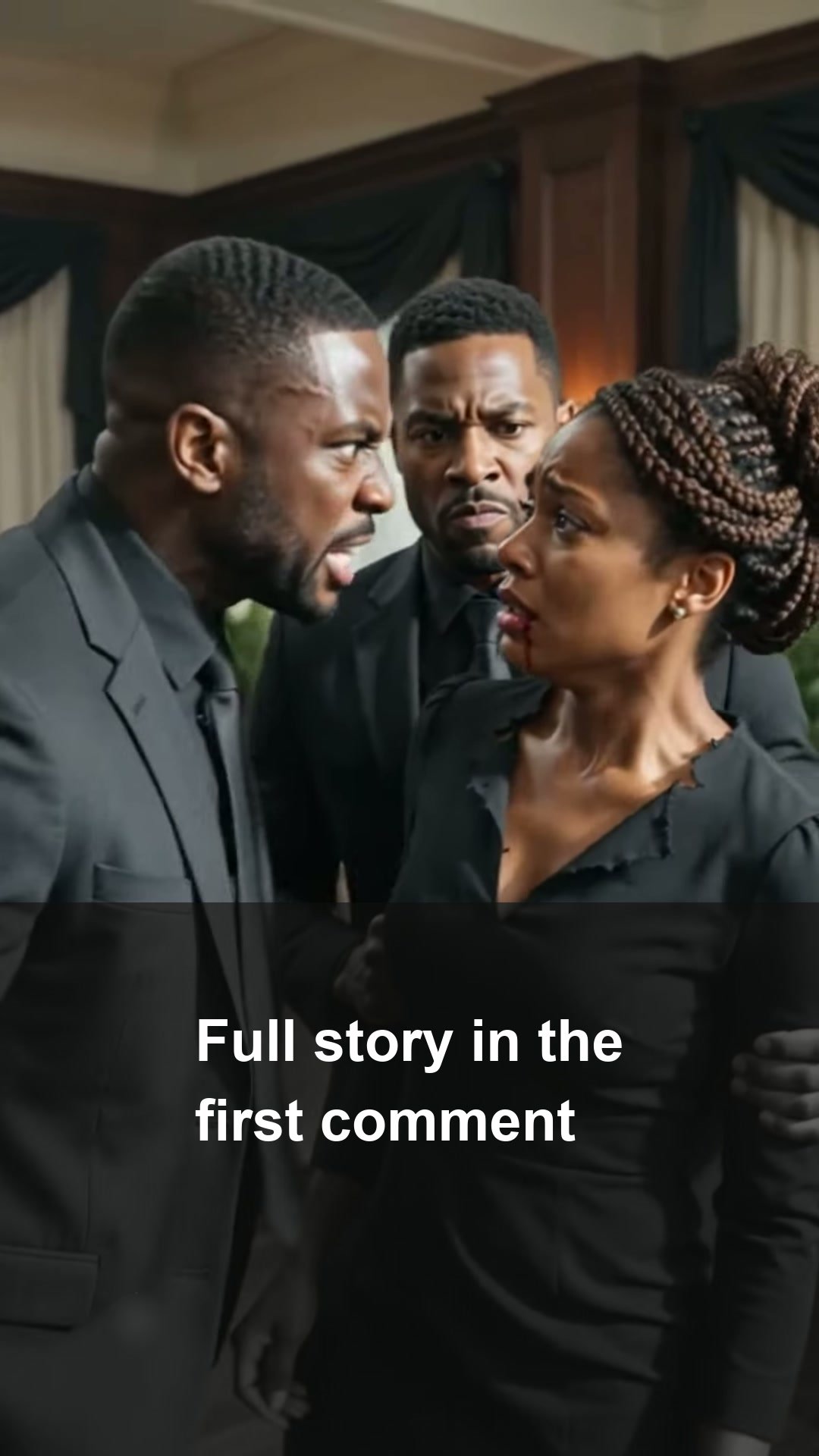
The iron taste of blood in my mouth was the only thing grounding me as my brother lunged, turning our father’s funeral into a battlefield of greed.
The heavy oak pew splintered under the force of his shoulder. Marcus’s tailored suit jacket ripped at the seam, a pathetic sound against the cathedral’s suffocating silence. He gasped, his face mottled with a rage that hadn’t seen the light of day since we were children. Mourners drifted backward like smoke, their hushed whispers replaced by the sharp, rhythmic clicking of Vanessa’s heels as she retreated toward the vestry.
I stood perfectly still, my fingers white-knuckled around the small brass key hidden in my palm. The weight of it was cold, solid, and absolute. I didn’t flinch when he grabbed my wrist, his skin slick with sweat. He leaned in, his breath sour with scotch.
“Open the safe, Elena,” he hissed, his voice a jagged promise of violence. “Or I will break your hand to get it.”
I looked past him toward the back of the chapel, where two men in charcoal suits stood motionless by the door. I nodded once. It was time.
The air in the archives smelled of dust and decaying parchment, a scent I found more comforting than the sterile, floral rot of the funeral home. It was Tuesday, a day so unremarkable it felt like a blank page. I sat at my desk, the rhythmic hum of the building’s HVAC system vibrating through my chair. My morning routine had been a study in inertia: the same light roast coffee, black, sipped while watching a grey drizzle smear the windows of my studio apartment. The city outside was a blurred smear of wet asphalt and yellow cabs, moving with a purpose that felt entirely disconnected from my own.
I tapped the edge of my stapler against the blotter, counting the seconds between the office printer’s labored groans. It jammed, as it did every three days, spitting out a wrinkled stack of quarterly reports. I walked over, my movements practiced and unhurried, and slid the tray open. The paper was still warm, smelling faintly of toner and ozone.
Sarah, a junior archivist with a penchant for loud scarves, leaned against the doorframe, balancing a stack of ledgers on her hip. She was talking about her weekend trip to the coast, her voice a pleasant, chirping background noise. I nodded at the right intervals, mimicking the cadence of someone who was present.
Did you see the weather report? she asked, gesturing toward the window with a chin-tilt. Supposed to be clear by noon. Real summer weather for once.
I watched a raindrop trace a jagged path down the glass, splitting at a speck of grit. It’s about time, I said. I felt the familiar weight of my badge against my hip, a heavy, cold reminder of the access I held to every locked cabinet in this building. My inner monologue was a quiet, clinical tally of the files I needed to cross-reference before the lunch hour. I decided to prioritize the probate records from the mid-nineties; they were rotting at the seams, their glue failing under the humidity.
It was safe, orderly, and entirely devoid of surprises. My life was a series of managed archives, a collection of histories that stayed where I put them. I prided myself on that control. I liked the silence of paper. I liked the way a ledger didn’t lie, provided you knew how to read the ink, not just the claims written in the margins.
My phone, resting on the corner of my desk atop a stack of index cards, vibrated. It was a sharp, aggressive sound against the quiet of the office, the screen lighting up to display a number I didn’t recognize. The vibration seemed to last a second too long, humming with a low-frequency urgency that made the hair on my arms prickle.
I looked at Sarah, who was still waiting for a response to something she’d asked about a brunch spot downtown. The hum of the printer resumed, a mechanical grinding that suddenly sounded like a warning. I looked down at the phone. The screen flickered, the light casting a pale, sickly glow over the mahogany finish of my desk.
I reached out, my fingers hovering just above the glass. I didn’t recognize the area code, but the rhythm of the ringing felt heavy, tethered to something I had been trying to outrun for years. I pressed my thumb to the screen and slid it to answer, the silence of the office suddenly feeling thin, fragile, and ready to shatter.
The voice on the other end wasn’t my father’s, though for a heartbeat, I expected his gravelly, measured rasp. It was Samuel Price, his attorney, and the tone was stripped of its usual professional veneer, reduced to a jagged, urgent whisper. Elena, he said, and the air in the room seemed to vacate, leaving a vacuum where my lungs should have been. It is done. The bank contacted me an hour ago. The primary accounts are not just empty; they are overdrawn. And Marcus… he is filing for probate this afternoon.
I felt the plastic of the receiver press hard against my ear, a cold, unyielding pressure. I looked at the stacks of audit logs on my desk, the numbers I had spent six months meticulously cross-referencing until they blurred into a landscape of betrayal. My pulse hammered in my throat, a frantic, irregular rhythm that mocked my outward stillness. I thought of the velvet-lined safe in the study, the one Marcus believed held nothing but sentimental trinkets and useless paper. He was so sure his charm had blinded everyone to the ledger entries. He had played the golden child so perfectly that he’d forgotten I was the one who kept the books.
I stood up, the chair scraping sharply against the hardwood floor. Sarah glanced up, her eyes bright with a brunch-time triviality that suddenly felt alien, a language I no longer spoke. I kept my face blank, a practiced mask of dutiful composure. I’m sorry, Sarah, I said, my voice steady, betraying nothing of the fire rising in my chest. Family business. It’s reached a breaking point.
I didn’t wait for her reply. I walked out, the soles of my shoes clicking against the hallway tile with a finality that felt like the closing of a tomb. As I reached the elevator, I pulled the small brass key from my pocket, rolling its jagged teeth against my thumb until the metal bit into my skin. The sting was a cold, sharp anchor. I had spent my life cleaning up his wreckage, patching the holes he punched in our world with my own silence, but the ledger didn’t lie. I had the audit trail, the evidence of his gambling debts disguised as medical expenses, and the funeral was scheduled for tomorrow.
I reached the lobby, the automatic doors sliding open to reveal a gray, overcast afternoon that matched the precise, clinical anger churning in my gut. I didn’t call an Uber. I walked toward the parking garage, my mind mapping the sequence of the next twenty-four hours. I would let him stand at the altar, let him weep his performative tears, and then I would give him exactly what he had worked so hard to steal. I reached my car, unlocked the door, and caught my reflection in the window. My eyes were clear, cold, and entirely finished with being invisible. I started the engine, the ignition roar signaling the end of the long, quiet war I had been losing in the shadows.
I pulled the sedan into a narrow slip between a dumpster and a rusted delivery van, my phone already warm against my ear. The hospital’s switchboard had the hollow, frantic resonance of a place that had already stopped caring about my father. I waited for the administrative line, watching a nurse in sea-foam scrubs discard a pair of blue latex gloves into an overflowing bin.
Is this the billing department? I asked, my voice flat, devoid of the soft, wheedling tone I usually employed to get information out of people.
The woman on the other end sighed, a dry sound like crumbling parchment. We’re closed, honey. Try the central office in the morning.
My father died at 4:12 AM, I said, staring at the concrete wall. Someone moved funds from his personal account to a private equity firm in the Cayman Islands six hours later. I need the name of the clerk who authorized the digital transfer.
There was a pause, long enough for the hum of the hospital’s ventilation system to bleed through the line. The accounts were frozen by the executor at noon, the clerk replied, her voice shifting into a scripted, defensive cadence. No transactions were processed after he was declared.
I pressed the phone harder against my ear. Marcus Vance is not the legal executor. I am.
That’s not what we have on file, she muttered, and the call disconnected with a sharp, electronic chirp.
I sat in the silence, the steering wheel slick under my palms. If they claimed the accounts were frozen at noon, but the wire transfer had cleared at ten, then someone had walked into that office with a forged power of attorney. I shifted the car into gear, steering toward the Grand Hotel.
The valet booth was empty, the lobby smelling of expensive, cloying lilies. I bypassed the front desk, heading straight for the concierge, a man who looked like he had been sculpted from mahogany and indifference. I placed a crisp hundred-dollar bill on the blotter.
Mr. Vance checked out this morning, he said, not waiting for a question. His wife left the baggage. They were in high spirits.
I looked him in the eye. They were leaving for a funeral, not a vacation. Did they have a courier? A man with a briefcase?
The concierge adjusted his silk tie. There was no courier. Mr. Vance received a visitor, a woman in a grey coat. They argued in the suite until the walls shook. She left alone.
I felt a cold prickle of sweat at the nape of my neck. Vanessa had been sobbing in the garden at ten. She hadn’t been here. I turned and strode toward the back service entrance, pulling my coat tight. Every piece of the puzzle was jagged, intentionally filed down to prevent a fit.
I reached the nurse’s residence at the edge of the estate, pounding on the door until it swung open. Sarah stood there, her eyes swollen, a crumpled bank statement in her hand.
I saw you leave the safe open, Sarah whispered, stepping back into the shadows of her kitchenette. You told me it was empty. You told me the bank took everything months ago.
I didn’t open the safe, Sarah, I said, my pulse drumming in my ears.
She looked at the document, then back at me, her expression hardening into something unrecognizable. Your brother paid me to lie. He said you were the one stealing. He said you were hiding the records to frame him.
I took a breath, the air in the room thick with the scent of cheap cleaning supplies and betrayal. I had spent years cataloging their lies, but I hadn’t realized they were writing their own history, one that cast me as the villain. I turned back toward the driveway, the gravel crunching under my heels. The car was waiting. I had a clear view of the road ahead, and for the first time, I didn’t care who was watching. I was going to the study to see what was really missing.
The study door resisted for a second before the heavy oak groaned inward. I stepped into the room that smelled of stale cigar smoke and the faint, citrus tang of the polish I had applied a thousand times before. My fingers traced the velvet backing of the mahogany desk, finding the hidden groove beneath the drawer. The safe key, cold and biting, rested in my palm like a dormant predator.
Marcus appeared in the doorway, his silhouette blocking the weak afternoon light. His suit was too sharp for the occasion, the fabric pulling across his shoulders as he took a step inside. He didn’t look like a grieving son; he looked like a man counting coins in a dark alley.
Give it to me, Elena, he said, his voice dropping into that familiar, oily register he used to charm the house staff. You don’t even know what you’re holding. You’re playing with things far beyond your reach, and I’m tired of cleaning up your messes.
He lunged, his hand a blur of expensive watch links and desperation, reaching for the key. I pivoted, pressing my spine against the cool metal of the safe. The movement was calculated, a clinical necessity I had rehearsed in my mind for three years. I caught his wrist, feeling the frantic, uneven thrum of his pulse against my skin. He was trembling. Beneath the arrogance, he was terrified.
I thought of the medical bills he claimed to have paid, the ones I had secretly covered with my own savings while he bought custom Italian leather. I thought of the night I held our father’s hand as he whispered about the wolf in the study, his eyes pleading for a sanity I hadn’t yet found the courage to claim.
I pulled the key back, my grip iron. I looked into his eyes, watching the panic finally shatter his mask.
I didn’t lose the money, Marcus; I found where you buried Dad.
The kitchen of our childhood home smelled perpetually of scorched coffee and the faint, ozone-heavy scent of a paper shredder running overtime. I was ten, sitting on the cool tile, watching my father’s silhouette pace behind the frosted glass of the study door. Marcus, two years older and already cultivating that effortless, lopsided grin that excused everything from broken windows to failing grades, leaned against the counter, tossing an apple into the air. He didn’t look at the study. He didn’t hear the way our father’s voice cracked when he begged the unseen person on the phone for just one more week. Marcus only watched the apple. I watched his hands. He had the same long, elegant fingers as our father, but he used them like a card shark, restless and hungry.
Dad called me in that night, the house silent except for the rhythmic clicking of a stapler. He didn’t look up from the ledger, his face a map of grey exhaustion. Elena, he said, his voice a dry rasp, your brother is a sun that blinds everyone, but he leaves a shadow behind him that will swallow this house whole. He pressed a heavy, brass key into my palm, the metal cold and biting. Don’t let him into the study, no matter what he promises. I nodded, my heart hammering against my ribs like a trapped bird. I didn’t know then that he was handing me a life sentence of vigilance. I just knew that when I stepped out, Marcus was there, his expression shifting instantly into a mocking, saccharine concern. Let me see, El, he whispered, reaching for my closed fist, his breath smelling of sugar and secrets. I turned away, the key digging into my skin, and walked to my room, locking the door for the first time in my life.
Middle school brought the first real proof of his alchemy. Marcus didn’t just spend money; he transfigured it. He borrowed a hundred dollars from the household petty cash to buy a designer blazer for a dance, claiming he’d return it before the billing cycle. When the late notice arrived, I found him in the living room, charm radiating off him as he explained to our mother how the bank had made a clerical error. She looked at me, her eyes pleading for me to corroborate his lie, to keep the peace, to preserve the illusion of the golden child. I felt the familiar, acidic bile rise in my throat. I stood there, a witness to the fraud, and said nothing. I chose the silence. I chose to be the shadow that held the floorboards together while he walked over them.
By high school, the pattern had hardened into a ritual. Marcus would crash a car or wreck a reputation, and I would be the one called into the principal’s office or the insurance adjuster’s desk to provide the context, the apology, the correction. I became an expert in the art of the rewrite. I learned how to bury a scandal under a pile of well-worded administrative memos. Every time he failed, I was the one who paid the price—not in currency, but in the slow erosion of my own identity. I was the curator of his mistakes, the ghostwriter of his absolution. Dad would watch us from the doorway, his eyes tired, a silent judgment passing between us that never quite bridged the gap of his favoritism. He loved Marcus for what he hoped he would be, but he trusted me with the truth of what he actually was.
The marriage was the final nail in the illusion. Vanessa was a mirror image of Marcus, a woman who treated social standing like a religious calling. I remember the engagement dinner at the club, the way she clinked her crystal glass, talking about the estate as if it were already a liquid asset. She looked at me with a pity that burned hotter than rage, as if my refusal to be a part of their frantic, desperate consumption was a defect of character. Marcus sat beside her, his hand resting on her knee, his gaze fixed on my face, daring me to speak, daring me to drop the veil. I didn’t say a word. I drank my wine, watching the way he glanced at his watch, counting the minutes until he could retreat to the study to look for the things he hadn’t yet managed to steal.
The warnings were always there, encoded in the mundane. Dad’s cryptic notes, the missing bank statements replaced by glossy travel brochures, the way Marcus would suddenly develop an intense interest in the history of the house, questioning me about the security codes and the provenance of the family silver. He never asked how Dad was feeling. He never asked about the radiation treatments or the nights I spent listening to the labored, wet rattle of his lungs. He asked about the safe. He asked about the offshore accounts. He asked about the deeds to the land. Each time, I gave him the same, practiced, clinical answer—the ones I’d spent years perfecting—that everything was under control. I was the guard dog, protecting a bone he had already picked clean.
I remember standing in the study three years ago, the air thick with the smell of old paper and dust. Dad was barely conscious, his hand clutching mine with a strength that belied his frailty. He whispered about the wolf in the study, his eyes darting to the corner where the safe sat, a hulking beast of iron. I didn’t understand the depth of his betrayal until I opened the desk drawer and found the stack of overdraft notices hidden beneath a stack of blank checks. They were all signed by Marcus, forged with a terrifying, practiced accuracy. My father hadn’t been losing his mind; he had been losing his legacy, one signature at a time, to the boy he had taught to believe he was entitled to the world.
I didn’t react then. I didn’t scream. I didn’t call the police. I took the notices, filed them alphabetically, and sat in the dark for three hours. I thought about the thousands of hours I had spent fixing, scrubbing, and hiding. I thought about the life I hadn’t lived because I was busy managing the wreckage of his. I realized that my silence wasn’t loyalty—it was complicity. I had been his gardener, trimming the weeds until the garden was nothing but soil and roots, and now the weeds were coming for the house itself. I made a decision, a cold, sharp thing that cut through the years of conditioning. I would stop fixing. I would start documenting.
The funeral preparations were the culmination of that decision. I watched Marcus move through the house like a scavenger, his eyes hungry, his movements hurried. He didn’t realize that every time he walked past me, I was calculating the weight of his guilt. I had the audit trails, the forged signatures, the evidence of the systematic extraction of our father’s lifeblood. I had the flash drive, the keys, and the leverage. I watched him rehearse his grief, a performance so shallow it made my teeth ache. He was waiting for the moment to claim the prize, to step into the vacuum he had created. He didn’t know that the vacuum was a trap, and I was the one holding the door shut.
When he looked at me across the casket, his eyes filled with a predatory warmth, I saw the little boy who used to toss the apple. I saw the man who had traded his soul for a lifestyle he couldn’t afford. I saw the end of the line. I didn’t hate him, not then. I felt a strange, detached pity. He had lived his life believing that because he was the golden child, the rules didn’t apply to him. He thought the world was a bank that would never stop honoring his bad checks. He was about to find out that the bill had finally come due, and I was the one who had written it. Every insult he had ever thrown, every warning I had ignored, every night I had spent in the shadow of his ego, it all led to this. The study, the safe, the silence—it was all a preamble to the reckoning. I gripped the key in my pocket, the brass biting into my palm, and walked toward the light.
The foyer was a vacuum of hushed tones and expensive perfume. Vanessa stood by the grandfather clock, her fingers frantic as she smoothed a wrinkle in her silk dress that wasn’t there. She looked like a bird of prey that had suddenly realized the cage door was locked from the outside. I caught her gaze and she flickered, her bravado splintering. She had spent a decade playing the doting sister-in-law to hide the fact that she was the one pulling the strings of Marcus’s spending. She needed this inheritance to pay off the private debt collectors currently circling her social circle. I didn’t say a word, just let my silence stretch until she looked away. She knew she was collateral damage, and the realization was already turning her skin grey.
Samuel Price stood near the velvet curtains, his posture stiff, a man whose spine had been fused by years of burying the sins of the elite. He kept checking his watch, his knuckles white against his briefcase. He had been our father’s lawyer for twenty years, a man who had watched Marcus siphon the family wealth and had done nothing but file the paperwork. He saw his own reflection in the audit I had handed him earlier; the guilt was a visible weight on his shoulders. He didn’t want justice; he wanted absolution. I watched him swallow hard, his eyes meeting mine with a desperate, silent plea for me to keep his own failures out of the public record. I gave him a curt nod, a promise I had no intention of keeping.
Uncle Raymond approached, his face a mask of performative grief. He leaned heavily on his cane, the patriarch who had ignored the theft because the thief was a man. He clapped a hand on my shoulder, his touch heavy and patronizing. He wanted me to be the quiet, obedient girl who would handle the logistics while the men divided the spoils. He still viewed the family estate as a feudal fiefdom, unaware that the kingdom had already been liquidated. I watched him blink, confused by my lack of reaction. He expected an apology for my brother’s outburst, but all he got was my steady, unblinking stare. He stepped back, a flicker of genuine fear crossing his eyes as he realized he was looking at a stranger.
Marcus lunged again, his face a landscape of sweat and veins. He grabbed my arm, his grip bruising, but his eyes were wide and vacant. He was terrified of the empty space where his privilege used to be. He had been raised to believe that his charm was a form of currency, and now, for the first time, he was bankrupt. He thought if he could just break me, he could get the key and reset the board. I didn’t pull away; I leaned into his space, smelling the stale scotch on his breath. I realized then that he had never actually seen me, not once in thirty-two years. He had only seen a mirror for his own delusions.
I leaned close to his ear, my voice steady, stripped of the clinical distance I usually wore. I told him he had already lost the house, the money, and the name he used as a weapon. He gasped, his mouth opening in a silent, jagged O. The room went still. The guests turned. The mask of the golden child hit the floor, shattered, leaving only a man who had built his life on a foundation of sand. I felt the key in my pocket, cold and heavy. I didn’t need to shout to destroy him; I only needed to tell the truth. He let go of my arm, his hands trembling as he backed away, right into the path of the investigators entering through the side door. The hunt was over, and the prey had finally walked himself into the trap.
The sound of the heavy mahogany doors creaking open was the only noise in the foyer as the two investigators, their suits charcoal-grey and utilitarian, moved with the synchronized precision of bailiffs. I watched from the periphery, my hand resting on the smooth, cold surface of the marble entryway table. Marcus stared at them, his face a map of confused arrogance that began to pale as the lead agent, a woman with silver-rimmed glasses, produced a badge encased in cracked leather. I reached into my pocket, my fingers finding the brass teeth of the safe key, and squeezed until the metal bit into my palm. It was the physical anchor I needed to stay present.
The woman didn’t look at me. She addressed Marcus directly, her voice cutting through the thick, expensive perfume of the room like a scalpel. She spoke of the suspicious wire transfers, the pattern of drain-accounts leading back to his personal offshore shell, and the formal criminal complaint I had filed forty-eight hours prior. Marcus sputtered, his eyes darting toward Uncle Raymond, who stood frozen near the fireplace, his glass of scotch trembling in his grip. I had spent the previous evening sitting in the dim light of the library, meticulously scanning the bank statements I had retrieved from under my father’s floorboards, uploading every timestamped fraud to the digital portal of the state attorney’s office. Every entry was a thread I had pulled until the entire tapestry of Marcus’s life unraveled.
I took a deliberate step forward, the click of my heels against the parquet floor sharp and rhythmic. Marcus spun toward me, his composure finally fracturing into a snarl. You did this, he hissed, the words barely audible over the sudden, sharp intake of breath from the surrounding mourners. I didn’t flinch. I kept my expression blank, mirroring the clinical detachment I used when archiving my father’s business records. I told him that I hadn’t done anything but document what he had chosen to manifest. The irony of his own greed being the primary witness against him seemed to hit him then, his shoulders sagging under the weight of his tailored jacket.
The investigator signaled to her partner, who moved to block the doorway. Marcus tried to pivot, his hand darting toward his pocket as if he could still intimidate his way out of the narrative, but the movement was clumsy, unpracticed. I looked past him at Vanessa, who was huddled near the velvet drapes. Her eyes were wide, calculating, already scanning the room for an exit strategy that didn’t involve an accused felon. I realized then that she was the first to realize the ship had hit the iceberg; her silence was the loudest betrayal I had witnessed all day. She wouldn’t lift a finger to save him, not if it meant jeopardizing her own standing in the circles we occupied.
I pulled the key from my pocket and held it out, a small, inconsequential piece of brass that held the contents of the family safe—the final audit trail. The lead investigator accepted it with a nod of professional acknowledgment. As Marcus was escorted toward the side door, his protests morphing into stuttered, frantic denials, I felt a strange, hollow sensation in my chest. It wasn’t triumph. It was the clinical realization that a long-standing error had finally been corrected. The house, the money, the name—they were all tied up in litigation now, frozen in the cold gears of the probate court.
I turned back to the remaining guests. Their faces were a blur of shock and suppressed curiosity, the social mask of the mourner replaced by the predatory hunger of the gossip. I didn’t care. I walked toward the study, the place where my father had spent his final, paranoid months warning me about the wolf. I passed Uncle Raymond, who caught my arm with a withered, spotted hand. Elena, he whispered, his voice cracking with the indignity of it all, you didn’t have to ruin the family name to save the books. I looked at his hand, then up at his face, seeing the cowardice that had allowed Marcus to thrive for years. I didn’t pull away; I simply met his gaze until he dropped his hand, flustered and defeated.
I stepped into the study and closed the door behind me. The silence was immediate and absolute, a sharp contrast to the murmurs still filtering in from the foyer. I walked over to the desk, opened the top drawer, and pulled out the legal notice I had drafted with my lawyer the week prior—a formal request to contest the will based on the evidence of elder abuse and financial manipulation. It was sitting there, signed and notarized, waiting for the exact moment the investigators needed to establish jurisdiction. I placed it on the blotter, a final, irreversible strike.
My pulse began to slow, the thrum of adrenaline receding into a cold, steady hum. I opened the safe. It was already being emptied by the team, the bundles of fraudulent checks and the ledger of missing assets being tagged as evidence. The void left behind in the metal box felt like the first clean space I had occupied in years. I leaned against the heavy oak desk, my legs finally beginning to tremble with the release of tension. I had spent a lifetime being the daughter who maintained the peace, the one who patched the leaks and smoothed the edges. Now, the edges were jagged and the leaks were flooded, and for the first time, I wasn’t the one holding the bucket. I looked out the window at the long, manicured lawn of the estate. The sun was dipping toward the horizon, casting long, distorted shadows across the grass. I wondered, briefly, what I would do with the silence once the police cars were gone and the house was legally sealed. I had no answer, only the knowledge that the next step was entirely mine to define. I reached for the phone on the desk, my fingers hovering over the keypad. There was one more call to make, a cancellation of the private security contract Marcus had used to keep the house staff in line, and after that, the transition from participant to spectator would be complete. I dialed the number, my voice clear and unwavering as I gave the order to terminate the services. The voice on the other end hesitated, then complied. The final thread was cut.
The house held a different quality of silence now, one that vibrated with the absence of Marcus’s frantic pacing. I stood in the kitchen, staring at the granite island where Vanessa used to leave her designer bags, now just a slab of cold, polished stone. My phone buzzed against the marble—a notification from the community portal. Someone had posted a grainy video of the arrest, the handcuffs glinting like jewelry in the afternoon sun. I watched the comments scroll by: shock, then rapid-fire condemnation, then the inevitable vultures circling for gossip.
The screen flickered. A message from our neighbor, Mrs. Gable, slid into view. Are you safe? I replied with a single word, yes, and blocked the notifications. The local school board had already sent an automated email regarding Marcus’s board seat, their tone meticulously neutral, distancing the institution from the scandal. The social web that had sustained our family name for decades was currently tearing itself apart, thread by thread. I felt a strange, detached curiosity watching it happen, like observing a structural failure from a safe, reinforced bunker.
The doorbell chimed, a sharp, intrusive sound that echoed through the foyer. I didn’t move. It was likely a reporter, or perhaps an old family friend looking for a soundbite to justify their own discomfort. I watched on the security monitor as a man in a gray suit lingered on the porch, checking his watch. He looked like he belonged in one of Father’s old boardrooms, someone who had built a career on the pretense of loyalty. He turned away eventually, his shoulders slumped in a performance of sympathy that fooled no one.
I walked to the sink and turned the tap. The water ran cold, biting against my skin. I scrubbed at a smudge of dried blood on my wrist, a remnant of the scuffle in the study. The drain swallowed the pink-tinged water, and I felt the weight of the last few years—the hidden medical bills, the falsified records, the constant, suffocating need to manage Marcus’s failures—dissolve down the pipe. I was an archivist of disasters, and for the first time, I didn’t have to file the report.
Uncle Raymond’s car pulled into the gravel driveway. I watched from the window as he stepped out, his posture stiff, his eyes scanning the windows as if expecting to see ghosts. He had spent his life valuing ‘family honor’ above truth, and now he was faced with the reality of what that honor had actually cost. He stood by the gate, hesitant, waiting for an invitation I had no intention of extending. My phone lit up again—an email from the bank investigators confirming the asset freeze. The estate was locked, the liquidity gone, the lifestyle he had protected effectively dismantled.
I walked toward the front door, the heavy brass key to the study still tucked into my pocket. My reflection caught in the hallway mirror: tired, yes, but steady. I looked like a woman who had finally stopped apologizing for her own existence. I decided then that I would not open the door for Raymond. I would let him stand there until the weight of his own realization forced him to turn back. I reached for the bolt, sliding it into place with a sharp, definitive click. The silence in the house didn’t feel lonely anymore. It felt like space. I breathed in the scent of lemon polish and old dust, knowing the next chapter was already being written without my help.
The house settled with a groan, the floorboards sighing under the lack of heavy, frantic footsteps. I walked into the kitchen, the marble countertops cold against my palms. The dried smear of Marcus’s blood on my thumb was a dark, jagged map of the last few hours. I turned the faucet, watching the water turn pink as I scrubbed until my skin was raw and stinging. The drain swallowed the evidence of the struggle, and for the first time in a decade, the room felt sterile instead of suffocating.
I moved to the study, the door standing slightly ajar, the lock forced by the authorities earlier that afternoon. The safe sat wide open, a gaping, hollow mouth in the wall. The morning light caught the interior, revealing nothing but the dust of long-forgotten ledgers. I reached into my pocket, pulling out the brass key. I let it drop. It clattered against the hardwood, spinning once before coming to rest in the center of the rug. I didn’t reach for it. I didn’t care where it landed.
I walked to the mahogany chair where my father had spent his final months tethered to machines and silence. I sat down and poured a glass of cold water from the carafe. My hand didn’t shake. I watched the bubbles cling to the side of the crystal, listening to the absolute stillness of the estate. The investigators had taken the files, the computers, and the ledger books; the room looked skeletal, stripped of the pretense that had held us all hostage.
I stood and walked to the hallway where a single, medium-sized suitcase waited by the door. It contained a few clothes, a handful of books, and the signed documents that finally severed my legal ties to the Vance name. I had no sentimental attachments to the portraits on the walls or the silver on the sideboard. They were just objects now, stripped of their power to command my loyalty.
I stepped out onto the porch, the air crisp and biting with the early scent of frost. The garden was dark, the iron gate standing open where the police cruisers had exited. I took a breath, the oxygen filling my lungs without the obstruction of a hidden secret or a pending crisis. I didn’t look back at the windows or the tall, imposing stone facade. I walked toward the edge of the property, my boots crunching on the gravel drive, moving toward the line where the driveway met the main road and the rest of my life began.
I reached the small cottage three towns over by noon. It was a space defined not by what it held, but by what it lacked: no heavy velvet drapes, no ancestral portraits, no ghosts. I dropped my suitcase on the hardwood floor and felt the silence settle around me like a weighted blanket.
I walked into the kitchen, the sunlight hitting the linoleum in sharp, clean rectangles. I filled a glass from the tap. The water was cold, biting against my teeth, and for the first time in a decade, I didn’t worry if the pipes were about to burst or if a bill was sitting unopened on the counter. I sat at the small pine table and watched a robin hop across the grass outside.
“You’re shaking,” I whispered to the empty room. The tremor in my hands wasn’t from grief, but from the sudden absence of a weight I hadn’t realized I was carrying until it was gone.
I stood up and went to the back door, stepping out into the overgrown yard. The air tasted of salt from the nearby coast and damp earth. I walked to the center of the patch, kicking aside a pile of rotting leaves to find the soil beneath. It was dark, rich, and waiting.
I knelt, pressing my palms into the dirt. The grit worked its way under my fingernails, a physical reminder that I was here, anchored, and untethered from the estate. I thought about the garden at home—meticulously manicured, suffocating, perfect. I reached into my pocket and pulled out the brass key, the one that had unlocked the secret of my father’s ruin. I dug a hole, dropped the key in, and covered it over.
I stood, wiping my hands on my jeans, and looked toward the horizon. A dog barked in the distance. I decided I would go to the shelter tomorrow. I took a deep breath, and finally, my lungs stayed full.
The living room of the estate stood silent, stripped of the frantic energy that had defined it for years. I walked to the study, the heavy oak door swinging open on silent hinges. The room smelled of stale cigar smoke and the faint, metallic tang of the papers I had spent months auditing. I approached the wall safe, its heavy iron door swung wide like a gaping, hungry mouth. Inside, the velvet lining was empty, stripped of the ledgers and flash drives that had once held my family’s fragile reputation hostage. I ran a fingertip along the cold, vacant shelf, the metal humming beneath my touch. Outside, the gardener’s shears clicked rhythmically against the hedges. On the polished floorboards, the brass key lay abandoned in a sliver of morning sun.
Leave a Reply