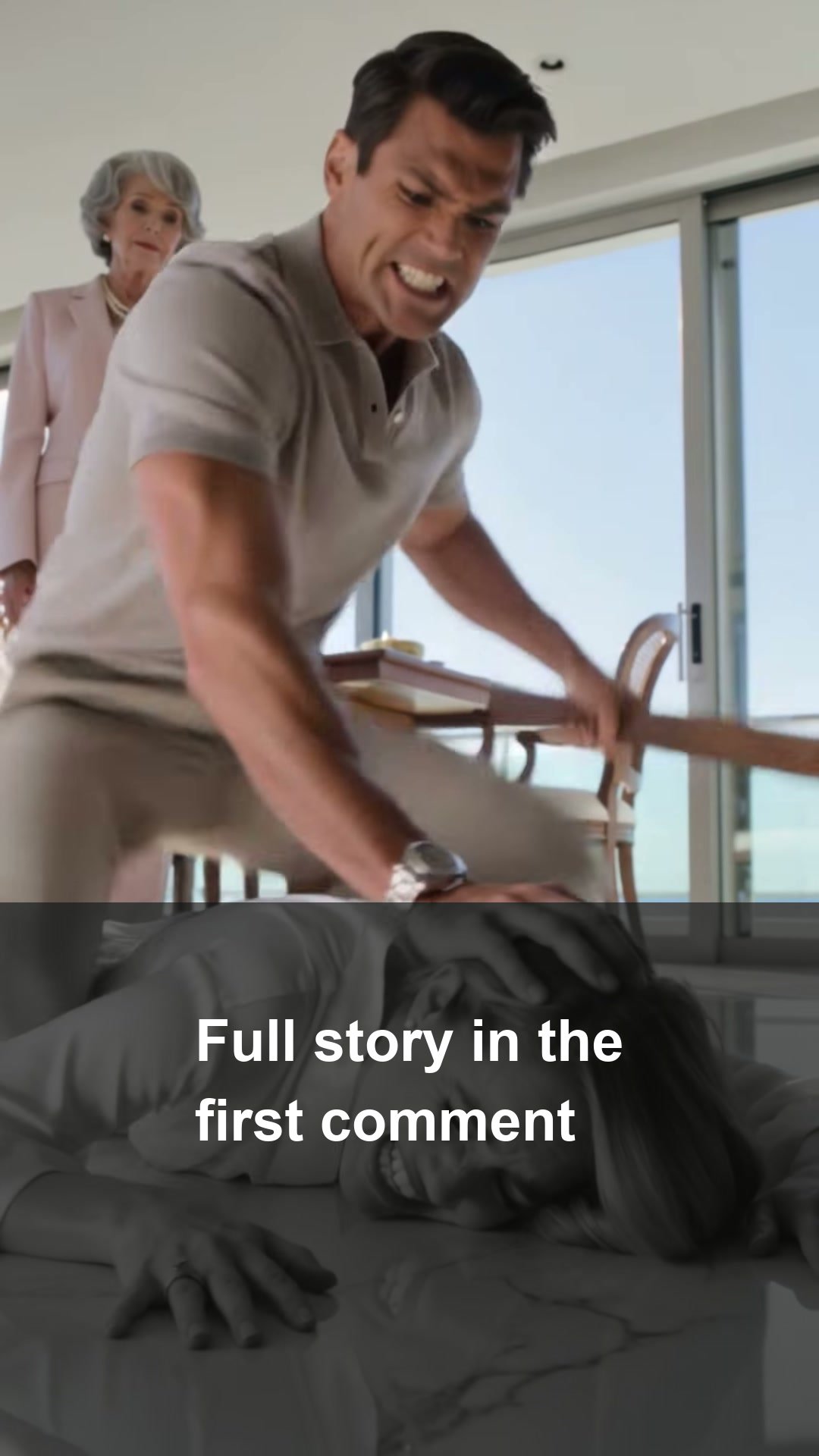
The blood from my lip tasted like copper and expensive vintage red. I stood in the center of the terrace, the moonlight turning the Big Sur cliffs into jagged teeth. The reception music pulsed behind the glass doors, a muffled, rhythmic thrumming that felt like a dying heartbeat. Julian walked toward the railing, his cufflinks catching the moonlight with clinical precision. He adjusted his silk lapel, his breathing perfectly regulated, as if he had merely corrected a stray thread on a suit jacket. Elena, you look pale, he said, his voice a low, smooth friction. I touched my cheek, the skin already swelling where his signet ring had bitten into the surface. My reflection in the sliding glass door looked like a flawed painting, the varnish cracking under the pressure of the frame. I looked at the champagne flute trembling in my hand, then at the vast, uncaring drop of the cliffside. I could jump, or I could ruin him. I took a breath, feeling the cool salt air sharpen my resolve into something serrated. If I move his chessboard now, the king falls first. I turned to look at him, and smiled.
The morning light in the studio was always thin and gray, filtering through the skylight to land in sharp, dusty rectangles on the worktable. I liked the smell of that room. It was a mixture of linseed oil, rabbit-skin glue, and the faint, acidic bite of varnish remover. I spent my mornings with a cotton swab and a steady hand, lifting centuries of grime from a Dutch landscape. The work was slow, requiring a monastic sort of patience that felt like a secret.
Around ten, I pushed back from the easel and walked to the breakroom. The floorboards creaked in a familiar rhythm, a sound that felt like home. Marcus was already there, hovering over the office printer. He was wearing his usual gray sweater, the elbows fraying just enough to look lived-in.
Coffee? he asked without turning, his voice cutting through the mechanical whir of the machine.
Black, I said, leaning against the doorframe.
The machine hissed, spitting out a thin, bitter stream into a chipped ceramic mug. I watched the steam rise, curling into the stale office air. Outside, the sky over the city was a bruised, low-hanging slate, promising a cold rain that would turn the streets into slick, black ribbons. It was supposed to be a Tuesday like any other.
The printer jammed, a sharp, grinding noise that made Marcus sigh and hit the plastic casing with the side of his fist. Always the same temper, he muttered, finally pulling out a crumpled sheet of paper. He handed it to me—a printout of the latest museum inventory.
Everything looks correct, I said, scanning the rows of dates and names. My eyes felt tired, a dull ache behind the temples that came from staring too long at micro-fissures in oil paint.
He shrugged, leaning against the counter. Hear about the merger? The firm downtown is folding. Everyone’s talking about the sudden shift in the stock indices.
I looked at the mug in my hands, the ceramic warm against my palms. It seemed like a world away, that sort of chaos. I preferred the quiet of the studio, the way the past could be repaired if you were careful enough with the solvents. I didn’t care about mergers or the gilded lives of people who lived on cliffsides.
I think I’ll take a walk to the park at lunch, I said. The air is supposed to clear up by noon.
Marcus glanced at the window, his expression unreadable. You’re always looking for a way out of these four walls, Elena.
I smiled, a small, genuine thing. It’s not about getting out. It’s about seeing the light change.
I turned back to the studio, my shoes tapping against the linoleum. I was halfway to my station, already thinking about the delicate work waiting on the Dutch canvas, when the sound cut through the silence. It wasn’t the hum of the printer or the distant rhythm of traffic. It was the sharp, insistent trill of my phone sitting on the workbench. It sounded jarring, a metallic intrusion into the stillness of the room. I stopped, watching the screen light up, the name blinking like a warning. Julian. I stood there for a heartbeat, the silence of the studio suddenly feeling precarious, like a thin layer of glass about to shatter.
I reached out, my fingers hovering an inch above the glass before I finally tapped the green icon. The air in the studio felt thin, the smell of turpentine and aged linseed oil suddenly sharp enough to sting my lungs. I didn’t say hello. I just held the phone to my ear and let the silence stretch, listening to the static hum of his private jet connection.
Elena, he said, his voice stripped of the smooth, practiced charm he reserved for the press. Where is the ledger?
My throat tightened, a physical constriction that made it hard to draw breath. I looked at the Dutch canvas, the centuries-old paint depicting a tranquil landscape that suddenly seemed like a lie. I don’t know what you are talking about, I lied, my voice steady despite the tremor in my knees.
There was a pause, so heavy and deliberate that I could hear his rhythmic breathing. Don’t play the martyr, Elena. It doesn’t suit the dress you’re wearing. He knew. Of course he knew. He didn’t need to be in the room to track my movements; he lived in the security feeds, the bank statements, the very air of this house. Check the safe in the study. If it isn’t there, I will have the staff strip the house until they find whatever you’re hiding.
He hung up, the line dropping into a hollow, buzzing void. I lowered the phone, my hand shaking so violently that I had to grip the edge of the workbench to stay upright. The studio, my only sanctuary, suddenly felt like a cage with invisible, electrified bars. I thought of the ledger, hidden behind the loose floorboard in the pantry—a collection of names, dates, and offshore accounts that proved exactly how Julian had gutted those small firms to build his empire. It wasn’t just a list; it was a blueprint of his cruelty.
If he found it, he wouldn’t just destroy the papers. He would erase the evidence, and then he would erase me. I looked at the drying rack, then at the heavy, iron-cast palette knife sitting beside the canvas. The impulse to run, to sprint toward the coast and leave everything behind, clawed at my chest. But running would only confirm his suspicion, and he would hunt me down before I reached the main gate.
I needed to make it look like a accident—or better yet, like he had never been the one to call at all. I walked to the sink, splashed cold water on my face, and stared into the mirror. My eyes were wide, the pupils blown. I looked like a woman who had seen a ghost, not a woman who had just realized she was a weapon. I turned the light off, leaving the studio in darkness, and took a deep breath. I walked toward the study, my footsteps silent on the marble, each step a deliberate choice to stop being the surface and become the crack. The house was waiting for me, and for the first time, I was ready to tear it down.
I pulled the landline from the study wall, the cord trailing behind me like a severed nerve. The house felt too large, the marble floors magnifying the sound of my own shallow breathing. I sat on the floor of the butler’s pantry, the air smelling of ozone and floor wax, and punched in the number for the hotel desk in Monterey where Julian claimed to have spent the night of the gala.
The receptionist’s voice was thin, filtered through a headset. When I asked for the guest registry for the third, she didn’t even hesitate. She told me Julian had checked in at seven and checked out at five the following morning. It was a clean, polished lie—so clean it felt manufactured.
My mother answered on the second ring. I didn’t wait for her to finish her greeting. I asked her about the gala, about the man she claimed to have seen Julian talking to near the koi pond. She laughed, a brittle, sharp sound that reminded me of glass breaking. She insisted Julian had never left her side, that they had spent the entire evening discussing the board merger.
She was lying. I knew she was, because the hotel receptionist had been too precise, too rehearsed. I clicked the phone off and dialled the private nurse, Sarah, who looked after my father. Her voice was muffled, the background noise of the hospice ward creating a static hum. She told me Julian had visited the facility at ten that night, clutching a file, looking like a man who hadn’t slept in weeks.
Three stories. Three impossible realities.
I stood up, my legs trembling, and walked out to the garage. The air was thick with the scent of pine and salt spray, the Pacific Ocean roaring against the cliffs below. I climbed into the Range Rover, the leather cool beneath my fingertips. I drove to the witness—a valet who had been working the gate that night. I found him in the dim light of a roadside diner, his hands stained with engine oil, clutching a lukewarm coffee.
He wouldn’t look at me. He kept his gaze on the sugar packets on the laminate table. When I pushed him, his voice cracked. He said he hadn’t seen Julian’s car that night at all. He said he’d seen a black sedan with out-of-state plates drop off a man who looked exactly like Julian, but the man had walked with a limp. Julian didn’t limp.
My stomach turned. I thought of the way Julian had tightened his tie that morning, the way his movements were always practiced, always fluid. If the man at the gala was a decoy, the man at the hospital was a ghost, and the man at the hotel was a ghostwriter for a narrative that didn’t exist, then who was currently sitting in the master bedroom, waiting for me to return?
I looked at my hands. They were steady now, the tremor replaced by a cold, hard focus. I turned the ignition. The engine growled, a heavy, predatory sound that mirrored the feeling in my chest. I didn’t head back to the house. I turned the wheel toward the city, toward the archives. If the truth wasn’t in the present, it was buried in the paperwork of the past. The mystery wasn’t what had happened that night; it was how long I had been living in a house built of nothing but illusions. The hook was set, and I was finally pulling.
The archives smelled of wet wool and decaying adhesive, a sharp contrast to the antiseptic, ocean-salted air of the cliffside estate. I spent hours pushing through the dust, my fingernails black with the grime of forgotten ledgers. I wasn’t looking for a scandal; I was looking for a signature, a single, jagged crack in the foundation. By midnight, I found it. A shell company dated three months before our engagement, signed not by Julian, but by my mother. The paper was thin, brittle as a dried leaf, and it mapped out the sale of our family estate to cover the debt that Julian claimed he had paid off as a gesture of love. My mother hadn’t married me off to secure my future; she had liquidated me to maintain her membership in a country club that didn’t know her name.
I drove back under a bruised, violet sky. The mansion stood on the cliff like a tomb, every window glowing with an artificial, aggressive warmth. When I pushed open the mahogany doors, the house was silent, save for the rhythmic clink of ice against crystal in the study. Julian was waiting, his tuxedo jacket discarded, sleeves rolled up to reveal the forearms of a man who built his life on leverage. He didn’t look up when I entered. He just gestured to the chair opposite him, the leather groaning under my weight. I placed the photocopy of the ledger on the desk, the paper sliding across the polished surface like a weapon. He glanced at it, his expression not shifting, only his grip on the glass tightening until the knuckles turned the color of bone. He took a long, slow breath, a performance of patience designed to make me feel small. I watched him, the rage in my chest cooling into something precise and lethal. He looked at me then, his smile predatory.
I’m sorry you had to see that, he whispered.
The kitchen in our childhood home smelled of antiseptic and lemon polish, a sterile scent that disguised the rot of a mortgage we couldn’t afford. My mother stood at the island, her back a rigid column of silk and denial, methodically snapping the stems off a bouquet of lilies. The snap was rhythmic, a metronome for the anxiety that lived under my skin. I was ten, sitting on the high stool, watching the way her manicured thumb brushed the pollen from the petals. She didn’t look at me when she spoke, her voice dropping into that low, practiced register she used when neighbors were within earshot. Elena, she said, her tone as sharp as the garden shears, pull your shoulders back. You are slouching again. People don’t look at a girl who folds into herself. I straightened, the muscles between my shoulder blades aching, because I knew that if I was small, I was a failure of the investment she had made in my posture. I decided then that visibility was a trap, but invisibility was a death sentence.
My brother, Thomas, entered the room, his sneakers scuffing the hardwood. He was holding a crumpled school notice, a red slip for a missed tuition payment. My mother stopped snapping the lilies. She didn’t turn around, but the air in the room suddenly grew thin, oxygenated and cold. She took the paper from him without a word, her hand trembling just enough to make the slip rattle. My father wasn’t coming home tonight, she whispered, not to Thomas, but to the wall. He was busy finding the money we didn’t have, which meant we had to look as if we had already spent it. She turned then, her face a mask of serene, terrifying composure. She handed the notice to me. Burn it, she instructed. I walked to the stove, the flame flickering blue beneath the iron grate, and watched the ink curl into ash. I realized then that truth was merely an inconvenience, something to be erased before it stained the wallpaper.
School was an exercise in curation. I spent my teenage years in a private academy where the girls were taught that their value was an aggregate of their father’s net worth and their own ability to remain unblemished. In the locker room, Sarah Vance had been weeping because her boyfriend had forgotten to acknowledge her at the homecoming rally. I sat on the bench, lacing my boots, listening to her sob about how she felt invisible. I watched the way she touched her own face, as if checking for cracks. I didn’t reach out. I thought of my mother’s lilies, the way they stood tall in the vase even as they began to wilt from the inside out. I decided that feeling was a luxury I couldn’t afford if I wanted to survive the social calculus of our circle. I stood up, patted her shoulder with a mechanical, rehearsed grace, and said, He’s just a man, Sarah. Adjust your mascara and walk back out there. She stopped crying, shocked by the coldness of the advice, and I felt a strange, detached satisfaction in knowing I had taught her the first lesson of the gilded cage.
When I was twenty-two, my father’s business finally folded, a collapse that made no sound but left us hollowed out. I sat in a lawyer’s office, the beige carpet stained by the ghost of a thousand desperate meetings. My mother sat beside me, her jewelry the only thing about her that still held any weight. Julian was there, appearing in the doorway like a silhouette cut out of a magazine, his presence sucking the remaining air from the room. He wasn’t there for my father; he was there for the assets, for the connections, for the shell of a life that he wanted to acquire and refurbish. He looked at me, not as a person, but as a potential acquisition, his gaze scanning my features for symmetry, for polish, for the capacity to be shaped into a trophy. He reached out to shake my hand, his palm dry and firm, a grip that didn’t invite intimacy but demanded surrender. You look tired, he said, his voice a smooth, synthetic chime. I thought of the ash in the kitchen stove, the way my mother had taught me that survival required the quiet death of the self. I decided that I would be the most polished asset he had ever owned, a mirror he could trust to reflect only the light he wanted to see. I didn’t say that I was dying inside. I didn’t say anything at all.
The warnings had been everywhere, like landmines I had chosen to ignore because I was too busy learning how to walk the path. My aunt had tried to talk to me before the wedding, her hands clutching a cold cup of tea in the garden of the estate. She spoke of Julian’s first wife, the way she had simply stopped appearing in photographs, the way her opinions had been replaced by his talking points. She said, Elena, look at his eyes when he speaks to you. They aren’t looking at you; they’re looking through you, at the man he wants to become. I had laughed, a brittle, practiced sound, and told her she was being dramatic. I wanted the security of the silk, the immunity of the wealth, the silence that money could buy. I chose the cage because I thought I could learn how to own the lock. I walked away from her, my heels clicking on the stone path, and I felt a surge of arrogance—the belief that I was smarter than the women who had come before me.
I remember our first trip to the coast, before the house was finished, when Julian and I stood on the edge of the cliff. The wind was whipping my hair across my eyes, and he reached out to tuck a stray strand behind my ear, his touch lingering too long on the skin of my neck. He said, I like that you don’t fight the wind, Elena. You just let it pass over you. I stood there, feeling the vertigo of the drop, the ocean churning into a white froth against the rocks below. I realized then that he didn’t want a partner; he wanted a weather vane, something that would point wherever he dictated. I should have turned back then, but the luxury of the hotel, the champagne waiting in the suite, the sheer weight of his promise that I would never have to worry about a red slip again—it was too heavy a temptation. I leaned into his hand, closing my eyes, and gave up the last of my agency.
The silence grew over the years, a thick, suffocating velvet. I learned to read the shifts in Julian’s jaw, the tension in his shoulders that preceded a correction. If I wore a color he disliked, I was an embarrassment; if I spoke a thought he hadn’t vetted, I was a liability. I watched the staff tremble when he walked into a room, the way the house became a vacuum where only his needs existed. I became an expert at the art of the nod, the graceful exit, the smile that signaled compliance while my mind cataloged every insult, every condescending remark, every piece of evidence I had been collecting since the day we met. I realized, sitting in the silence of my own bedroom, that I had been building a case against my own life for years. I looked at my reflection in the mirror—not the woman Julian saw, but the one who existed beneath the surface—and I saw the cracks. I hadn’t been waiting for him to change. I had been waiting for the moment I could no longer stand the sound of my own silence. And now, standing here in this office, the ledger on his desk felt like the first honest thing I had ever touched.
I pressed my thumb against the heavy, cream-colored paper of the ledger. Julian entered the room, his footsteps muffled by the silk rugs he bought to keep me quiet. He didn’t look at me; he went straight to the decanter, the crystal stopper clinking against the glass with a sharp, dissonant chime. He was a man who measured his worth in decibels, yet he chose to live in a house that breathed silence.
You’re staring at the inventory again, he said, pouring amber liquid until it threatened to spill. His voice was a calm, practiced layer of varnish over a rotting core. I hated that I knew exactly how he’d snap if I challenged him. I thought about the night he’d broken the Ming vase—not because it was ugly, but because I’d placed it a millimeter to the left of his comfort zone. I decided then that the ledger wasn’t just data; it was a map of his panic. I’ll keep staring until it makes sense, I lied, my voice steady.
In the hallway, I found Victoria, my mother, tracing the frame of a painting with a manicured nail. She looked like a woman who had traded her soul for a seat at a table that no longer wanted her. She was terrified of the fallout, not because of what Julian did to me, but because the neighbors might stop inviting her to the galas. Elena, dear, she whispered, not meeting my eyes, remember that a diamond is only valuable because of the pressure. She thought she was giving me wisdom; I saw the fear of a woman who had never owned her own life. I walked past her, my heels clicking like a countdown on the marble floor.
Outside, Sloane was buffering the hood of the Porsche, her hands chapped from the winter air. She was the witness who saw everything and chose to scrub it clean. She caught my gaze and immediately looked down at the paint, her lip trembling. She wanted me to leave so she could go back to the comfort of being a bystander, but she knew the engine of this house was rattling. I stopped. Sloane, you don’t have to keep polishing the rust, I said. She didn’t look up, but her rag stopped moving, a frozen white flag in the gray morning.
I walked toward the gate where Marcus was waiting in a nondescript sedan. He was the ghost in the machine, a man who claimed to be a savior while keeping his own ledger of my husband’s sins. He had his own scars, mapped out in the way he gripped the steering wheel, knuckles white, eyes scanning the horizon for a redemption he wasn’t sure he deserved. He wasn’t helping me because he cared; he was helping me because Julian had destroyed his father years ago. I slid into the passenger seat, the smell of cheap coffee and damp upholstery a sudden, jarring relief from the floral rot of the mansion. Are you sure about this, Elena? he asked, his voice gravelly. I looked back at the house, the gilded cage gleaming on the cliffside, and realized we were all playing parts in a script written by a ghost. I decided that today, I would rewrite the ending. I just nodded, the weight of the ledger heavy against my thigh, and we drove away from the ocean, leaving the sound of silence behind us.
The fluorescent hum of the downtown precinct office felt like a surgical theater. I sat on a molded plastic chair, the ledger—the physical proof of Julian’s offshore laundering—resting on my knees. I pulled a pen from my bag and signed the statement. The detective, a man with tired eyes and a tie patterned with faded sailboats, tapped the paper. This is a one-way street, he said, his voice stripped of professional polish. Once this hits the desk of the district attorney, there is no calling it back. I looked at the ink drying on the signature, a sharp, black scar against the white page. I thought of the way Julian would touch my shoulder in public, his fingers digging into my trapezius until the nerves screamed, a silent reminder of who owned the skin. I nodded once. He didn’t smile. He just gathered the files, his movements rhythmic and final.
Three hours later, the vibration of my phone was a continuous, frantic pulse against the mahogany table of a mid-range diner. I didn’t answer. Instead, I tapped the banking application, my thumb hovering over the interface that controlled the joint accounts. With a precise, cold motion, I transferred the discretionary holdings into a private trust I had established through a shell company Marcus helped me secure. The screen flashed a confirmation: Transaction Complete. Within seconds, the phone rang again—Julian’s private line. I watched the caller ID, the elegant font mocking me, and hit block. The silence that followed was heavy, metallic, and tasted like freedom.
I met Marcus at a sterile office park in San Jose. He was waiting near a glass elevator, his posture rigid. We walked into the office of a firm that specialized in high-stakes litigation, their walls adorned with framed wins that smelled of old money and scorched earth. The lawyer, a woman named Sarah with hair pulled into a severe, sharp bun, took the ledger. She didn’t look impressed; she looked hungry. We are contesting the prenuptial agreement on the grounds of duress and fraud, she stated, already sketching a timeline on a notepad. I leaned back, my spine finally relaxing against the chair. My decision was set: I wasn’t just leaving; I was dismantling the structure brick by brick.
The retaliation was instantaneous. Before I reached the parking lot, my email pinged with a notification from Julian’s HR department. My mother, acting as the board’s mouthpiece, had officially filed a complaint against me, alleging theft of company intellectual property. It was a clumsy, desperate attempt to characterize the ledger as a corporate secret rather than evidence of a crime. I felt a surge of adrenaline, cold and sharp. By attempting to label me a thief, they had inadvertently confirmed the existence of the very records I had stolen. They were flailing, and I was the one holding the rope.
I drove to a private clinic in the city, the air smelling of antiseptic and impending change. I needed the final piece. The receptionist avoided eye contact, sensing the tension, as I provided the documentation for a private DNA test. I needed to prove that the ‘heir’ Julian paraded for the press—the child of a surrogate he had kept in a private facility in Zurich—was legally distanced from the biological markers he claimed. The technician took the swab, her gloves snapping against her skin. This usually takes five business days, she murmured. I didn’t care about the time. I cared about the destruction.
By the time I reached my temporary apartment—a sparse, quiet box where no one checked my wardrobe—the news had already broken. My phone was a graveyard of missed calls from journalists, friends, and lawyers. A notification popped up: Julian had filed an emergency injunction to freeze my assets, claiming I was mentally unstable. I laughed, the sound hollow in the empty room. He was playing the only card he had left: the hysterical wife. But the police report was already processed, the attorney was already filing in court, and the DNA test was already in motion.
I sat on the floor, the floorboards cold beneath me, and watched the sunset bleed across the city. My mother called again, her voice tight with panic, asking how I could be so selfish, how I could ruin the family legacy for a moment of spite. I listened to the tremor in her tone, the first sign of cracking in the gilded mask she had worn my entire life. She was terrified of the fallout, terrified of the board’s reaction, and most of all, terrified that she had failed to keep me quiet. I didn’t speak. I simply let the silence grow until she stopped talking, until the only sound was the frantic ticking of a clock on the wall. I had initiated the irreversible, and for the first time in my life, I was the one holding the heavy, silent weight of the consequences. The hook was set, the line was taut, and I began the long, slow process of reeling him in.
The front gates of the estate were no longer a perimeter; they were a stage. I stood in the solarium, watching the press pack gather through the reinforced glass. Their cameras caught the morning light like predatory eyes, rhythmic flashes that pulsed against the white walls of the foyer. The stock ticker on the wall-mounted monitor in the library crawled red, Julian’s conglomerate shedding value with every erratic minute that passed since the initial leak. My phone buzzed against the marble side table, a relentless vibration that felt like a dying heartbeat. I picked it up to see three hundred missed notifications, a slurry of redacted names and professional acquaintances suddenly realizing the social currency of my scandal was worth more than his sponsorship.
Sloane entered, her heels clicking too loudly on the hardwood. She didn’t look at me, but she couldn’t hide the tremor in her hands as she straightened a decorative vase that didn’t need moving. She smelled of expensive perfume and damp fear. She leaned in, her voice barely a whisper that scraped against the quiet. The board is calling for an emergency session, Elena. They are asking for your resignation from the foundation. They want the narrative shifted to your mental health before the federal subpoenas land. She looked at me then, her eyes darting toward the security cameras in the corners of the ceiling, the ones Julian installed to ensure loyalty.
I realized then that she wasn’t warning me; she was testing my resolve, trying to see if I would fold so she could keep her position as the chief witness for the defense. I felt a cold, sharp detachment bloom in my chest, a sensation akin to watching a varnish layer peel away from an old painting, revealing the rot underneath. I stepped closer to her, invading her space until she flinched. I said, tell the board that if they want my silence, they’ll need to buy it with the truth. I knew my voice sounded different—stripped of its ornamental cadence, flat and dangerous. She recoiled as if I had struck her, the color draining from her face until she looked as translucent as the crystal glasses on the sideboard.
I didn’t wait for her reply. I walked past her, my reflection caught in the gilded mirrors lining the hallway. I looked like a stranger, a woman composed of sharpened angles and cold intent. I opened the front door, not to flee, but to acknowledge the chaos. The noise hit me instantly—the shouting questions, the mechanical whir of shutters, the ugly, hungry collective breath of the public. My mother was standing in the shadows of the doorway, her grip tight on the edge of the frame, her knuckles white. She looked at me with a mixture of betrayal and sudden, sharp-edged realization that her daughter was no longer a decorative asset. I ignored her, walking toward the gate to watch the collapse of the empire I had once called home. The air felt thin, electric, and for the first time, I didn’t care who was watching. The first black sedan pulled up the drive, its windows tinted, carrying the lawyers who would dismantle the life I had built. I turned to look at the house one last time, recognizing the mansion not as a sanctuary, but as a tomb. I grabbed my bag, stepped over the threshold, and felt the weight of the cameras pivot toward me, waiting to see if I would shatter or burn.
I stepped over the threshold, my heels clicking on the travertine, the sound too sharp for the stifling air. At the wrought-iron gates, the media swarm pressed against the bars like a rising tide. I didn’t look at them. I walked past the line of black sedans, the scent of exhaust mingling with the salt air. Julian stood on the terrace, his silhouette framed by the expansive glass walls he had once told me were impenetrable. He didn’t shout; he just watched, his hands shoved deep into his pockets, his posture already sagging into the shape of a man whose legacy was leaking out of him.
My lawyer leaned out of a idling town car, holding a thick, manila-wrapped folder. He didn’t speak, just tapped the dashboard twice. I slid into the passenger seat, the leather upholstery cold against my legs. I didn’t look back at the mansion. I watched the security gate grind shut behind us, locking Julian into his own gilded cage. The settlement papers rested on my lap, a heavy stack of promises that I would never be tethered to his name or his net worth again. I felt a phantom weight on my left ring finger and caught myself rubbing the skin where the diamond band had been for two years. It was just skin now, raw and unadorned.
We drove in silence for miles, the winding road of Big Sur falling away into a blurred ribbon of grey. The lawyer handed me a burner phone and a set of keys to a place in a town that didn’t appear on any of the magazines Julian kept on his mahogany desk. I stared at the keys. They were plain, silver, and entirely unremarkable. I wouldn’t have to report my location to anyone. I wouldn’t have to curate my morning to match a husband’s schedule.
My mind flickered to the life I had discarded—the dinners where I spoke only when prompted, the clothes that were meant to be worn like architectural armor. I realized then that I had been a restorer of art, tasked with preserving crumbling paint, yet I had let my own life crack until it was unrecognizable. I touched my face, feeling the absence of foundation and powder. The air inside the car was cooling as we climbed higher. I thought about the first meal I would cook for myself, something messy and simple that didn’t require an audience or a critique. I exhaled, the sound thin and genuine. The ocean vanished from the rearview mirror. I finally let my shoulders drop.
The apartment smelled of floor wax and cedar, a sharp, honest scent that reminded me of my grandmother’s workshop. I knelt on the hardwood and pulled the plastic wrap off a second-hand bookshelf, the friction a rhythmic rasp in the quiet room. I lined up three books—not the leather-bound classics Julian insisted I display, but paperbacks with dog-eared pages and spines cracked by real use.
My stomach hummed, an unfamiliar sensation. I walked to the kitchen and cracked two eggs into a heavy iron skillet. The hiss of butter melting was the only soundtrack I needed. I didn’t set the table. I ate standing by the window, the yolk running down a slice of burnt sourdough, ignoring the way the crumbs scattered across the counter.
A dog—a golden retriever with a notched ear—barked from the yard below. I leaned out, my palms resting on the windowsill. The morning air was crisp, biting into my skin without the buffer of expensive creams.
You look different, the neighbor called up, her voice filtered through the screen. She was pruning hydrangeas, her knees stained dark with damp earth.
I touched my cheek, feeling the soft, uneven texture of my own skin. I am just hungry, I said. It felt like an admission of a crime.
She smiled, a slow, unpracticed thing that didn’t reach for a camera lens. I’ve got extra tomato starts if you’re looking to fill that box.
I looked at the empty wooden planter outside my door. For years, I had occupied spaces designed to wither under pressure. Now, I felt the itch of soil under my fingernails, a craving for something that grew because it wanted to, not because it was curated. I stepped outside, the wood grain rough against my bare feet. I could start with the tomatoes. I could learn to keep something alive. The gate clicked shut behind me, the sound final and light.
I walked past the gas station, the soles of my shoes clicking against the cracked asphalt. My fingers felt strangely light, devoid of the weight they had carried for three years. I stopped near the edge of the parking lot, where the asphalt crumbled into a dry, sun-baked ditch. I pulled the heavy, diamond-encrusted band from my pocket, the metal biting into my palm with a cold, insistent authority. I didn’t hesitate. I dropped it. It fell without a sound, landing deep in the gray grit and powdered dirt of the highway shoulder, instantly losing its luster among the cigarette butts and dead weeds. I kept walking toward the horizon, the dust from the road settling into the fine lines of my palms, burying the last of the sparkle.
Leave a Reply