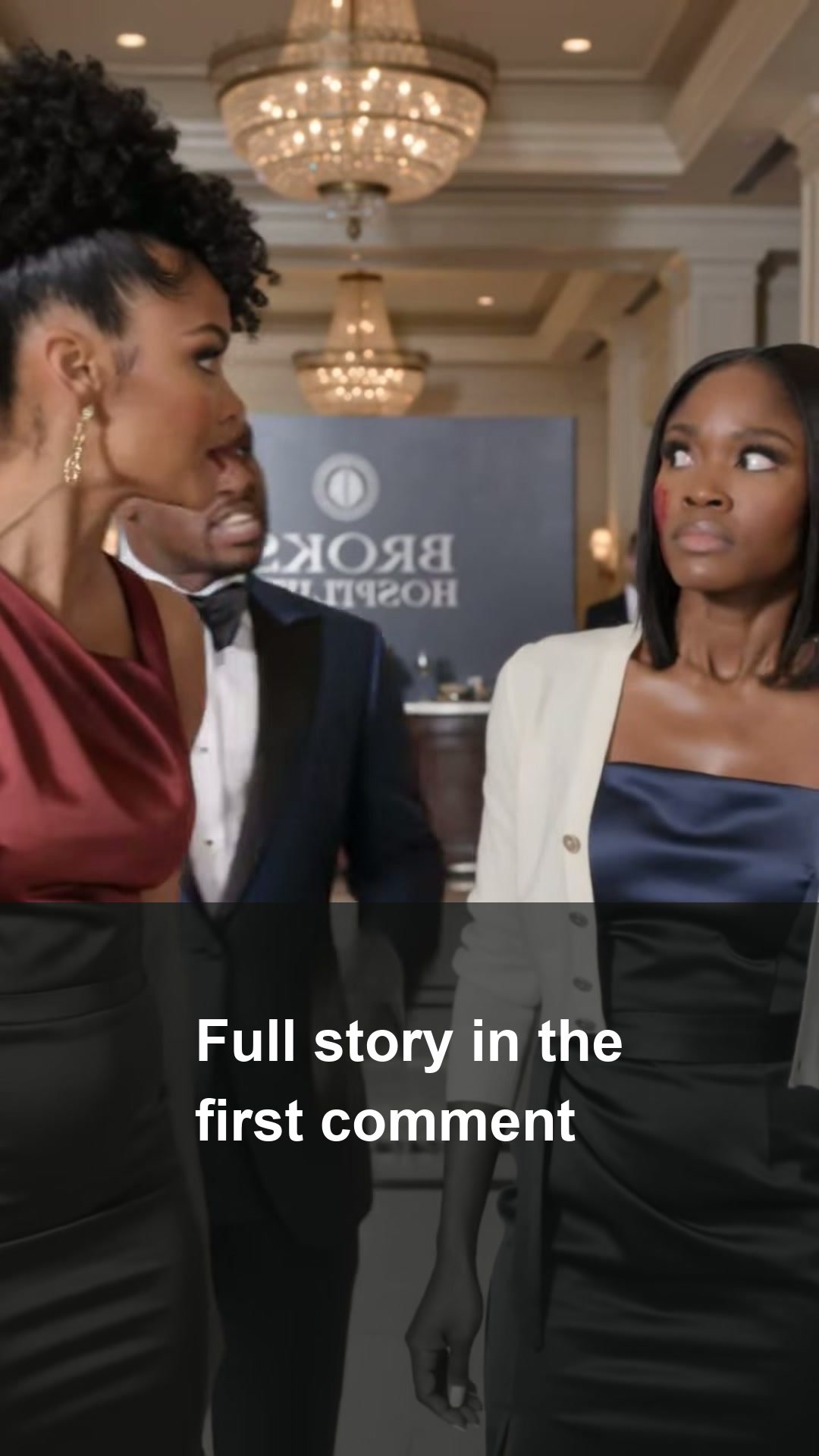
The red wine was dripping from the silk of my dress, tracing a slow, jagged path down my thigh.
The lobby of the Grand Meridian was a cathedral of marble and gold, but all I could hear was the frantic hum of the ventilation system. Around me, the elite of Manhattan froze, their glasses suspended in mid-air as if caught in a flashbulb’s glare. Elena’s hand was still curled into a claw, her knuckles white, her breath coming in shallow, jagged rasps. She looked less like a mistress and more like a cornered animal.
Logan stepped between us, his tuxedo jacket immaculate, his jaw tight enough to shatter teeth. He didn’t look at me; he looked at the stain on the floor.
I don’t care, I thought. I didn’t feel the sting of the glass shards embedded in my skin or the heat of the public humiliation. I only felt the cold weight of the tablet in my clutch, loaded with the final audit.
I stepped back, smoothing the ruined silk.
I’m going to liquidate every inch of this foundation, I whispered, loud enough only for him.
His eyes finally met mine, wide and hollow. I turned toward the exit.
The sun hit the granite countertop of our kitchen with that specific, sharp brightness that only happens in Manhattan on a Tuesday in mid-October. I watched a single dust mote dance in the shaft of light while the espresso machine hissed, a rhythmic, mechanical sound that promised order. Logan was already at the breakfast nook, his back to me, the screen of his laptop casting a pale blue glow over his neck. He was scrolling through the site plans for the hotel project, his fingers tapping a restless, uneven beat against the mahogany surface.
I poured two shots of espresso into porcelain cups. The ceramic felt heavy and warm, a grounding weight in my palm.
Breakfast is getting cold, I said, setting his cup down.
He didn’t look up, just grunted a wordless acknowledgment, his thumb still tracing the edge of a floor plan. I walked around the island to lean against the marble, watching the steam curl up toward the recessed lighting. His white shirt was pristine, pressed to a razor edge, the kind of armor he wore to convince the world—and perhaps himself—that he was building something from nothing. I sipped my coffee, the bitterness cutting through the morning fog, and thought about the portfolio I had rebalanced the night before. It was a delicate architecture of shell companies and offshore liquidity, a silent engine humming beneath the floorboards of his ambition.
Rain, Logan muttered, finally looking up as the sky darkened outside the floor-to-ceiling windows. It’s going to be a miserable commute.
I looked at the grey smear sliding down the glass. I don’t mind the rain, I told him. It keeps the streets quiet.
He stood up then, adjusting his cuffs with a practiced, elegant flick of his wrists. He leaned in to brush a quick, perfunctory kiss against my temple, his skin smelling of sandalwood and early-morning adrenaline. I watched him walk toward the entryway, his stride long and purposeful, the posture of a man who believed he was moving toward a horizon he had charted himself. I felt a flicker of something—not love, not pity, but a calm, clinical curiosity. I wondered if he knew that every step he took was being recorded, funded, and ultimately steered by the accounts I managed in the silence of my home office.
I stayed in the kitchen for a long time after he left, listening to the muffled rumble of the city waking up below us. I did the dishes, the clink of silverware against the sink sounding unnaturally loud in the empty apartment. I moved to my desk, a minimalist slab of glass and steel, and opened the laptop. I spent the morning drafting the wire transfers, my movements fluid, efficient, and devoid of hesitation. I felt like a surgeon performing a procedure that had already been decided in the consultation room.
By noon, I was at the office. The printer in the corner hummed to life, spitting out a thick stack of forensic audits. The smell of toner and ozone filled the room. I stood by the machine, watching the pages pile up, a methodical layering of evidence. My assistant walked in, holding a folder, and asked if I wanted to reschedule the afternoon board meeting.
No, I said, not looking up from the numbers. Keep the schedule as is.
I went back to my desk and looked out at the skyline. The rain had stopped, leaving the streets slick and reflective. I felt nothing but the quiet satisfaction of a perfect balance sheet. I was waiting for the final confirmation from the lead construction firm, the last piece of the puzzle to lock into place.
Then, the phone on my desk rang, its sharp, insistent trill cutting through the stillness. I let it ring twice, my hand hovering over the receiver, feeling the hum of the city vibrating through the floorboards. I picked it up.
It was Elena. Her voice didn’t carry the usual saccharine lilt she reserved for Logan’s donors; it was thin, jagged, and breathless. She was in the lobby of the Grand Meridian, she said, and she wasn’t leaving until someone acknowledged that the payroll shortfall was a clerical error. I listened to the background noise—the aggressive, rhythmic clicking of her heels against the imported Italian marble, the muffled protests of the security detail. I looked at my reflection in the darkened monitor. My face was a mask of calculated stillness, the same one I’d perfected over six years of laundering my own capital through my husband’s vanity projects. I didn’t care about the payroll. I cared that she had bypassed the private entrance. I stood up, smoothing the front of my silk blazer, and felt the weight of the phone cold against my ear. Elena hissed something about Logan being a fraud, her voice cracking as she moved deeper into the restricted zone. I checked my watch. The board meeting was sixty minutes away, and the margin call I had triggered against the shell company holding the hotel’s debt was already rippling through the firm’s back-end ledger. I told her to stay exactly where she was, then hung up without a goodbye. My driver was waiting downstairs, the engine of the black sedan already idling against the curb. I stepped into the elevator, the descent feeling like the slow, deliberate closing of a trap. The air in the lobby was thick with the scent of lilies and high-end floor wax. Elena stood by the concierge desk, her hair disheveled, a smear of mascara tracing a dark path down her cheek. She didn’t see me at first. She was shouting at a junior partner, waving a printed balance sheet that I had personally leaked to the press three hours ago. When her eyes finally locked onto mine, the silence that followed was heavy, punctuated only by the distant chime of the elevators. She didn’t look like a mistress; she looked like a casualty. I walked toward her, my stride measured, every movement devoid of performative anger. She straightened her posture, trying to reclaim a dignity she had surrendered the moment she decided to play a game she didn’t understand. She opened her mouth to speak, but I held up a hand. The lobby went unnaturally quiet as the security guards stepped back, recognizing the authority in my gait. I looked past her to the gilded logo on the wall—the symbol of Logan’s pride, the empire built on my secret reserves. I saw the tremor in her hands as she realized the paper she held wasn’t a mistake, but an eviction notice. I stopped inches from her, the temperature in the room dropping. I decided then that the divorce settlement would be absolute. I leaned in close, catching the faint scent of her desperation, and whispered that she was holding the wrong paperwork. The real audit was currently being hand-delivered to the board. Elena’s face went hollow, the realization dawning that she had been the distraction, not the competition. I stepped around her, heading toward the boardroom, leaving her standing in the center of the lobby, completely erased.
I retreated to the quiet of the back stairwell, my heels clicking against the concrete with a rhythmic, clinical precision. My phone felt heavy, a cold weight of leverage. I dialed the head of the construction firm, Marcus, while staring at the graffiti on the stairwell door.
Marcus answered on the first ring, his voice tight, bordering on frantic. When I asked about the personal guarantee, he sputtered. He claimed he had never seen the documentation I was referencing, insisting that Logan had paid the balance in full three months ago. I traced a chip in the wall paint with my thumbnail. He was lying, or he was being paid to lie. I decided then to pull the financing records from the private server. I hung up without a farewell, the silence in the stairwell suddenly absolute.
I moved to the hotel lobby, the marble floors reflecting my image like an interrogation mirror. I found the front desk manager, a man whose tie was perpetually knotted too tight. I tapped the granite counter. I asked about the last delivery of offshore luxury linens, the ones I knew Logan had invoiced to a shell company. The manager blinked, his eyes darting toward the security cameras. He told me the crates had never arrived, that the project was purely domestic. My stomach tightened—an old, familiar sting of betrayal. If the goods never arrived, the money had gone directly into a private account. I thanked him, my voice flat, and walked toward the nurse station in the executive wing where my husband’s private assistant, Sarah, was meant to be filing reports.
I found Sarah clutching a stack of files. She smelled of stale espresso and nervous sweat. When I asked about the medical expenses Logan had been billing to my firm, she didn’t look up. She mumbled that they were for a private specialist in Zurich, a man who, according to her, didn’t exist in any directory I knew. She kept her eyes on the floor, her hands trembling as she adjusted her glasses. She claimed she was just following the ledger provided by the accounting department. I realized then that the entire paper trail had been manufactured to mirror my own investment habits. I decided to stop asking, to stop playing the role of the curious wife. The inconsistencies weren’t errors; they were evidence of a coordinated effort to bury the truth.
I stepped outside into the biting Manhattan wind, the city lights blurring into long, jagged streaks of neon. I dialed the investigator I had kept on retainer for years. He picked up immediately, his voice gravelly and impatient. I told him I needed the full history of the offshore account Logan used for his personal investments. He hesitated, then told me the account had been closed by a woman claiming to be me two days ago.
I stopped walking. The pavement felt hard beneath my feet. If I hadn’t closed it, then someone had forged my signature with terrifying accuracy. The air felt thin, sharp with the scent of exhaust and ozone. I looked up at the hotel’s glass tower, the facade glowing with the light of a hundred boardrooms. I stood there, watching the windows, knowing that the person inside, the man who called himself my husband, was currently dismantling the very floor beneath his own feet. I turned toward my car, the key fob cold in my palm. The investigation had ended; the audit was now a hunt.
I pulled the sedan into the basement garage, the low hum of the ventilation system the only sound in the cavernous dark. My heels clicked against the polished concrete, a rhythmic, solitary tally of every hour I had spent curating Logan’s image. When I reached the elevator, I didn’t press the button for the lobby. I went straight to the sub-level utility core.
The air here smelled of copper and stagnant water. Logan stood by the central junction box, his tuxedo jacket discarded on a rusted crate. He was frantic, his fingers stained with graphite as he bypassed the secondary security nodes. He didn’t hear me approach until my shadow fell across the wires. He spun around, his face flushed with the kind of performative panic that had fooled me for a decade. He looked like a boy caught stealing from a collection plate, his eyes darting toward the exit.
You should not be here, he said, his voice straining to maintain that practiced, authoritative baritone. I’ve almost stabilized the flow. The firm is going to survive the night, Rebecca. I just need more time to divert the offshore holdings.
I watched a single bead of sweat track through the expensive powder on his temple. My chest felt hollow, a sudden, cold vacuum where my devotion used to reside. I walked past him, ignoring his reaching hand, and retrieved the tablet from my briefcase. I tapped a single icon, the command sequence glowing blue in the dim light. The main power grid hummed in protest before the lights in the garage flickered and died, leaving us in the heavy, suffocating dark of the foundation.
He stepped toward me, his silhouette looming, his breath ragged. We can fix this, he whispered, his voice cracking with the desperation of a man who suddenly realized he was standing on air. I did it all for us.
I looked at him, seeing the emptiness behind his eyes for the very first time. I have never been your wife, Logan.
The kitchen in my childhood home smelled of copper and floor wax, a scent that always preceded my mother’s periodic disappearances into the city. I was seven, perched on a stool, watching her zip a leather suitcase that looked like a cavern. She didn’t look at me; she looked at her reflection in the darkened window, checking the line of her eyeliner with a precision that bordered on the clinical. My father sat at the breakfast nook, his hands wrapped around a mug of cold coffee, his knuckles white against the ceramic. He was the one who asked the questions, but he never waited for the answers.
Are you coming back this time, Margaret? he asked, his voice thin, stripped of any authority.
She clicked the suitcase shut, the sound echoing like a gunshot in the sterile room. She turned, her expression as smooth and unreadable as polished marble. I am going to the bank, Elias. I am going to see if there is anything left to salvage.
He didn’t move to stop her. He watched her walk to the door, his posture collapsing an inch at a time, a man folding inward like a deck chair. I remember the way the front door clicked into its latch, a definitive, final sound. I reached for the edge of the granite counter, my fingers tracing the cold, hard surface. I decided then that I would never be the one sitting at the table, waiting for a door to open. I would be the one holding the keys.
Years later, at university, the pattern repeated itself in the fluorescent glow of the library. Logan was standing by the reference desk, his tie undone, his hair a frantic mess of ambition and exhaustion. He was explaining a logistics model to me, his hands moving with a nervous, kinetic energy that I found both exhausting and magnetic. He talked about leverage as if it were a religion, as if the right amount of debt could bridge the gap between his working-class origin and the penthouse view he felt he was owed.
You have to understand, Rebecca, he said, leaning in until I could smell the burnt coffee on his breath. If I don’t secure this mezzanine financing, the whole project vanishes by Monday. People like us don’t get second chances.
People like us? I asked, my voice steady, betraying none of the irony I felt.
He laughed, a sharp, jagged sound. You know what I mean. The people who didn’t inherit the city. We have to build it from the dirt up.
I looked at him and saw my father’s ghost, that same desperate hunger for a kingdom he hadn’t yet earned. I thought about the bank accounts my grandmother had left in my name, the quiet, growing interest that sustained my tuition while I pretended to scrape by on internships. I decided then to play the role he needed. I would be the silent partner, the foundation that kept him from realizing how close he was to falling through the floor.
Our wedding day was a masterpiece of performative success. The venue was a glass-walled box overlooking the Hudson, the light reflecting off the water and blinding the guests. Logan stood at the altar, shaking hands with men who looked at him with the guarded curiosity one reserves for a speculative stock. He was radiant, fueled by the champagne and the conviction that he had finally arrived. My mother was there, sitting in the third row, her gaze fixed on the back of my head. When I walked past her, she didn’t smile; she simply checked the time on her watch, a silent reminder that every event has an expiration date.
I caught Logan’s eye during the reception. He was holding a glass of scotch, his face flushed with triumph. He leaned toward me, pulling me into a shadow near the balcony.
We’re inside, he whispered, his eyes gleaming. Vane agreed to the terms. We’re officially players.
I felt a chill, not from the wind off the river, but from the certainty that he had no idea who had actually negotiated the deal. I had spent three weeks in back-channel meetings with Vane’s team, stripping away the interest rates that would have throttled us, replacing them with a structure I had designed to protect my own capital.
You did well, I said, reaching up to adjust his silk tie. I made sure it sat perfectly.
He looked down at me, his smile broadening. We did it together.
I didn’t correct him. I knew that for Logan, the truth was an obstacle to his self-image. If he admitted that I was the one holding the checkbook, the one ensuring the creditors didn’t tear us apart, he would crumble. He needed the illusion of his own gravity to keep his ego in orbit. I decided that night to keep the architecture of our marriage secret. I would be the architect; he would be the facade.
The fissures began to appear during the first expansion. It was a rainy Tuesday in my office, the kind of day where the sky bled grey into the skyscrapers. Logan walked in, throwing a stack of blueprints onto my desk. His face was blotchy, his jaw set in that familiar, defensive line.
The board wants a personal guarantee, he said, his voice vibrating with a dangerous tremor. They don’t trust the shell company. They want my name on the debt.
I looked at the documents, the ink still fresh, the legal language designed to trap him. If he signed, he would be liable for every cent of the construction cost, which was currently inflating by twenty percent every quarter. I had already diverted the liquidity from my private holdings to cover the shortfall, but he didn’t know that. He thought the money was a gift from a blind investor.
Don’t sign it, I said, leaning back in my chair. I’ll handle the liability.
He slammed his hand on the desk, the sound jarring in the quiet, climate-controlled air. No. I’m the one who started this. I’m the one who makes the calls. I won’t be a kept man in my own company, Rebecca.
I looked at him, seeing the terrifying fragility of his pride. He would ruin himself just to prove he wasn’t being saved. I thought about my father, watching the door, and the way he had begged for scraps of attention from a woman who had already checked out. I realized that Logan would never grow out of this. He was a creature of reaction, a man whose entire existence was predicated on the fear of being seen as insufficient.
I looked at the window, watching the rain streak the glass. I decided then that I would stop protecting him from the consequences of his own ego. If he wanted to be the sole provider, he would have to learn what it meant to provide nothing.
I stood up, smoothed my skirt, and walked to the door. I told him he was right, that his autonomy was paramount. I let him sign the papers. I watched him walk out of the office, his head held high, looking like a man who had just won a war he had invented. I sat back down at my desk and picked up the phone. I called the forensic auditor, the one I had been paying for six years, and told him it was time to finalize the report.
The silence in the room was absolute, a perfect, crystalline space where my old life finally ceased to exist. I looked at the screen, at the lines of data that represented every dollar, every leverage point, every hidden contract that Logan had built his empire upon. I wasn’t destroying a husband; I was reclaiming an asset that had never actually belonged to him. I felt a cold, sharp clarity, the kind of focus that only comes when you are finally holding the pen that writes the end of the story. I waited, listening to the hum of the building, knowing that in a few hours, the lights would go out on his world, and I would be the only one left standing in the dark.
I set my tablet on the mahogany desk and walked to the floor-to-ceiling glass, watching the grid of Manhattan pulse below. Logan was currently in the lobby, likely charming the board members with his practiced, self-deprecating grin. He was a man who built his identity on the myth of the self-made king, desperate to hide the reality that he had spent his life fleeing the ghost of his father, a man who had lost everything to his wife’s inheritance. Logan needed to be the provider to keep his shame at bay, yet he relied on the very woman he spent his career trying to diminish. My father, Arthur, had been the one to sign the initial funding, his signature a calculated investment in a man he knew would eventually fold under his own ego. He looked at me as a vessel for his legacy, a daughter who would manage the decline of others rather than build her own, never realizing I was recording every misstep he took.
My sister, Sarah, arrived in the doorway, her presence signaled by the sharp scent of jasmine perfume. She spent her days managing our mother’s charity foundation, a role that required her to be the public face of our family’s benevolence while secretly liquidating the assets to pay off her gambling debts. She didn’t want the empire; she wanted the chaos that came with it. I watched her reflection in the glass as she twisted her diamond tennis bracelet, a habit born of anxiety she refused to acknowledge. She asked if the merger was settled, her voice a practiced lilt of unearned concern. I told her it was finished, and the slight tremor in her hands confirmed she had already bet on Logan’s failure. She needed him to fall so she could leverage the family name for one last loan.
Behind her, Marcus, our lead counsel, stood with his briefcase clutched like a shield. He had spent twenty years in the shadow of the Collins family, an Ivy League genius who traded his autonomy for the promise of a partnership that never arrived. He looked at me and saw the end of his employment, his eyes darting toward the exit, calculating how much of the forensic audit he could sell to the board before the clock struck midnight. He was a man of integrity who had systematically compromised it for a paycheck, trapped by the knowledge that I had the evidence of his own small, desperate embezzlements locked in a server he couldn’t touch.
The office door creaked, and Elena, my assistant, slipped inside. She was the one who actually knew where the money moved, the quiet architect of the logistics I dictated. She carried a tray of untouched espresso, her eyes downcast, a protective barrier she’d cultivated after years of witnessing Logan’s volatility. She hated Logan for the way he treated the staff, yet she stayed because she found a strange, vicarious power in seeing me dismantle his facade. I thanked her, the simple exchange of a porcelain cup grounding me. She knew the truth, and in that shared silence, she became the only person in the room who didn’t want anything from me. I leaned back, letting the weight of their expectations settle. I realized then that none of them were truly against me; they were just waiting to see if I would let them fall with the man I had spent seven years creating. I looked at the clock, the red numbers bleeding into the twilight. It was time.
I walked into the walk-in closet, the scent of cedar and expensive cologne thick enough to choke on. Logan’s suits hung in a row, a spectrum of charcoal and midnight blue that had cost more than my first apartment. I reached for the safe hidden behind the silk shirts, my fingers dancing over the keypad. The latch clicked with a finality that echoed in the empty room. Inside, the documents weren’t just paper; they were the structural integrity of his entire life. I took the ledger of the shell companies—the ones registered in the Caymans under a defunct holding company I had bought in a quiet auction three years ago. I didn’t hesitate. I pulled out my phone and dialed the lead counsel at Miller & Associates.
“Arthur,” I said, my voice steady, the coldness of the room seeping into my marrow. “Initiate the margin call on the Vanguard debt. Every cent. Effective immediately.”
“Rebecca, that’s a nuclear option,” he countered, the static of the line making his voice sound tinny. “If you pull that credit, the hotel’s liquidity evaporates by morning. The contractors will walk.”
“They aren’t just walking, Arthur,” I said, staring at my own reflection in the vanity mirror. I looked calm, almost detached. “They are going to stop, pack their tools, and leave the site abandoned. Do it.”
I hung up, the silence that followed heavier than the conversation. I left the closet and walked to the kitchen, where I poured a glass of water, the ice clinking against the crystal. My phone buzzed again, a frantic rhythm. Logan. I ignored it, placing the phone face down on the marble island. I had spent seven years acting as the silent benefactor, the ghost in the machine that kept his ego inflated and his bank accounts bloated. I was finished with the haunting.
The next morning, I walked into the human resources department of his flagship office. The office was all glass and white noise, a place where people worked themselves to the bone for a man who didn’t know their names. I sat across from the HR director, Sarah, who looked nervous, her hands fluttering over a stack of files. I handed her a thick envelope. Inside was a forensic audit detailing the misappropriation of funds from the employee pension pool.
“This is serious, Rebecca,” she whispered, scanning the first page. Her eyes widened, the color draining from her face. “If I report this to the board, Logan’s career is effectively over.”
“That is exactly why you are going to put it on the chairman’s desk by noon,” I replied. I didn’t blink. I didn’t need to. I was simply presenting the inevitable.
She looked at me, a flicker of understanding crossing her face. She knew, as did I, that the evidence was ironclad. She didn’t ask why I was doing this to my own husband. She just nodded, reaching for her landline to alert security.
I stepped out of the building and into the humid Manhattan air, the smell of exhaust and roasting nuts grounding me. I walked three blocks to the boutique law firm where I had kept a retainer active for years. My lawyer, a woman named Elena who dealt exclusively in high-stakes divorces and asset protection, was already waiting.
“The petition is ready,” Elena said, sliding a heavy document across the mahogany table. “If you file this today, we block him from accessing the shared accounts immediately. He’ll be left with nothing but his personal credit cards, which I’ve already flagged for verification.”
I signed my name, the ink dark and permanent. It felt like shedding skin. I wasn’t just filing for divorce; I was executing a dissolution of an empire. When I walked out of the office, my phone finally rang with his personal ringtone. I didn’t answer. I reached into my bag, pulled out a second phone—a burner I’d used for the secret offshore transactions—and dropped it into a street-side trash can.
The counter-action arrived within the hour. My credit card was declined at a coffee shop near Bryant Park. My private assistant, a man Logan had hired, texted me to say that my access codes to our shared residence had been revoked. He was fighting back, swinging blindly in the dark, trying to lock me out of a life that I had built for him.
I sat on a park bench, watching the city pulse with a frantic, rhythmic energy. I pulled out a legal folder and opened it to the DNA test results I’d received that morning—the one confirming that the child his mistress had been parading around, the one he was using to justify his ‘need’ for a new start, wasn’t his. I had known for months, of course, but having the paper trail was the final hammer. I took a photo of the result and sent it to the mistress, then forwarded the entirety of the evidence to his father, the man Logan had spent his entire life trying to impress.
The phone vibrated in my palm, a relentless, frantic hum. It was Logan again. This time, I picked up.
“What did you do?” he screamed, his voice cracking. He sounded small, terrified.
“I reclaimed my capital, Logan,” I said, listening to the sound of sirens wailing in the distance, likely headed toward his office, toward the chaos I had carefully orchestrated. “The champagne at your opening? You never paid for it. Neither did you pay for the foundation of the hotel. I did. And today, I decided I wanted my money back.”
I hung up, the decision final, the bridge burned. I watched a group of tourists walk by, oblivious to the fact that the man they saw on the billboards was currently unraveling in a high-rise office ten blocks away. The wind picked up, cool and sharp, blowing through my hair. I looked at the heels I was wearing—pristine, expensive, and grounded firmly on the pavement. I had spent years being the foundation of his kingdom, and now, I was the earthquake that would reduce it to dust. I turned away from the park, walking toward the subway. I had one more stop to make: the court clerk’s office to contest his father’s will, the final tether keeping Logan’s delusions of grandeur alive. The day was only half over, and I was just getting started.
The lobby of the courthouse smelled of floor wax and stale ambition. I sat on a bench of peeling mahogany, watching the digital ticker above the clerk’s desk. My phone pulsed in my bag like a trapped insect. Every vibration was a notification: a news alert from the Times about the sudden insolvency of the hotel’s primary holding company, a frantic text from my sister asking if the rumors about Logan’s arrest were true, and a dozen missed calls from his lawyers. I reached into my bag, pulled the phone out, and powered it off. The silence that followed felt heavy, almost physical, pressing against my eardrums.
A woman in a tailored suit, someone I recognized from the summer gala at the Hamptons, hovered near the revolving doors. She looked at me, then at her own reflection in the glass, and hurriedly looked away. The social frost was setting in. By noon, the Manhattan elite had already determined the winning side, and it wasn’t the man currently being liquidated in the press. I stood up and smoothed my skirt, feeling the weight of the legal documents in my leather portfolio. My reflection in the dark marble wall showed a woman who looked exactly the same as she had yesterday, yet the geography of my life had shifted tectonic plates.
I approached the clerk’s desk. The man behind the glass didn’t look up from his computer. I slid the paperwork for the will contest toward him. He glanced at the signature, then up at me, his eyes widening as he recognized the name on the filing. He leaned in, his voice dropping to a whisper. It’s all over the feeds, Mrs. Collins. You sure you want to proceed with this today? There are cameras outside.
I checked my watch. My flight to London was in six hours. I didn’t look toward the glass doors where the shadows of reporters were beginning to congregate. I just need you to stamp the receipt, I said, my voice steady, devoid of the tremor that usually accompanies the end of a ten-year marriage. He stamped it with a sharp, final thud. I took the document, placed it back into my portfolio, and walked toward the exit.
Outside, the air was thick with the scent of exhaust and rain. I pushed through the revolving doors. A wall of camera flashes blinded me for a second, a jagged, artificial lightning strike in the gray afternoon. Questions hit me like hail—was it true about the bankruptcy? Where was Logan? Did I know about the mistress? I kept my head down, my heels clicking with metronomic precision against the concrete. I didn’t acknowledge a single one of them. I climbed into the waiting town car, the door shutting with a solid, isolating thud that silenced the world.
My driver glanced at me in the rearview mirror. Where to, ma’am?
I looked at the city skyline, the buildings I had financed, the towers I had kept standing through sheer capital and patience. Now, they looked like elaborate gravestones. The fallout was just beginning, a ripple effect that would reach the schools my friends’ children attended, the boards I sat on, and the quiet dinners I used to enjoy. I had burned the house down to get out of the basement, and now I had to learn how to exist in the open air. Airport, I said, and closed my eyes as the car pulled into the gridlock. The chaos behind me was no longer my concern; the empire was ash, and I was the only one who had remembered to bring an umbrella.
The interior of the town car smelled of stale leather and expensive cologne, a scent that had permeated my life for a decade. I reached into my bag, pulling out the final settlement agreement—a dense stack of heavy, cream-colored cardstock bound by a single gold clip. The ink was still fresh, the signatures stark against the page. My lawyer’s hand had trembled slightly when he handed it to me; Logan’s, I imagined, had been steady, fueled by a delusional final spurt of defiance before the reality of the forensic audit settled in.
I traced the line where I had signed away my stake in the hotel, releasing my personal guarantees and effectively pulling the floor out from under his feet. The judge had been brief, her gavel sounding like a final door closing in a long, drafty hallway. Logan didn’t look at me in the courtroom. He sat hunched over the mahogany table, his tie loosened, his eyes fixed on a scratch in the woodwork as if he could unmake the last forty-eight hours.
I thought of the hidden accounts, the shell companies that had served as the lifeblood of his vanity, now drained and redirected to the creditors. I had spent years meticulously constructing a wall of glass around him, only to watch it shatter at the precise frequency of my own choosing. There was no joy in it, only the profound, metallic taste of clarity.
The car slowed, the tires crunching against the gravel of the private terminal. I stepped out, the crisp autumn air hitting my face with a sharpness that felt like a baptism. A porter approached, but I shook my head, my heels clicking rhythmic and sharp against the tarmac. I didn’t need assistance. I looked back one last time, not at the city, but at the reflection in the tinted window of the car. My expression was neutral, a blank slate that owed nothing to anyone.
I reached into my coat pocket and pulled out the physical keycard to the penthouse, the one I had kept as a morbid souvenir. I didn’t drop it; I tucked it into a trash bin near the entrance, a small, unremarkable piece of plastic that had once held the power to open every door in his world. It was over. The debt was settled, the paperwork was filed, and for the first time since my twenties, the horizon wasn’t blocked by someone else’s shadow. I walked toward the plane, the engine humming a low, steady promise of departure. I was finally, irrevocably, alone.
The salt air of the Maine coast bit at my cheeks, a sharp, cleansing contrast to the stagnant, climate-controlled silence of the Manhattan office. I stood where the tide pulled at the hem of my trousers, the sand gritty and cold beneath my bare feet. It had been six months since I’d touched a balance sheet, and my pulse no longer mapped to the opening bell of the exchange.
Barnaby, a golden retriever with one ear that permanently flopped, nudged my palm with a wet, insistent nose. I knelt, the damp sand staining my jeans, and buried my fingers in his thick, coarse fur.
I think you need to come inside, Clara said from the porch, her voice cutting through the rhythmic collapse of the waves. The tea is getting cold.
I stood, my joints popping in the quiet. I’m coming, I called back, my voice sounding thinner than I remembered, less like an instrument of command and more like a human throat.
I watched a lone gull circle the gray horizon. For years, I had viewed the world as a series of assets to be leveraged or liabilities to be shed. Now, I found myself counting the way the light hit the jagged rocks, noting only that they would be there tomorrow, indifferent to my presence. It was a terrifying, beautiful insignificance.
I turned away from the water, the wood of the porch steps creaking under my weight. In the kitchen, the smell of rosemary and roasting garlic filled the room—a meal prepared for no one but myself. I placed my hands on the cool marble countertop, feeling the steady, unhurried rhythm of my own breathing. The divorce papers were long signed, the debts had been cleared, and Logan’s empire was a flickering memory in the city’s rearview mirror. I picked up a knife and began to slice the bread. The blade was sharp, the crust yielded, and for the first time in a decade, I wasn’t hungry for anything more than the quiet.
I walked into the office, the silence heavy and absolute. Dust motes danced in the light pouring through the floor-to-ceiling glass, illuminating the vacant mahogany desk where Logan once postured as a titan. I didn’t sit. Instead, I unbuckled the straps of my shoes, the leather groaning slightly under the pressure. I left the heels side-by-side in the center of the polished floor, their soles pristine and unmarked by the rubble of the last few months. I stepped onto the cold tile in my bare feet, feeling the rigid texture of the floor against my arches. Outside, the skyline sprawled under a bruising violet sunset, the lights of the city flickering on like a ledger being balanced. I turned toward the window, leaving the empty shoes standing tall, facing the glass.
Leave a Reply