The heavy click of steel ratcheting against Adrian’s wrists echoed louder than the cathedral organ.
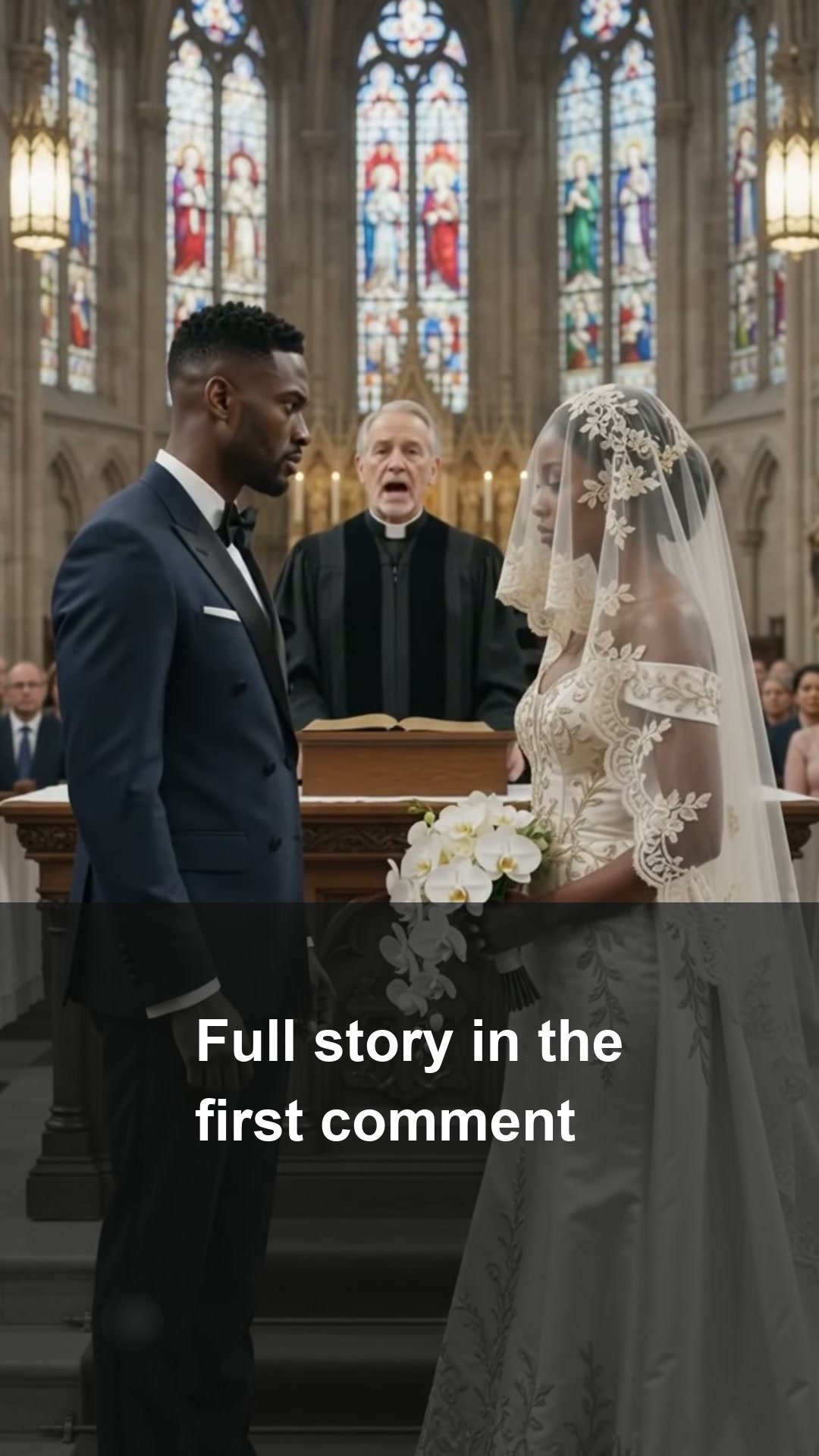
A collective gasp sucked the oxygen from the nave, turning the air brittle with shock. I stood at the altar, my ivory lace veil still obscuring the jagged purple bloom darkening my cheekbone. Beside me, Adrian’s face drained of its groomed arrogance, his jaw slackening as Detective Miller stepped from the sacristy shadows.
“Adrian Vale, you are under arrest for financial fraud and domestic battery,” she said, her voice clinical, cutting through the heavy scent of incense.
Adrian’s eyes darted to mine, searching for the submissive silence he had cultivated for months. Instead, I gripped the bouquet tighter, the thorns biting into my palms. I didn’t flinch. I felt a cold, sharp clarity wash over me, the kind that only comes when the final piece of a legal trap snaps shut. My father, slumped in the front pew, finally straightened his spine. I looked at the cameras, steady and precise, and realized the empire wasn’t just crumbling; it was being liquidated. I reached up, untied the silk ribbon under my chin, and let the veil fall onto the blood-flecked marble floor.
The steam from my coffee mug curled into the stale, conditioned air of the office. I adjusted the stack of merger documents on my desk, ensuring the corners were perfectly flush with the mahogany edge. The clock on the wall ticked with a rhythmic, mechanical indifference, marking 8:14 AM. Outside the window, the city was a smear of gray rain against the glass, blurring the taxis into streaks of yellow. My thumb traced the edge of my engagement ring, the diamond cold and heavy against my skin, a weight I had grown accustomed to carrying.
I stood and walked to the breakroom. The printer was humming a low, grinding tune, its status light blinking a monotonous amber. Marcus was there, waiting for a document to cycle through, his tie knotted with an agonizing, meticulous precision.
Looks like rain all week, he said, not looking up from his phone.
It’s the season for it, I replied, pouring a splash of cream into my cup. I watched the swirl of white dissolve into the dark liquid, thinking only of the filing deadline for the Sterling acquisition audit.
Any word on the Vale merger? he asked, his voice casual, yet sharpened by the kind of curiosity that usually preceded a favor.
Standard procedure, Marcus. You know how the regulators love their paperwork.
I returned to my desk, the carpet muffling my footsteps. I felt the familiar, clinical comfort of a day mapped out in billable hours. There was a draft of the settlement agreement to review, a call to the auditors at noon, and a brief lunch with Adrian at the bistro down the street. It was a life of clean lines and predictable outcomes. I sat down, opened my laptop, and began to read, my mind cataloging the clauses with the detachment of a surgeon examining a scan.
I thought about the weekend, about the dress fitting, and the way the lace felt against my throat—restrictive, but elegant. I wondered if the florist had secured the specific shade of ivory I’d requested. It felt like a small, manageable problem to solve. I told myself that once the wedding was behind us, the erratic shifts in the corporate charter would stabilize, and the tension that had tightened the muscles in my shoulders for months would finally dissipate. I was just tired. The stress of the merger was clearly manifesting in minor, physical ways—a slight tremor in my fingers, the bruise on my arm that I’d blamed on the vanity corner in the hallway. I simply needed more iron in my diet.
I reached for my phone to check the calendar, my hand steadying as I prepared to draft an email to the board. I was about to type a response to the latest query from the legal team when the screen flickered, the light hitting my face in a sharp, sudden glare.
The silence of the office was absolute. Then, the phone vibrated against the desk, the sound a jarring, insistent buzz that seemed to vibrate through the entire structure of the building. I looked down. The screen lit up with an incoming call from an unknown number. My breath caught in my throat, a strange, metallic taste blooming at the back of my tongue. I watched the progress bar for a second, then reached out, my finger hovering over the glass.
I answered. The silence on the other end was heavy, a vacuum of sound that stretched until the hum of the air conditioning seemed to roar.
Lena, a voice rasped. It was Marcus Thorne, the fixer. His cadence was usually measured, a metronome of corporate indifference, but now the words tripped over one another. He was standing in the shadows of the cathedral sacristy, his breath shallow. Everything is in motion. The merger papers are signed, but the audit trail was found in the vault. Vale is coming for you earlier than the ceremony.
I looked at the clock on my wall: 10:14 AM. The wedding was scheduled for noon. Adrian had moved the timeline. He was accelerating the acquisition to ensure my father couldn’t contest the board vote while we were at the altar.
They have the warrants, Thorne continued, his voice dropping to a jagged whisper. Not for the company. For your brother. They’re framing Leo for the embezzlement to force your father’s signature.
The pen in my hand snapped. The plastic casing bit into my palm, but I didn’t feel the sting. My mind shifted into a cold, clinical architecture, mapping out the contingencies I had spent months perfecting. I thought of the heavy lace veil waiting on my vanity, a shroud for the bruise Adrian had left on my collarbone during our last dinner. I wouldn’t need to speak. The evidence was already sewn into the lining of my train.
Thorne, I said, my voice steady, devoid of the panic he expected. Stay in the sacristy. Do not engage. When he arrives at the estate, tell him I am ready to finalize the transfer of the manufacturing assets.
But the police— he started.
I am the one holding the gavel, I interrupted.
I disconnected the call before he could protest. The office felt suddenly small, a cage of mahogany and glass. I stood, my legs stiff, and walked to the window. Below, the city sprawled in a gray, indifferent grid. I could see the black town car idling at the curb, its tinted windows reflecting the harsh morning light. Adrian was inside, waiting for me to surrender.
He believed he was closing a deal. He didn’t realize that in the world of high-stakes litigation, the moment of greatest leverage is always the moment of the supposed total defeat. I picked up the small, encrypted drive from my desk drawer. It contained the forensic accounting that would dismantle Vale Capital in an afternoon. I slid it into my garter, the cool metal pressing against my skin.
I checked my watch one last time. The timeline had shifted, but the outcome was now inevitable. I opened the door to the hallway, the sound of the cleaning crew’s vacuum dying away as I stepped into the elevator. My reflection in the stainless steel doors was a stranger—a woman in ivory lace, composed and lethal. I was ready to walk to the altar.
The elevator hummed, a sterile vibration against my heels. My thumb traced the hidden bulk of the drive through the silk of my dress. I bypassed the ballroom and ducked into the alcove behind the coat check, pulling my phone from its hidden pouch. My father answered on the first ring, his voice thin, rattling like dry leaves.
Arthur, I said, keeping my tone flat. Did you sign the supplementary merger documents yesterday?
There was a pause, the sound of a heavy intake of breath. No, Lena, of course not. Adrian told me the SEC had pushed the deadline back to Monday. He said we had time.
I stared at the gilded moulding on the ceiling. Adrian told me the signing was completed at noon.
The silence that followed was absolute. I could hear the faint, frantic scratching of a fountain pen in the background of his call, and then, Arthur’s voice dropped to a frantic whisper. He’s in the study, Lena. He’s locking the drawers.
I ended the call and dialed the front desk of the Grand Imperial. The lobby was a warren of activity, but the concierge answered with practiced, oily efficiency. Mr. Vale’s suite, please. I need to confirm the florist delivery for the cathedral.
Ms. Sterling, the concierge replied, his voice shifting into a polite, professional drone. Mr. Vale checked out of the suite three hours ago. He mentioned he would be staying at the estate with you until the ceremony.
I let the phone slip into my palm. He had told me he was at the hotel finalizing the guest list updates. I stepped out of the alcove and found the head nurse, Elena, waiting near the service stairs to collect the final payment for my brother Leo’s private detox facility.
He didn’t come to see Leo today, I said, pinning her with a look.
Elena adjusted her spectacles, her eyes darting toward the heavy velvet curtains of the ballroom. Mr. Vale was here at eleven, Ms. Sterling. He spent an hour in the wing. Leo seemed… agitated after he left. He wouldn’t stop pacing.
I felt the blood drain from my face. My brother was under strict orders for bed rest. Leo, I whispered, clutching the bouquet I hadn’t realized I was holding.
I turned and walked toward the side exit, my movements precise, clinical. The gravel of the driveway crunched under my wedding shoes as I reached the idling town car. The driver, a man named Miller who had been in Adrian’s employ for six years, wouldn’t meet my eyes.
Where did he go after he left the facility? I asked, sliding into the leather seat.
To the docks, Ms. Sterling, Miller mumbled, his hands white-knuckled on the wheel. He said he was inspecting the cargo manifests for the new shipping line.
I looked at the digital clock on the dashboard. The docks were forty minutes away, and the merger documents were allegedly sitting on the desk of a man who was, according to the hotel, checked out and, according to his driver, currently at the industrial sector.
I pulled my phone out one last time, my fingers hovering over Detective Sarah Miller’s contact. The contradictions were a tightening noose. Adrian wasn’t preparing for a wedding; he was liquidating a life. I hit send, my heart hammering a rhythm against my ribs that had nothing to do with love and everything to do with the hunt.
The cathedral air was thin, smelling of lilies and floor wax, a sterile scent that failed to mask the metallic tang of my own anxiety. I stood in the sacristy, my reflection fractured in the tall, arched mirror. I smoothed the lace of my gown, tracing the jagged outline of the bruise on my collarbone where Adrian had gripped me three nights ago. The fabric felt like a shroud.
I heard the heavy oak doors groan open. Adrian entered, his footsteps measured, rhythmic, and entirely devoid of hesitation. He crossed the room, stopping inches from me. He didn’t kiss my forehead or reach for my hand. Instead, he adjusted my veil with long, precise fingers, his touch clinical, as if he were inspecting a piece of machinery he intended to sell. He looked at me, but his eyes were fixed on the empty space over my shoulder, checking the perimeter for witnesses.
I thought of Leo, tucked away in a rehab clinic in the mountains, his medical records held over his head like a guillotine blade. Every asset we owned, every brick of the Sterling factory, was currently being parsed out into the bottomless coffers of Vale Capital. I had spent months playing the part of the fragile, decorative heir, waiting for him to grow arrogant enough to leave the back door of his shell company unlocked.
I felt the digital recorder taped to my inner thigh, a cold weight against my skin. The plan was a machine of its own design, requiring only this final, perfect trigger. I needed him to articulate the motive. I needed the court to hear him define the destruction of my family not as a business transaction, but as a deliberate, systematic obliteration. I took a shallow breath, feeling the lace tighten across my throat.
I looked into his eyes and whispered, tell me again why you bought the factory.
Adrian leaned in, his smile vanishing into a thin, triumphant line.
The sound of a heavy steel door slamming shut echoed in the basement of our estate twenty years ago, the vibration rattling the leaded glass display cabinets in my mother’s dining room. I was eight, sitting on the velvet stool of the piano, practicing a C-major scale that my father insisted was the foundation of order. My brother Leo was downstairs, hiding behind the furnace, his breathing ragged as he clutched a stolen bottle of gin he’d found in the guest suite. My father walked past the piano without looking at me, his footsteps heavy and rhythmic, a military cadence that signaled a lecture on the cost of weakness. He pushed open the basement door, his voice booming into the dark, demanding to know what leverage Leo had handed over to the board this time. I kept my fingers on the keys, the ivory cold and unforgiving, and watched as my mother sat perfectly still in the parlor, staring at an unopened letter from the bank. She didn’t move to help him. She didn’t move to stop the shouting. She simply adjusted her pearls, a habit she performed when the world began to tilt. I realized then that in this house, silence wasn’t a peace treaty; it was a surrender.
Years later, at boarding school, the pattern shifted from the domestic to the contractual. I spent my afternoons in the library, not reading poetry, but dissecting the fine print of the trust funds that kept us afloat. My roommate had asked why I cared so much about indemnity clauses and liquidation preferences, and I told her that a promise is only as strong as the penalty for breaking it. She laughed, calling me a cynic, and I thought about the way my father’s handshake deals had crumbled the moment the market shifted. I was seventeen when I saw the first lawyer leave our house in the middle of the night, his briefcase light, his expression hollowed out by the realization that he was representing a sinking ship. My father had stood in the foyer, his hands behind his back, pretending he was merely observing the weather. I walked up to him and asked if he had read the renewal terms of the Sterling merger. He tapped my forehead with his index finger, a gesture meant to be affectionate but feeling like a branding, and told me that business was for gentlemen and that I should focus on the guest list for the winter ball. I went back to my room and began drafting my first set of shadow bylaws, a private record of everything he refused to acknowledge.
Then came the university years, where the arrogance of the elite was distilled into a single, blinding pressure. I met Adrian at a gala for the industrial arts, where he was already being hailed as a visionary, a man who could revitalize the rust belt with the cold, efficient scalpel of private equity. He looked at me across a glass of champagne, his gaze not appreciative, but proprietary, as if he were auditing my bloodline. He asked me about my father’s manufacturing plants, his questions precise, stripped of the usual social pleasantries. I didn’t see the trap; I saw an intellect that matched my own. When he started showing up at my apartment unannounced, bringing gifts that felt like bribes—a diamond watch, a rare first edition of a legal text—I mistook his intensity for devotion. He would sit on my sofa, his thumb tracing the line of my jaw, and talk about how the Sterling name was a heavy burden, a relic that needed to be liberated from my father’s sentimentality. I let him pull me into his world, thinking I was a partner in the consolidation of power. I ignored the way he corrected the volume of my voice in public, or the way he insisted on reviewing my emails before I sent them to my professors. I told myself it was professional diligence.
The first bruise appeared on my ribs the month he moved his office into our family’s headquarters. We were arguing about a liquidation clause he had inserted without my father’s signature, his voice rising in the sterile air of the boardroom. He grabbed my arm, his fingers digging into the muscle until I winced, and then he let go, smoothing the fabric of my blazer with a sickening, practiced gentleness. He told me that I was clumsy, that I had walked into the corner of the mahogany desk, and he looked at me with such genuine concern that I almost believed him. That night, I stood in the master bathroom of our townhouse, stripping away the layers of silk and lace, staring at the purple bloom on my skin. I didn’t cry. Instead, I opened my laptop and began to document the date, the time, and the specific clause he was trying to hide. I started keeping two sets of books—one for the life he thought I was living, and one for the evidence I was collecting. I began to view my own body as a piece of property that had been foreclosed upon, waiting for the moment I could reclaim the title.
Leo was the one who broke the silence, calling me from a detox center three states away, his voice shaking as he confessed that Adrian had been paying for his treatment in exchange for his proxy votes on the board. The betrayal was so clinical, so perfectly executed, that I felt a strange sense of admiration for the sheer, cold malice of it. I told Leo to stay where he was, to keep his head down, and that I would handle the ledger. I visited my father at the estate, finding him sitting in the same piano room where I had learned my scales, the house now stripped of its history, the walls bare of the portraits that had defined our lineage for generations. He looked older, his skin like parchment, his eyes searching mine for a reassurance I could no longer provide. He asked me if I was happy, if the marriage was everything I had dreamed of, and I lied to him with the ease of a veteran trial lawyer. I told him that everything was under control, that the merger was a success, and that his legacy was safe. I touched his hand, feeling the tremors of a man who had traded his backbone for the illusion of stability, and I decided then that the only way to save the family was to burn the house down to the foundation.
I remember the night Adrian told me he was going to strip the final assets from the Sterling line. We were dining at a restaurant that overlooked the city, the lights glittering like the shards of a broken mirror. He reached across the table, his hand covering mine, his touch heavy and possessive. He spoke of his plan with the detachment of a surgeon removing a tumor, failing to realize that I was not the patient, but the one holding the scalpel. He told me that my father had never been a threat, only an obstacle, and that my brother was nothing more than a convenient leverage point. He smiled, that thin, sharp smile that reached no further than his lips, and he waited for me to agree, to play the part of the devoted, silenced wife. I felt the digital recorder tucked into my bodice, the plastic edges biting into my skin, a secret anchor keeping me grounded in the reality I had spent years constructing. I looked at him, really looked at him, and for the first time, I didn’t see a titan. I saw a man who had never once faced a consequence he couldn’t buy his way out of.
The decision was made in that moment, not with a flare of anger, but with the cool, calculated finality of a court ruling. I would give him exactly what he wanted—a public display, a ceremony of union that would mask the execution of his own downfall. I would be the witness, the ivory-clad architect of his erasure. Every insult he had ever uttered, every warning I had ignored, every night I had spent stitching together the threads of his secret accounts—it was all leading to this, to the altar of Saint Jude’s. I realized that the trap hadn’t been set today, or even when he first bought our debt. It had been set the moment I realized that my father’s silence was a choice, and that I was capable of making a different one. I took another drink of wine, watching the way his eyes tracked the movement of my throat, never guessing that the very woman he thought he had dismantled was the one holding the remote detonator. I leaned forward, the lace of my dress whispering against the chair, and I invited him to talk about the factory one last time, waiting for the arrogance to peak, waiting for the final, damning words to spill into the record.
The heavy mahogany door to the study groaned as Arthur entered, his shoulders hunched in that characteristic, defeated slump that had defined him since the Vale buyout. He gripped the back of his chair, the leather creaking under his knuckles. He had spent forty years building Sterling Manufacturing on handshakes and empty promises, only to realize that honor was a liability in Adrian’s modern, bloodless market. I watched him study the floorboards, a man who had sacrificed his daughter’s autonomy to shield a legacy he no longer possessed. He wanted to apologize, but the words died in the stale air between us. He had traded my agency for the illusion of stability, yet here he was, clutching a briefcase of forensic files he’d spent months quietly compiling, finally choosing his child over the company’s ghost. He set the files down and walked out, his steps silent, his resolve a belated, fragile thing.
I turned to the window, watching Leo pacing the garden below. His jaw was tight, the muscle twitching with the phantom tremors of withdrawal. He had spent three years as Adrian’s favorite pawn, his addiction weaponized to ensure my compliance, yet he held the ledger of Adrian’s private offshore accounts in his jacket pocket. He looked up, catching my gaze, and I saw the desperate, clawing hunger for redemption in his eyes—a young man realizing that being a victim didn’t excuse him from being a witness. He touched his chest, a subtle signal that the recording device was secure. He was terrified, but for the first time in his life, his hands were steady.
A shadow shifted by the oak tree. Detective Sarah Miller waited there, her badge tucked beneath a heavy coat, her gaze fixed on the cathedral entrance. She was a woman who despised the pedigree of this city, yet she had spent her career polishing the reputations of the predators she was meant to cage. She hated the elite, yet she was their primary housekeeper. She stepped into the light, her eyes locking onto mine for a fraction of a second, confirming the sacristy was occupied. She didn’t want glory; she wanted a win that would outlast the news cycle. She adjusted her gloves, a small, professional tick that betrayed her nerves, and nodded once.
Inside the foyer, Marcus Thorne stood by the refreshment table, swirling a glass of lukewarm champagne. He was the architect of Adrian’s ruin, though he didn’t know it yet. He knew every fraudulent entry in the Vale Capital books, having ignored them to secure his own commission, blinded by the arrogant belief that he was the smartest man in the room. He laughed at a joke from a guest, his teeth bright and predatory. He thought he was playing a game of chess where he held all the pieces, never seeing the board tilting beneath his feet. He glanced at his watch, checking the time until the ceremony, smug in his ignorance of the trap I had laid in the corporate bylaws.
Adrian walked into the room then, his presence sucking the oxygen from the space. He took my hand, his grip firm, possessive, and cold. He leaned in, whispering a correction about the seating chart, his smile not reaching the hollow blackness of his eyes. He thrived on the appearance of harmony, terrified that the world might see the bruise beneath my lace. He was a titan constructed of glass, waiting for the first crack. I looked at him, feeling the sharp, clinical weight of the recorder against my skin, and smiled back. The trap was set. The characters were positioned. I took a breath, feeling the lace tighten against my ribs, and prepared to play the role that would burn the world down.
The humidity in the office was stifling, the air conditioner humming a low, mechanical drone that did nothing to pull the heat from the room. I sat at my desk, the mahogany surface scarred by years of my father’s nervous drumming. My fingers moved with the surgical precision I had spent six years of law school perfecting. I opened the encrypted file containing the forensic audit of Vale Capital’s debt buyout. It was a masterpiece of financial deceit, hidden in layers of shell companies. I hit the button to trigger the transmission to the District Attorney’s office, feeling the cursor blink as the file uploaded. Outside, the city was just waking up, unaware that the foundation of its newest titan was being dissolved.
I picked up the phone and dialed the bank. My voice, cool and practiced, requested the immediate freezing of the joint accounts Adrian and I shared. The clerk on the other end hesitated, citing the marital nature of the funds. I cited the specific, obscure clause in the prenuptial agreement we had signed—the one Adrian had insisted on, thinking it protected his interests—that allowed for an emergency hold upon the discovery of fraudulent activity. I heard the click of keys as she complied, her tone shifting from dismissive to professional the moment I invoked the legal terminology. When I hung up, the silence in the room felt heavy, a vacuum waiting to be filled.
A sharp knock at the door signaled the arrival of Marcus Thorne, my lead investigator. He didn’t wait for permission. He looked disheveled, a stark contrast to his usual polished exterior. He tossed a manila envelope onto the desk. The paternity report. I opened it, scanning the DNA markers. The match was definitive. It wasn’t a smoking gun for the business, but it was a leverage point for his character, a private shame he had kept buried under a mountain of non-disclosure agreements.
I’m filing this with the court this afternoon, I said, my gaze locked on his.
Thorne leaned forward, his hands flat against the desk. You know what he does to people who back him into a corner, Lena. He won’t just fight back. He’ll burn everything you touch to the ground.
He already has, I replied.
He shook his head and left without another word, his footsteps echoing in the hallway. I watched him go, then pulled a legal pad toward me. I began to draft the formal HR complaint against his board members, detailing the pattern of coerced silence and the illegal termination of employees who refused to sign his predatory contracts. Each sentence was a scalpel, designed to cut deep.
Ten minutes later, my phone vibrated against the wood. An unknown number. I answered. Adrian’s voice didn’t sound angry; it sounded predatory, a low, smooth purr.
I see the accounts are locked, Lena. A glitch, I assume?
It’s not a glitch, Adrian, I said, my voice steady, devoid of the tremor that used to define our conversations. It’s an audit.
There was a long silence on the other end, the kind that usually preceded a lecture or a physical intimidation. This time, he simply laughed. It was a thin, brittle sound. He knew, or at least he suspected. He was calculating the fallout, trying to find the crack in my armor. I didn’t give him the chance to speak. I hung up.
I stood and walked to the window. Below, a black sedan was idling at the curb, just as it had every day for the last month. But today, it felt different. I wasn’t the one trapped inside it. I was the one directing the traffic.
I picked up my bag and headed for the courthouse. The halls were crowded with people desperate for justice or fleeing from it. I navigated the marble floors with a sense of purpose I hadn’t felt since before the takeover. I met with my attorney in a small, windowless conference room. We went through the documents—the amended corporate charter, the evidence of blackmail involving my brother, the sworn affidavits from the former assistants.
Is this enough? I asked.
It’s more than enough to trigger an investigation, he replied, his eyes scanning the stack of papers. But once you file these, there is no reconciliation. You understand that?
I looked at my reflection in the window, seeing the pale, determined set of my jaw. There was no reconciliation to be had. There was only the aftermath. I signed the documents, the ink dark and permanent against the white paper. As I left the courthouse, the sun hit my face, harsh and blinding. I felt the weight of the recorder in my pocket, the tiny, mechanical heartbeat of my own defense.
Back at the estate, the house was unnaturally quiet. My father was in the library, staring at the walls, his hands shaking as he held a glass of scotch. He looked up as I entered, his eyes searching mine.
I filed the paperwork, Dad, I said. It’s over.
He didn’t speak. He just nodded, a slow, mournful movement. He knew the cost of what I had done. He knew that even if we won, the Sterling name would be dragged through the mud of public scrutiny. I walked to the kitchen and poured myself a glass of water, the ice clinking against the glass like a warning.
A heavy thud sounded from the foyer. The front door had been kicked open. I didn’t flinch. I waited, my breath steady, my heart keeping pace with the clock on the wall. Adrian was here, and for the first time, I wasn’t afraid of what he would do. I was ready to see what he would lose.
The foyer filled with the frantic, wet slapping of rain against the marble, trailing behind the man who had once owned my future. Adrian didn’t enter with his usual measured gait; he stumbled, his bespoke tuxedo jacket hanging open, the silk lining shredded near the shoulder. He looked less like a corporate titan and more like a ghost being chased by the headlines he couldn’t stop. He lunged for the foyer table, his eyes wild, sweeping a porcelain vase onto the floor. It shattered with a sharp, dissonant ring.
I didn’t move. I stood in the kitchen doorway, my hand wrapped tightly around the cold glass of water. Adrian stopped, his chest heaving, the vein in his temple pulsing rhythmically.
You think this ends with the handcuffs, Lena? he rasped, his voice losing its customary baritone authority. You’ve burned the house down. Everyone is watching. My board, the SEC, the entire damn city. They don’t want justice. They want a sacrifice.
My father sat at the kitchen table, his head bowed, his knuckles white as he gripped the edge of the mahogany. I watched Adrian’s face, tracing the cracks in his composure. The power dynamic hadn’t just shifted; it had evaporated.
The city isn’t watching you, Adrian, I said, my voice steady, clinical. They’re watching the forensic audit. The handcuffs were just the punctuation mark.
He laughed, a jagged, broken sound that carried no mirth. He reached for his phone, his thumb hovering over the screen, but his hand shook so violently that he dropped it. It skittered across the floor, the screen lighting up with a deluge of notifications. My own phone, sitting on the counter, vibrated in a constant, frantic stutter. My friends, my former colleagues, the press—everyone was picking a side, and the internet was already etching the verdict into the digital bedrock.
I reached out and turned my phone face down. The vibration ceased, but the silence that followed felt heavy, suffocating.
I’m not the only victim who walked through those cathedral doors, Adrian, I continued, stepping toward him. Three more women contacted the DA’s office this morning. The ‘Sterling-Vale’ merger wasn’t a business deal. It was a cover-up for a life of predatory cruelty.
He lunged for me, a flicker of his old reflexive violence, but his momentum failed him. He tripped over the rug, falling hard. I looked down at him, realizing that the fear I had carried for years was gone, replaced by an analytical distance. He was a legal liability now. Nothing more.
My father stood up, his legs trembling, and walked toward the door. He didn’t look at Adrian. He didn’t look at me. He just walked out into the rain, leaving the house to the echoes of the fallout. I watched him go, feeling the weight of the Sterling name finally slipping from my shoulders. It was heavy, but it was no longer mine to carry.
I turned back to the man on the floor. I didn’t need to speak. I simply walked to the kitchen, picked up the house phone, and dialed the number I had memorized months ago.
Detective Miller? He’s here, I said.
I set the phone down and walked toward the back exit. Outside, the flashbulbs of the press illuminated the driveway like lightning. I pushed the door open, ready to face the blinding light.
The cathedral air held the scent of stale incense and ozone. I stepped over the discarded veil, its ivory lace snagged on a marble floor tile. Behind me, the heavy oak doors groaned, muffled by the rhythmic thud of police boots. Adrian lay on the carpet of the altar, his bespoke suit bunched at the shoulders, his face a mask of calculated fury that had finally shattered into genuine, trembling shock.
Detective Miller’s hand settled on his collar, not with the practiced ease of an arrest, but with the firm authority of a closing ledger. She pulled his hands behind his back. The metal ratcheted twice. A sharp, singular sound that echoed against the vaulted ceiling.
I reached into the clutch I had abandoned on the pew and pulled out the digital recorder. My thumb brushed the stop button. I walked over to Miller, the silk of my gown whispering against the stone. I pressed the device into her palm. Her eyes met mine; there was no pity there, only the steady acknowledgement of a contract fulfilled.
He looked up at me then, his jaw tight. Lena, he hissed through clenched teeth. You think this holds? You think they’ll let you keep the company after this?
I didn’t answer him. I thought of the forensic audit sitting in the District Attorney’s office—three hundred pages of offshore accounts, falsified debt restructuring, and the systematic bleeding of Sterling Manufacturing. I didn’t need to argue with a man who was already a ghost. I turned my back, the heavy lace of my train catching on the sharp edges of the altar railing.
I walked toward the narthex, my gait measured. The silence in the cathedral was absolute, heavy with the weight of five hundred guests who had come for a merger and stayed for a dismantling. I didn’t look at the pews. I focused on the stained glass, the red and blue light fracturing across the floor like blood and bruises.
Outside, the air was cold. The rain had stopped, leaving the driveway slick with oil and reflection. My father stood by the black sedan, his shoulders hunched, his hands shoved deep into his pockets. He saw me, and for the first time in three years, his posture straightened. He didn’t offer a hug. He just opened the passenger door.
I slid into the seat, the leather biting against my skin. I reached up, unclasping the diamond studs from my ears, and set them in the console. The metal clicked against the plastic. It was a small sound, but in the quiet of the car, it felt like the final gavel strike. I was finished.
The house smelled of damp earth and woodsmoke. Three weeks had passed since the courthouse steps, and the silence in the kitchen no longer felt like a vacuum waiting to be filled. I pushed a ceramic bowl of oatmeal across the scarred oak table. My father sat opposite me, his gaze fixed on the steam rising from his mug. He didn’t check his watch. He didn’t jump when the radiator hissed.
You’re eating, he said. It wasn’t a question, just a quiet observation.
I took a breath, the air tasting of rosemary from the garden outside. I am. It tastes like salt, not like obligation.
He reached out, his fingers grazing the edge of the table. We’re going to be all right, aren’t we?
I watched him trace the grain of the wood. I thought about the files stacked in the study, the legal weight of the company finally back in our hands, and the way the shadows in the hallway no longer seemed to follow me. I didn’t need to lie. I decided that for the first time, I would be entirely, brutally honest. We are. We’re just not the people we were before the contract was signed.
I stood up and walked to the back door, stepping onto the porch. A golden retriever, young and clumsy with paws too big for his frame, bounded from the shadows of the porch swing, his tail a rhythmic thud against the railing. He pushed his wet nose into my palm, grounding me in the living, breathing present. I felt the bruise on my shoulder—faded to a yellow ghost—where his collar bumped against me. It didn’t ache anymore. It was just a mark of where the skin had knit itself back together. I watched the dog trot toward the fence, tail held high. Tomorrow, I told myself, I would walk him past the factory gates and listen to the hum of the line. Tomorrow, I would start again.
The silence of the house was absolute, punctuated only by the distant, rhythmic ticking of the hallway clock. I entered the master suite, moving with a deliberate stillness I had not possessed months ago. My hands hovered over the vanity, tracing the edges of the marble top where my expensive, suffocating cosmetics used to live. I gathered the remaining jars of heavy, opaque concealer and tipped them into the wastebasket, watching the gray sludge pool against the plastic liner. There was no tremor in my fingers. I turned to the walk-in closet and reached for the heavy velvet coat hanger that once held my designer bridal gown. It was empty now, the wire bent slightly out of shape. On the cold, marble floor of the cathedral, the ivory lace veil remained exactly where I had dropped it.
Leave a Reply