The silver candlestick hit the wall, showering Julian’s tuxedo in a spray of plaster and dust.
I stood in the corner of the bridal suite, my camera lens pressed against my eye, paralyzed by the weight of the moment. The air tasted of ozone and expensive perfume. Arthur’s chest heaved, his knuckles white as he tightened his grip on the wooden bat, his shadow stretching long and jagged across the white carpet.
Julian scrambled backward, his velvet loafers slipping on the ruined silk of the runner. He tried to speak, but the words bubbled into a wet, guttural choke.
“You don’t get to touch her again,” Arthur whispered, his voice trembling with a terrifying, rhythmic precision.
I watched the vein pulse in Arthur’s temple. This wasn’t the man who toasted to their future three hours ago. This was a man reclaiming a ledger written in blood. My finger hovered over the record button, the red light mocking the stillness of the room. I should leave. I should bury this footage in the darkest corner of my hard drive and never look back. Instead, I zoomed in. Elara moved, and the light caught the jagged edge of glass hidden in her palm.
The alarm clock hit six-fifteen with a digital chime that felt more like a serrated edge against my nerves. I rolled over, the sheets cool and smelling faintly of the lavender detergent I used to try and trick myself into feeling domestic. My studio apartment was a graveyard of camera equipment: tripod legs splayed like spider limbs, lenses arranged by focal length on the mahogany desk, and a stack of SD cards labeled with dates that blurred into a singular, monotonous timeline of other people’s joy.
I stumbled into the kitchen, the linoleum cold beneath my bare feet. The coffee maker hissed, a rhythmic, wheezing sound that reminded me of my own breathing during long shoots. I poured the black liquid into a chipped ceramic mug, watching the steam rise in thin, translucent ribbons. It was a Tuesday. Or maybe a Wednesday. The days were just spacers between the weddings, the rehearsals, and the edits.
I stood by the window, clutching the mug with both hands to catch the warmth. Below, the city was waking up in shades of slate grey. A delivery truck double-parked, the driver swearing at a cyclist who swerved to avoid the open door. It was mundane, predictable, and profoundly dull. I watched a woman in a beige trench coat hurry toward the subway, her head bowed against the biting morning wind. She looked like she had somewhere to be, someone waiting for her. I felt a pang of envy so sharp it was almost a physical ache, then I shoved it down. I was the observer. I didn’t participate; I only documented.
My commute was a twenty-minute slog on the blue line, jammed between a man reading a crumpled financial paper and a girl scrolling through TikTok with the sound muted. The air in the car smelled of stale rain and overheated electronics. I checked my reflection in the dark glass of the train door. My eyes looked tired, the skin beneath them bruised with the fatigue of a dozen twelve-hour shifts. I touched my earlobe, a nervous habit, and wondered if I should take the Sterling job. The money was absurd, enough to cover my rent for a year, but the contract was thick with non-disclosure clauses that made my skin crawl.
I reached the office by eight-thirty. The printer was already churning, a rhythmic clacking that echoed through the empty lobby. I walked past the receptionist’s desk, nodding at Sarah, who was busy trying to peel a stubborn sticker off a delivery box.
Morning, Clara, she said without looking up. Bit of a storm coming in later. Better get your gear indoors before the sky opens up.
She was right. The light outside was turning a bruised, sickly yellow. I murmured something about the weather, a throwaway comment about umbrella policies, and retreated into my edit suite. The room was dark, lit only by the soft blue glow of the monitors. I sat down, my chair squeaking in protest, and opened the folder for the week’s work.
I pulled a file from the previous Saturday—a simple, elegant affair in the suburbs. I scrubbed through the footage: the bride’s mother adjusting a veil, the groom nervously checking his watch, the soft, blurry laughter of guests during the toasts. It was perfect. It was fake. It was exactly what they paid for. I started the color correction, tweaking the warmth of the highlights, making the world look slightly more golden than it had ever actually been.
I was mid-thought, debating whether to cut a shot of the father stumbling over his words, when the vibration started. It was rhythmic, persistent, a frantic buzzing against the polished wood of my desk. My heart skipped a beat, a sudden, jagged spike of adrenaline that had no business being there on a Tuesday morning. I looked down. The phone screen blinked. It wasn’t a client. It wasn’t work. It was a private number, a long string of digits that pulsed like a warning. I stared at it for a long, frozen second, the silence in the room suddenly heavy, suffocating. I reached out, my fingers hovering just a fraction of an inch above the glass, and tapped the icon to answer.
The voice on the other end was not a voice at all, but a wet, rhythmic rasping, like lungs struggling to draw air through a filter of blood. Arthur’s breathing. I pulled the receiver away from my ear, the plastic slick with a cold, sudden sweat. Beneath the ragged inhalations, I heard the faint, sickening thud of something soft hitting a marble floor, followed by the crystalline chime of shattering glass. It sounded like the wedding suite.
I didn’t think about the ethics of eavesdropping or the sanctity of the contract. I just moved. My chair skidded backward, the metal legs shrieking against the hardwood, and I grabbed my camera bag. The weight of the equipment felt strangely reassuring, a professional anchor in a room that was suddenly tilting. I drove the coastal road with the speedometer needle buried in the red, the Sterling estate looming on the cliffside like a tombstone.
The front doors were wide open, swaying in the wind that smelled of brine and impending rain. I didn’t knock. I stepped into the foyer and saw them.
Julian was sprawled at the base of the grand staircase, his tuxedo jacket torn away, his chest heaving in shallow, disjointed gasps. The white marble around him was stained with a dark, sprawling Rorschach map of red. Arthur stood over him, the baseball bat hanging limp in his right hand, the wood stained dark near the heavy end. He wasn’t looking at Julian. He was looking at Elara.
Elara stood by the velvet curtains, her bridal gown shredded at the hem, one hand pressed firmly against the small of her back. In her other hand, she held a jagged shard of a decanter, the edges catching the light of the chandelier. Her face was a mask of terrifying, crystalline calm. She didn’t look like a bride. She looked like a survivor standing amidst the wreckage of a war she had started and ended in the span of a single hour.
Arthur looked at me. His eyes were wide, bloodshot, and frantic, the eyes of a man who had finally looked into the abyss and realized the abyss had his daughter’s face.
Is it done, he whispered, his voice cracking like dry parchment.
Elara didn’t answer. She dropped the glass. It hit the floor with a sound that felt like the final period at the end of a long, miserable sentence. I realized then that I wasn’t here to record a wedding; I was here to document the erasure of a history. I lifted my camera, my thumb twitching over the record button, the instinct to capture the image overriding the revulsion crawling up my throat. I had to know if the frame could hold the truth of what they had just become. I pressed the button, the red light glowing in the dark, silent hall.
The Sterling Estate’s foyer was cavernous, smelling of lilies and floor wax. I sat on a bench of carved mahogany, my phone buzzing against my palm like a trapped insect. My first call went to the family’s estate lawyer, a man whose voice usually dripped with professional detachment. Now, he sounded like a man drowning. He told me the incident in the bridal suite was a domestic accident, a freak slip on a champagne-slicked floor. He didn’t explain the bat. I stared at the way the light caught the dust motes dancing in the air, thinking about how easily a narrative could be polished until it reflected only what people wanted to see. I decided to ignore his warning to keep my footage private.
I pulled into the gravel drive of the Grandview Hotel, where the catering staff had been sequestered. I found the head of housekeeping near the service entrance, her knuckles white as she gripped a clipboard. She wouldn’t look at me. When I asked about the broken glass in the suite, she insisted the room had been pristine when she performed the final sweep at eight o’clock. She kept repeating that she hadn’t seen or heard a thing. Her eyes darted toward a black sedan parked near the gate, and I realized her terror had nothing to do with the mess and everything to do with the witnesses who never made it to the police report. I turned away, the crunch of gravel beneath my boots sounding like bone grinding against stone.
The private nurse, a woman named Sarah who had been hired to attend to Elara’s stress, was my next stop. I caught her at a roadside cafe three miles from the estate. She was nursing a lukewarm coffee, her hands trembling so violently that the spoon rattled against the ceramic. She told me Julian had been the one to call for help, claiming a masked intruder had broken in. When I pressed her on the timing, she faltered. She said she had arrived at the suite and found the door locked from the inside, with both of them already screaming. She swore there was no intruder, just the sound of a man begging for his life and a woman who had stopped making any noise at all. I thought about the silence I had witnessed in the hall. It felt like a confession.
I drove toward the coast, the ocean air biting through the car windows. A local witness, a fisherman who had been mooring his boat near the estate cliffs, gave me the final, jagged piece of the puzzle. He didn’t mention an intruder or a slip. He told me he saw Arthur Sterling walking toward the cliffside path at midnight, his sleeves rolled up, his hands stained dark in the moonlight. He said the man wasn’t carrying a weapon, but he was carrying the weight of something that had already died. I watched the waves hit the jagged rocks, realizing that every version of the night was a lie designed to protect a different culprit. I reached for my camera bag, the weight of the memory card suddenly feeling like a leaden anchor. I had enough fragments to build a cage, but no idea who would be trapped inside.
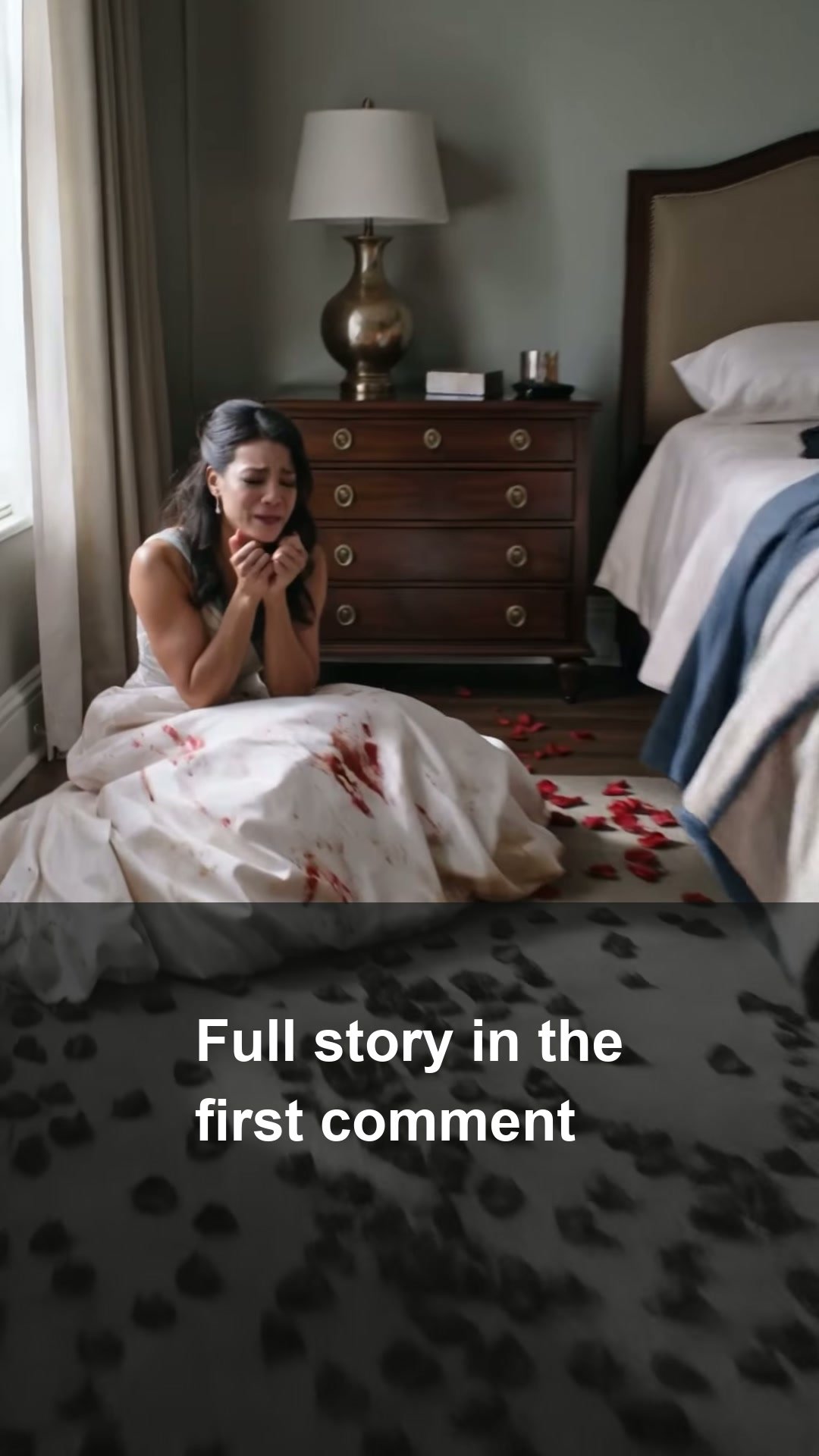
I retreated to the bridal suite, the air thick with the cloying scent of lilies and the metallic tang of bleach. My boots crunched over shattered champagne flutes, the glass shards glimmering like diamonds against the white marble. Elara sat on the edge of the velvet ottoman, her silk gown ruined, a dark, star-shaped stain blossoming across her bodice. She didn’t look up when I entered. She was meticulously cleaning a single earring with a lace handkerchief, her fingers steady despite the tremor in her jaw.
I set the camera bag down. The leather groaned, a sound that seemed too loud in the suffocating quiet. I thought of the footage I hadn’t yet offloaded, the way Julian’s eyes had flickered with cold, predatory delight during the first dance. I decided then that the truth was not a service I owed the public, but a weapon I might need to survive.
Arthur stepped from the shadows of the dressing room, his dinner jacket discarded. He looked older than the portraits in the foyer, his skin paper-thin and grey, his knuckles raw and scraped. He didn’t look at his daughter. He stared at the spot on the rug where the bat had rested minutes before, his gaze vacant, hollowed out by the permanence of his choice. The weight of his silence pressed against my ribs, a physical pressure that made it difficult to draw breath. He wiped his hands on a clean towel, a rhythmic, frantic motion, as if he could scrub away the memory of the impact. He stopped, finally glancing at Elara. She held the earring up to the light, inspecting it for imperfections, her face a mask of porcelain indifference.
Arthur cleared his throat, the sound dry as dead leaves. He looked at me, then back at her, his voice barely a rasp.
I’m the one who should have died tonight, not him.
The study smelled of cedar and the faint, acidic tang of spilled scotch, a scent that always preceded the sound of Arthur’s heavy footsteps in the hallway. I was ten, sitting on the mahogany floorboards, tracing the grain with a fingernail until it caught on a splinter. My brother, Leo, was across from me, his small hands busy dismantling a clock he had stolen from the mantle. He didn’t look up when the door creaked open, his focus absolute and terrifyingly calm. I looked up. Arthur stood in the frame, his shadow stretching long and jagged over the rug. He wasn’t looking at us. He was looking at the ledger on his desk, his jaw set in a line so hard it looked like bone pressed against skin. He tapped his signet ring against the wood, a rhythmic, metallic clicking that signaled the beginning of the quiet. I knew that sound better than I knew the sound of my own heartbeat. It meant the world was about to tilt. I held my breath, waiting for the inevitable shift in gravity. When he finally spoke, his voice was a flat, dead thing, devoid of the warmth he reserved for the dinner guests. He told us that legacy was not a gift, but a debt. He didn’t explain what we owed, or to whom, only that we were already overdrawn. I felt a cold prickle of sweat at the nape of my neck. I looked at Leo, whose eyes remained fixed on the gears of the clock. Leo had learned early that if you made yourself small enough, the house would eventually stop trying to crush you. I realized then that my father’s love was a currency that could only be spent, never kept. I stood up, smoothing my skirt, and walked out of the room without a word. That was my first lesson in survival: silence is a shield, but it is also a grave.
School felt like a gilded cage where the birds were taught to sing for their supper. I remember the smell of floor wax and the way the girls in my class would preen when their fathers pulled up in black sedans. They thought the money made them untouchable. I knew better. I watched Eleanor at the parent-teacher mixers, her smile a masterclass in static geometry. She would tilt her head, touch the pearls at her throat, and pivot away from anyone whose net worth didn’t match our own. She once caught me staring at a girl who had been crying in the bathroom. She didn’t ask what was wrong. She pulled me into the backseat of the car, the leather cool against my thighs, and told me that tears were a symptom of poor management. If I was crying, it meant I had lost control of my circumstances. She reached over, adjusted my collar, and smoothed my hair with a hand that felt like polished marble. She didn’t look at me. She looked at the traffic, her eyes tracking the movement of other cars with a predatory focus. I realized then that she was not my mother; she was a curator of my existence. I decided right there, at twelve years old, that I would never give her the satisfaction of seeing me cry again. I stared out the window, counting the streetlamps as they flickered by, a steady, rhythmic pulse. The next day, I didn’t say a word when I saw the girl from the bathroom. I walked past her, head held high, my face a mirror of my mother’s own ice.
The house grew quiet as the years passed, the silence punctuated only by the sound of Arthur’s business dealings echoing through the vents. Leo changed. He stopped taking apart clocks and started taking apart himself, hiding his failures in the dark corners of the basement. I watched him shrink. He would walk through the kitchen, his shoulders hunched, his eyes darting toward the study door whenever Arthur’s voice boomed. We were a family held together by the glue of shared secrets. I remember a dinner where the air felt thick enough to swallow. Julian was there, a guest of Arthur’s, his eyes lingering on Elara, who sat across from me. Julian had a way of looking at people that made you feel like you were under a microscope. He didn’t speak much, but when he did, the room went still. He leaned forward, the candlelight catching the sharp angles of his face, and asked a question about our family’s early expansion. Arthur laughed, but it didn’t reach his eyes. It was a jagged, brittle sound. I watched Elara’s hand tremble beneath the table. She dropped her fork, the clatter loud as a gunshot. Julian didn’t look at her. He just smiled, a thin, stretching line that lacked any humor. I felt a sudden, visceral urge to scream, to shatter the crystal glasses and burn the tablecloth, to break the perfection that was slowly suffocating us all. I kept my hands folded in my lap, gripping my own skin until it turned white. I thought of the way Leo had locked himself in the bathroom for hours after Julian left that night. I decided to start keeping a log. Not of what was said, but of what was avoided.
The marriage was supposed to be the anchor that held the Sterling name in place. I watched Elara pack her bags, the movements deliberate and slow. She didn’t look excited. She looked like someone preparing for an autopsy. I went to her room, the door ajar, and found her standing in front of the vanity. She was brushing her hair, the strokes rhythmic, hypnotic. She looked at me in the mirror, her eyes flat, the color of a winter sky. She told me that Julian knew everything. Not just the business, but the gaps in our foundation. He had been digging for years, she said, collecting the debris of our past to build a structure of his own. I felt a chill bloom in my chest. She reached into a hidden velvet pouch and pulled out a key. She pressed it into my palm, her skin cold, her grip surprisingly firm. Don’t let them rewrite this, she whispered. The irony was a jagged blade; we were the ones who had been rewriting the truth for decades. I looked at the key, then at her reflection. She wasn’t asking for help; she was asking for a witness. I closed my hand over the metal, the ridges biting into my skin. I remembered the way Arthur had looked at the ledger, the way Eleanor looked at the traffic, the way Julian looked at his prey. It was all the same pattern, a loop of power and submission that had no end. I thought of my own life, the way I had spent years observing, recording, staying silent. I decided that I would no longer be a camera. I would be a part of the frame. I turned and walked out of her room, the weight of the key pulling at my pocket. The hallway felt infinite, a long, dark tunnel that led to a place I wasn’t sure I could survive. I knew, with a certainty that burned, that the end was already written. We were just waiting for the ink to dry.
I stepped into the library, the air thick with the smell of floor wax and old leather. Arthur stood by the fireplace, his fingers tracing the grain of a heavy mahogany desk. He wasn’t looking at the papers; he was watching his own reflection in the darkened glass of the cabinet, his hands steady, though his pulse throbbed visibly at his temple. He had spent a lifetime building an empire on the ruins of men like Julian’s father, convinced that morality was a luxury for the impoverished. He looked at me, his eyes devoid of the warmth he projected at galas. You shouldn’t have seen what was in that room, he said, his voice a dry rasp that sounded like gravel grinding. I didn’t answer. I thought of the ledger, the columns of debts that looked like headstones, and realized Arthur didn’t want to protect Elara; he wanted to protect the ledger. I decided then to play the fool. I nodded slowly, turning toward the stairs.
Eleanor was waiting in the transition between the library and the grand hall, her silhouette sharp against the moonlight. She was adjusting a silver brooch, her movements precise, almost surgical. She had known about Julian’s predilections for months, perhaps years, treating them as necessary expenses in the marriage of her daughter. She looked at me, not with suspicion, but with a terrifying, hollow sympathy. We are all pieces on a board, Clara, she whispered, her eyes tracking the movement of a security guard outside. She loved Elara, but she loved the Sterling name more, viewing her child’s suffering as a regrettable but unavoidable tax on their legacy. I felt the key in my pocket, a cold, jagged weight against my thigh. I chose to smile, a flat, practiced expression that mirrored her own. She turned away, satisfied that I was just another staff member she could buy or silence.
I slipped into the kitchen where Detective Miller stood by the service door, his badge tucked partially out of sight. He was drinking lukewarm coffee from a Styrofoam cup, his gaze fixed on the security monitors. He was a man who prided himself on his integrity, yet he had spent his career looking the other way whenever the Sterlings surfaced in his files. He knew the truth about the missing friend, the one who had vanished before the vows were exchanged, but the weight of his own mortgage and the proximity of his retirement kept him tethered to his chair. He glanced at me, his eyes tired, searching for a sign that I might be the one to break the silence. I stared back, deciding that he was just another ghost in this house, someone who would write a report that blamed a burglar, an intruder, anyone but the man in the master suite.
I reached the hallway and saw Elara standing by the window, her back turned. She was clutching a piece of jagged glass, her knuckles white. She had been the perfect socialite, the daughter who never misstepped, but in the silence of the aftermath, she had shed the skin of the victim to reveal something harder, more crystalline. She heard my footsteps and didn’t flinch. She was waiting for the exit, not for the justice Miller couldn’t provide. I knew then that she wouldn’t leave empty-handed. I watched her, wondering if I was the only one who realized the transformation was already complete. I walked past her, my decision hardened by the collective apathy of the room. I wouldn’t be the witness who testified; I would be the witness who deleted the footage. The ink was dry, and the frame was closing.
The fluorescent hum of the precinct lobby felt like a physical weight against my temples. I sat on a bench of cold, industrial steel, clutching a manila envelope that contained the unedited raw files from the Sterling wedding—the ones Julian didn’t know existed. I pulled my phone from my pocket and navigated to the banking app. With a thumb that felt disconnected from the rest of my body, I hit the button to cancel the recurring transfer to the Sterling foundation. The screen blinked: Transaction Canceled. It was a digital severance, a small, invisible line drawn in the sand, but it felt like cutting a carotid artery.
Detective Miller emerged from the back office, his shirt wrinkled, smelling of burnt coffee. He looked at me, his eyes tracking the envelope. You shouldn’t be here, Clara, he said, his voice dropping into that low, gravelly register he used when he was trying to sound like an ally. I stood up, the chair scraping against the linoleum with a sound like a shriek. I didn’t answer. I slid the envelope across the laminate counter, feeling the grit of the table beneath my fingertips. This is what you asked for, I said, my voice unnervingly steady. The footage of the library, the audio of the argument, the timestamp of the break-in.
Miller reached for it, but his hand hovered. If you hand this over, the Sterling legal machine will tear you apart before you reach the parking lot, he warned. I thought about the way Julian had looked at me during the reception—not as a person, but as a liability to be managed. I looked at the security camera mounted in the corner of the ceiling, its red eye blinking. I’ve already contacted a lawyer, I told him. A firm that doesn’t share their social circle. The decision had been made three hours ago, sitting in my car with the engine running, watching Arthur Sterling walk into the house with that heavy, purposeful stride. Miller finally took the envelope. I walked out of the precinct, the night air biting at my skin, feeling the first true breath of oxygen I’d had in weeks.
By noon the next day, the fallout began to vibrate through the city’s veins. I sat in a high-rise office downtown, the smell of mahogany and ozone filling the room. My lawyer, a woman named Sarah with razor-sharp bangs and eyes that missed nothing, listened as I detailed the surveillance devices I had found in the suite. I watched her tap a fountain pen against her teeth. You understand the implications, Clara? You are essentially burning your career to the ground, she said. I watched a pigeon land on the ledge outside the window, tilting its head. I don’t want a career, I told her. I want the injunction. I want the paperwork filed to block their access to the offshore accounts Elara is trying to drain.
The counter-action was instantaneous. My phone buzzed on the desk, vibrating with a force that threatened to slide it off the edge. It was an email from the Sterling corporate office, marked URGENT. I opened it. It was a cease-and-desist, threatening a breach-of-contract lawsuit for the metadata I’d allegedly stolen. Attached was a formal HR complaint filed against me by a shell company Julian owned, alleging I had committed industrial espionage. They weren’t just hitting back; they were trying to erase me. I looked at Sarah. File the motion, I said. I want them served before the stock market closes.
I went to the clinic that evening, the air thick with the antiseptic sting of a place where bodies were processed like inventory. I had the DNA kit in my bag—not for me, but for the question that had been eating at the family’s foundation since the engagement. I found the contact I needed in the back of a medical file stolen from Arthur’s desk. When I handed the sample to the technician, she didn’t look up. Name? she asked. I gave her a pseudonym. I thought about the blood on the wedding dress, the way the silk had puckered. If the lineage was compromised, the inheritance was void. That was the leverage that would shatter the facade.
As I left, I saw a black sedan idling at the curb. The tinted window rolled down an inch, revealing nothing but the darkness within. It was a warning, a physical manifestation of their reach. I didn’t flinch. I climbed into my own car and drove in the opposite direction, toward the courthouse. I had the petition to contest the will in my passenger seat. It was a document that would strip Arthur of his control over the estate, turning his own weapon—the law—against him. Every step I took was a domino falling. I knew that by dawn, the Sterling empire would be hemorrhaging cash, and the police would be knocking on the front door of the mansion.
I pulled into the courthouse garage, the concrete ceiling low and oppressive. I stepped out, my legs heavy, my mind a clinical machine. I didn’t feel fear. I felt the sharp, intoxicating clarity of a final act. I walked toward the clerk’s office, the heavy doors looming ahead. Behind me, I heard the screech of tires, a car pulling in fast, cutting off the exit. The game had moved from the drawing room to the battlefield, and for the first time, I wasn’t just observing. I was the one pulling the trigger. I pushed the door open, the sound of the metal hinge echoing in the quiet rotunda, and stepped into the light of the clerk’s desk, ready to file.
The fluorescent lights of the records room flickered, buzzing with a frequency that vibrated against my teeth. I placed the flash drive on the glass counter, a small, obsidian weight that held the footage Julian had tried so hard to erase. The clerk didn’t look up, his fingers dancing across a keyboard with rhythmic indifference, unaware that he was about to trigger the detonation of a dynasty. Outside, the Sterling family’s influence was already hemorrhaging; a notification buzzed in my pocket, a headline from the Financial Times declaring a massive, unexplained divestment from their primary holdings. The silence in the room felt heavy, pressurized, like the seconds before a lightning strike.
My phone screen illuminated again, showing a flurry of missed calls from numbers I didn’t recognize—reporters, likely, or perhaps legal vultures sensing blood in the water. I tucked the device away, turning my back on the clerk. The decision was made. There was no going back to being the girl behind the camera, the silent witness to the gilded cage. I walked toward the exit, my heels clicking sharply against the polished marble floor, each step a severance of ties. I thought of Elara, probably already miles away, her identity stripped back to the bone, while her father sat in that mansion, watching his life’s work disintegrate into ticker tape and public scorn.
In the parking garage, the air was stagnant, smelling of exhaust and damp concrete. A black sedan was idling near my car, its windows tinted to an opaque obsidian. A man stepped out—a lawyer, perhaps, or a fixer—his suit too expensive for the setting. He didn’t speak; he simply stood there, his presence a silent ultimatum. My breath hitched, a brief flare of the old, paralyzing instinct, but I pushed it down. I walked past him, my gaze fixed on the driver’s side door of my own vehicle. He didn’t move to stop me. That was the first shift in the tide: they were no longer the gods of the coastal cliffs; they were just people who had lost their grip on the narrative.
I unlocked my car, the sound of the mechanical chime echoing in the cavernous space. I sat in the driver’s seat for a long moment, gripping the steering wheel until my knuckles turned white. My social media feeds were already a toxic slurry of speculation; friends I hadn’t spoken to in years were messaging me, fishing for scraps of gossip, their curiosity thinly veiled as concern. The school, the neighborhood, the entire ecosystem of our social world was fracturing along the fault lines of this single night. I deleted the apps, one by one. The digital noise vanished, replaced by the low, rhythmic thrum of the engine coming to life.
I pulled out of the garage, the ramp spiraling upward toward the daylight. I saw a news van idling at the street level, cameras perched like vultures on the roof. They were looking for the Sterlings, for the daughter, for the face of the scandal. I kept my head down, driving straight past the blockade, blending into the flow of anonymous traffic. I wasn’t the storyteller anymore; I was a ghost in the machine. As I merged onto the highway, a strange, hollow peace settled over me. I looked at the rearview mirror and saw only the road behind me, empty and fading into the distance. The fallout was just beginning, but for the first time in my life, I was finally outside the blast zone.
The courtroom felt like a cathedral built of cold marble and indifference. I sat in the back row, my camera bag heavy against my knees, watching the judge sign the final decree of annulment. The ink bled into the paper, a permanent scar on a union that had never truly existed. Elara did not look back at the gallery. She signed her portion with a single, sharp motion, her posture rigid, her eyes fixed on the exit signs. When the gavel fell, the silence that followed was not the quiet of relief, but the weight of a secret being buried in the concrete floor.
Arthur stood near the mahogany double doors, his suit hanging loose on his frame as if his very bones had started to shrink. He reached out to touch Elara’s shoulder, a reflexive gesture of paternal authority, but she flinched, stepping out of his reach before he could make contact. I saw his hand hover in the air, trembling slightly, before he retreated into the shadow of his coat. He was a man holding onto the wreckage of his own design, realizing too late that the walls he built to protect the family had become the walls that locked them in.
In the private wing of the state hospital, Julian lay in a bed that seemed to swallow him whole. A nurse adjusted the IV drip, the rhythmic clicking of the machine marking the seconds of his new, stagnant life. He stared at the ceiling, his eyes vacant, trapped behind the curtain of a brain that could no longer signal the tongue or the limbs. He could hear, surely, but he could never speak the truth of what had transpired in the suite. He was the perfect witness, a living tombstone for the Sterlings.
Elara disappeared three days later. The airport bathroom was bathed in sterile, flickering fluorescent light. She stood before the mirror, a pair of rusted sewing scissors in her hand. With one decisive snip, her long, elegant hair fell to the tiled floor, leaving her profile jagged and unrecognizable. She didn’t look at the face in the glass; she looked at the passport on the vanity, a document with a name she had never owned. She turned the lock, the latch clicking with finality. The gate to her old life was bolted. She walked out of the terminal, leaving the shadow of the estate behind, heading toward a horizon that didn’t demand a price for her survival. The silence she left in her wake was total.
The rental cottage smelled of salt spray and cedar. It was small, a single room perched on the edge of a cliff in Maine, where the Atlantic threw itself against the rocks with a rhythmic, indifferent thud. I sat on the porch, my fingers tracing the grain of a weathered wooden bowl. I had spent three hours sanding it. The wood was smooth now, stripped of the splinters that had snagged my skin when I first found it in the shed.
My phone sat on the table, face down. I hadn’t touched the screen in weeks.
“Tea is ready,” a voice called from the kitchen. It was Sarah, the woman who owned the property. She didn’t ask questions; she only asked if I wanted honey or lemon.
I stood, my legs feeling steadier than they had in months. “Honey, please.”
She handed me the mug, her knuckles brushing mine. The warmth of the ceramic seeped into my palm, grounding me. “You didn’t sleep well again, did you?” she asked, her tone flat, lacking the pity I had grown to loathe.
“The wind,” I lied. The truth was the ghosts, the way Julian’s face kept surfacing in the dark whenever I closed my eyes.
“The wind is loud here,” she agreed, moving to the garden. She began pulling weeds with a methodical, brutal efficiency.
I watched her, feeling the tightness in my chest loosen just a fraction. I thought about the wedding dress, the white silk, the way it had burned in the incinerator. That girl was ash. I was here, breathing air that didn’t taste like fear. I walked to the garden bed, knelt in the damp soil, and began to dig. My hands were dirty, my fingernails caked with dark, honest earth. I decided then that I would plant lavender. It would take time, but the scent would eventually drown out the smell of the sea. I reached for the trowel, ready to bury the next seed.
I pulled the final weed from the patch, the roots snapping with a sharp, clean sound. Arthur stood on the terrace, his shadow stretching long and thin across the manicured lawn. He didn’t look at me; he stared fixedly at the edge of the cliff where the tide chewed at the rocks. His hands were stuffed deep into his pockets, fingers curled into fists as if still gripping the handle of the bat. My mother moved behind him, her movements stiff, arranging a bowl of fruit on the outdoor table with a precision that bordered on the frantic. Neither of them spoke. I pushed the trowel into the dirt, burying the last of the lavender seeds. On the mantle inside, through the glass doors, the heavy cream-colored wedding invitation lay face down in the dust.
Leave a Reply